WASHINGTON — As he crisscrosses the country in the closing stretch of the midterm elections, President Donald Trump has portrayed himself as the GOP savior who is boosting Republican candidates everywhere he goes.
"Every single place I go, people that are down are now winning," Trump told reporters Oct. 23, as he left the White House to hold a rally in Fort Myers, Florida, his latest destination in his midterm blitz.

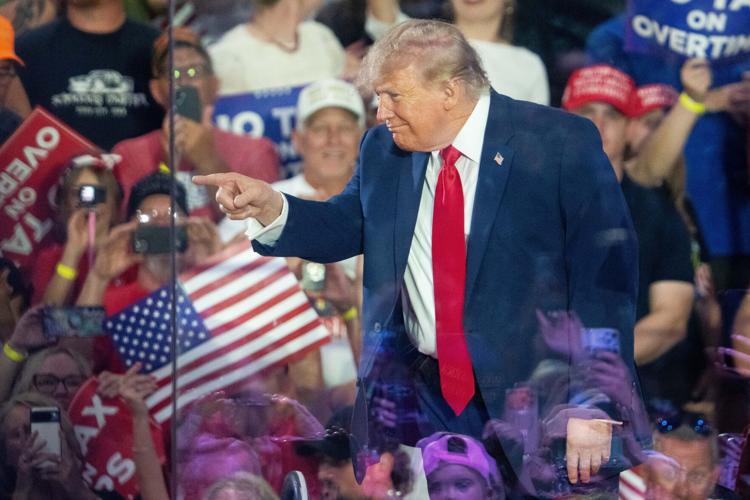
President Donald Trump takes the stage for a rally on Oct. 22, at Sioux Gateway Airport in Sioux City.
Yet even as the president works to rally his MAGA base in the closing stretch, polling indicates the political landscape continues to worsen for the GOP, setting off a scramble by the party to stave off a blue wave that is poised to wipe away Republicans' congressional majorities.
Trump’s approval rating continues to plummet, threatening to drag down Republican candidates. It hit a record low in three new surveys released last week, and is the lowest for any president heading into midterm elections in 80 years.
People are also reading…
As backlash to the unpopular president continues to build ahead of the Nov. 3 elections, Republicans are making a desperate late push, leveraging a massive financial advantage — boosted by outside super PACs ‒ in an attempt to hold onto seats in red states and districts that once seemed like unlikely battlegrounds, but are now fiercely competitive.
Meanwhile, the president keeps veering off script, delivering what some Republicans view as a muddled closing message that is distracting from the issues voters care most about – the economy and high prices.
“The number one issue is affordability and I think the sense I continue to see from a lot of polling data is voters feel like that’s not where he’s focused,” said Marc Short, who served as Trump’s liaison to Congress in his first term.
Trump in recent days has touted his plans to overhaul a Washington, DC, golf course and mused about the beauty of men’s bodies during multiple rallies. His administration, meanwhile, has been consumed by a series of controversies – with the president firing his press secretary and ambassador to Greece, walking back plans to livestream a federal execution and lashing out at a political opponent after her home was searched by federal authorities.
Republican strategist Charlie Black said voters “expect all this stuff to swirl around Trump and a lot of them were willing to put up with it when they thought he would make the economy good." He suspects it is now wearing thin, though.
Trump's approval rating craters
Despite his unpopularity in polls, Trump has played a starring role in the GOP’s midterm strategy, going back to the party’s first ever midterm convention in Texas last month.
The president spoke both nights at the event dubbed “Trumpapalooza” by the Republican National Committee chair, and subsequently launched a barnstorming tour of the country that has taken him from Alaska to Florida. The only top-tier battleground state he has no current plans to visit is Maine, where Republican Sen. Susan Collins, a political moderate, is in a close race against Democrat Troy Jackson.
Historically, presidents with Trump's unpopularity stay far from the campaign trail in the midterms given the headwinds the party in power faces. President Joe Biden rarely appeared with Democratic candidates in the weeks before the 2022 midterm election, allowing them to distance themselves from the president. The strategy helped Democrats exceed expectations.
Trump, however, has gone all in, turning the race into a referendum of his presidency — a dynamic most Republicans are trying to avoid.
An analysis by ad-tracking firm AdImpact found that just 1% of GOP ads aired in October mention Trump, compared with 47% in May. Meanwhile, Democrats are mentioning Trump in 21% of ads.
Trump has fretted that his voters don’t turn out in large enough numbers when he’s not running, and urged Republicans to “pretend” he’s on the ballot. The strategy — aimed at turning out low-propensity MAGA voters — is a recognition that the GOP has an enthusiasm gap with Democrats.
"President Trump is a voter turnout machine, and he's barnstorming the country to highlight his administration's achievements, expose Democrats' extreme agenda, and boost turnout in strategic areas for our candidates," said Republican National Committee National Press Secretary Natalie Baldassarre. "The president has cut taxes, put workers first, and created thousands of American jobs, and anyone who thinks those policies are not popular is deeply confused and more interested in ginning up fake news than winning elections."
Putting Trump front and center on the campaign trail risks tying battleground candidates more closely to the unpopular president, though, and recent polling shows the potential perils.

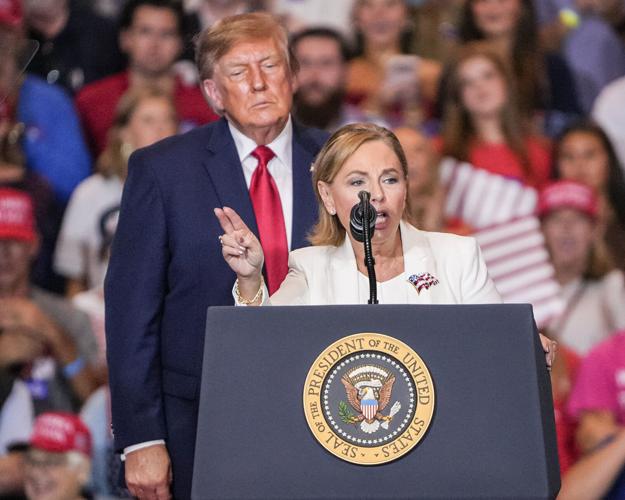
U.S. Sen. Darline Graham speaks near U.S. President Donald J. Trump at the rally at the Clemson University T. Ed Garrison Livestock Arena in Pendleton, S.C. Oct. 21.
A New York Times/Siena poll released Oct. 21 found that just 36% of voters approve of Trump’s job performance, the lowest approval rating in the survey over his two terms. CNN and Reuters/Ipsos polls released last week also found Trump at record low approval ratings. Trump has the lowest approval rating of any president heading into midterm elections since 1946, according to a New York Times analysis of polling data.
Trump is unpopular even in deeply red districts.
USA TODAY obtained an internal poll conducted by a Republican candidate in a House district Trump carried by more than 20 percentage points. The president is underwater in the district, with 47% of voters approving of his performance and 50% disapproving.
As Trump’s approval craters, Republican candidates have sought to distance themselves from the president.
In New Hampshire, GOP Senate candidate John Sununu put out an ad saying his opponent is trying to portray him as the president’s “long lost son.”
“I’ve never even met the man,” Sununu said of Trump. “When the president’s policies are bad for New Hampshire, I’ll oppose them, just like I opposed the war in Iran and the trade war with Canada. That’s New Hampshire independent.”
Sununu’s comments echo Republican Senate candidates in Iowa and Michigan, who also have called for an end to the Iran war.
GOP pollster Patrick Ruffini said the war and gas prices are key factors contributing to what he called a “horrendous environment for Republicans” this cycle.
“There’s been a pretty direct relationship between gas prices and presidential approval,” he said, adding that the war has “exacerbated” cost-of-living concerns that remain the top issue for voters.
Trump has tried to ease those concerns by saying the war will end soon and fuel prices will drop. Yet even as voters focus on high prices and the economy, the president has struggled to sell his economic agenda and often has been consumed with other issues.
'World class' golf course
With Election Day just two weeks away and GOP candidates fighting to stay competitive in battleground races, Trump took to social media Oct. 18 with a big announcement: plans for a "World Class Championship Golf Course” in Washington, DC.
The president’s push to transform the East Potomac Golf Links, a public golf course, into a championship-level club is the latest in a series of D.C. renovation efforts – including a triumphal arch and a White House ballroom – that Democrats have seized on to argue the president is more focused on vanity projects than Americans’ pocketbooks.
"The White House is so beautiful now, so beautiful,” Trump said during an Oct. 23 rally in Florida, where he spent as much time discussing his White House renovations as the economy.
A CNN survey from July found voters believe Trump has the wrong priorities, with 73% saying he hasn’t focused on the country’s most important problems. Yet the president has continued to highlight his D.C. construction projects as the election approaches, while often veering onto other topics that have raised eyebrows.
Producing an array of headlines, Trump has praised male bodies with regularity at his campaign rallies, continuing his long ‒ and at times, perplexing ‒ history of remarking publicly on the looks of men he finds strong, masculine or "straight out of central casting." He has fixated especially on the physique of Sen. Jon Husted, with the president in three separate speeches discussing the Ohio senator's backside.
Rather than focus his message on the Americans' economic anxieties, Trump has leaned hard into a familiar mix of hot-button, culturally divisive issues ‒ from fears about migrants and Islamophobia to "transgender insanity" ‒ in a push to rev up the MAGA base.
Trump and Republicans have zeroed in especially on the transgender community, with Republican candidates or pro-Republican groups spending more than $100 million on anti-trans ads since Aug. 1, according to AdImpact. Trump used a deluge of anti-trans ads in his 2024 election victory, but it's unclear whether the commercials will pack the same punch with high prices on the minds of voters.
“There’s no question there could be more of a focus on cost of living,” Ruffini said. “Because that is the number one, two and three voter concern.”
Yet Ruffini also noted that Trump has long gone off script at his rallies.
“That’s been a concern before in terms of the rally speech content and I don’t think that’s been a game changer in the past,” he said.
Short believes Trump’s economic message has been overshadowed by other issues as his administration faces a series of controversies.
The president recently fired his new press secretary, Katie Zacharia, just five days into her tenure after she struggled in her first press briefing and was criticized for representing herself as a lawyer despite not having a law license. A few days earlier, he fired his ambassador to Greece, Kimberly Guilfoyle, after Trump campaign donor Eric Deters alleged she asked him to pay off her $100,000 American Express bill.
The president also faced backlash in the closing weeks of the election over plans to livestream the execution of Fort Hood mass shooter Nidal Hasan, prompting him to call off the livestream, and over a Justice Department raid on the home of Rep. Ilhan Omar, D-Minnesota.
Short, who also served as Vice President Mike Pence's chief of staff, said Trump should focus on promoting the big tax cut package he passed through Congress in 2025, “but in reality that’s not what he’s usually talking about.”
Battleground map keeps growing
The deteriorating political environment for the GOP has expanded the battleground map, leaving Republicans fighting to hold their ground in states and districts that Trump carried by double digits in 2024.
Democrats are now strongly favored to win control of the House, and increasingly are on offense in Senate races that once seemed like safe GOP seats.
The fight for the Senate is playing out in deep red states, including Iowa, Texas, Ohio and Alaska. More recently, Senate races in Kansas, Nebraska, South Carolina and Mississippi have looked increasingly competitive.
The growing Democratic momentum has set off a red state scramble by Republicans, who are leveraging a big cash advantage. Aided by massive contributions from trillionaire Tesla and SpaceX CEO Elon Musk and the big war chest in Trump’s own super PAC, Maga, Inc., Republicans are heavily outspending Democrats.
An analysis by AdImpact found the GOP had a $322 million advantage in advertising spending in seven key Senate races. Musk has contributed $369 million to GOP campaign efforts , while Trump said he plans to exceed $400 million in campaign spending by Election Day.
The latest state to see a burst of spending is Mississippi, where the PAC controlled by Senate Democratic leadership recently announced $1.2 million in ads to help Democrat Scott Colom in his bid to unseat GOP Sen. Cindy Hyde-Smith. Axios reported the main super PAC supporting Senate Republicans is considering a late round of spending in the Mississippi race to defend Hyde-Smith, after recently pumping funds into the South Carolina and Kansas races.
Trump was set to visit Mississippi for a campaign rally Oct. 26. He was in South Carolina Oct. 21 and Kansas on Oct. 19.
Trump’s travel schedule highlights the defensive crouch Republicans find themselves in as they try to hold onto Senate seats that typically aren’t competitive. Kansas hasn’t elected a Democrat to the Senate in nearly 100 years.
Some Republicans are wary of Trump taking such a prominent role in the midterm campaign, but Ruffini and others believe the president could make a difference in GOP turnout.
Despite signs of a potential blue wave, Ruffini said he's skeptical Democrats can overcome the heavy GOP voter advantage in some traditionally Republican states where polling shows them ahead or competitive. He pointed to Alaska and Texas as more likely to flip, but said states in the Midwest “have been historically very tough to poll.”
If Republicans can simply turn out their voters, the raw numerical advantage they have in many Senate battlegrounds could be enough to put them over the top, Ruffini said. That’s where Trump comes in.
Ruffini doesn't see much downside in Trump's rallies for Republicans, noting the president's critics already are highly motivated to vote. A visit from Trump isn’t likely to amplify that further, Ruffini said, adding the president can help “remind Republicans there’s an election to get out and try to match Democratic enthusiasm as much as possible.”
“That’s really what they’re trying to do, is hold the wave at bay,” Ruffini said.