

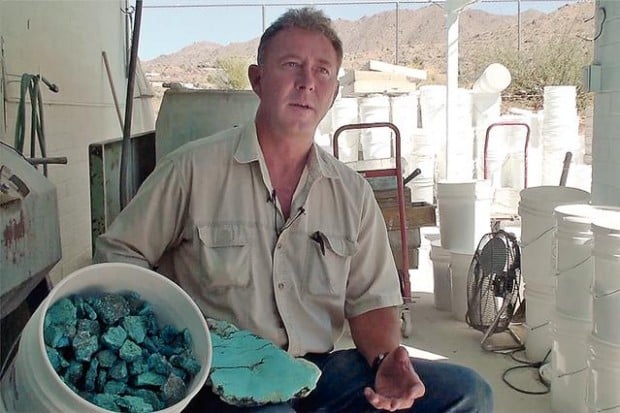
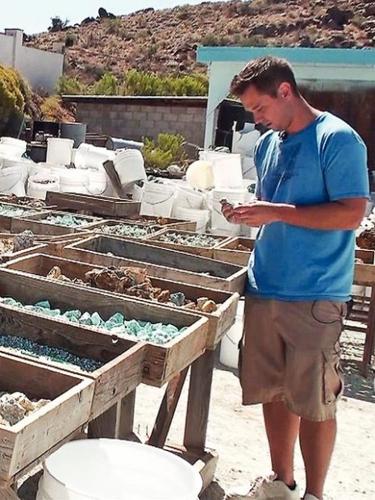
KINGMAN — Since 1962, members of Marty Colbaugh's family and their employees have been digging turquoise from a copper mine northwest of town, hauling it around in 5-gallon buckets, sorting through the rubble by hand and processing it into sky-blue and green gems.
Most of it becomes centerpieces in jewelry. Some goes into tile that a side business sells for $500 a square foot.
His business dates to a time when Kingman adopted the nickname "Turquoise Capital of the World." And even though many of the shops that sold "sky stone" to travelers are now gone, the mining operation Colbaugh's grandfather started in Mineral Park continues producing turquoise for a global market.
"It's in our blood," Colbaugh said.
Arizona is the nation's third-largest producer of gemstones thanks to turquoise, according to the U.S. Geological Survey. Yet there are only two commercial operations that mine the stone year-round: Colbaugh Processing Inc. in Kingman and Sleeping Beauty Turquoise in Globe.
People are also reading…
"We're keeping an entire industry alive that is pretty widespread," Colbaugh said.
Turquoise mining in the Southwest started with Indians who prized the gem for decoration and for religious ceremonies.
Because turquoise is part copper, Bisbee and Morenci once had operations. Each fall in Bisbee, hobbyists are allowed into a rock dump for a chance at recovering a chunk of prized Bisbee Blue.
Arizona's soil has a higher silica content that makes the color and hardness of its turquoise sought after by collectors and jewelers, Colbaugh said.
Because the mineral composition of the soil varies by mine, stones from each are known for specific characteristics. Turquoise from Bisbee's Lavender Pit is renowned for its deep blue color and small black veins, while turquoise from Morenci is prized for including iron pyrite, also known as "fool's gold."
Sleeping Beauty turquoise from Globe is known for its uniform blue, while the turquoise Colbaugh produces has a spectrum ranging from blue to green.
The value of turquoise depends on its density, color and rarity and the veins running through the stone. Lower– grade stones are common and porous, absorbing creams and body oils that may alter their color over time.
"You could have two pieces of turquoise, one could be worth $5 and the other could be worth $5,000," Colbaugh said.
Most turquoise is fairly soft and must be stabilized, usually with a clear epoxy resin that also darkens the color. Stabilized turquoise is still considered a gem.
Only 3 percent of turquoise from Colbaugh's mine is hard enough that it doesn't require processing. With a deeper and more consistent color, these are the most valuable stones.
China is the world's largest turquoise producer, and its turquoise is more affordable because of abundant supply, lower labor costs and fewer environmental restrictions. But Indian jewelry is much more valuable when made with turquoise from the Southwest because it's considered more authentic.
Colbaugh Processing, which also has a manufacturing facility in Hong Kong, distributes its turquoise to customers in Africa, Asia and South America as well as through the Home Shopping Network and QVC.
Joe P. Lowry, who runs a turquoise museum in Albuquerque and co-authored "Turquoise Unearthed," a book about the gem, said the labor required to produce turquoise and a low number of operating copper mines limit the number of commercial operations.
On average, a miner has to move a ton and a half of dirt to find a usable amount of turquoise, Lowry said. Some turquoise miners invest $500,000 to $1 million and never recover costs, he said.
"You just never know. It's a gamble and it's a romance," Lowry said.
On the Web
• Colbaugh Processing: www.colbaugh.net
• Sleeping Beauty Turquoise: www.sbturquoise.com