

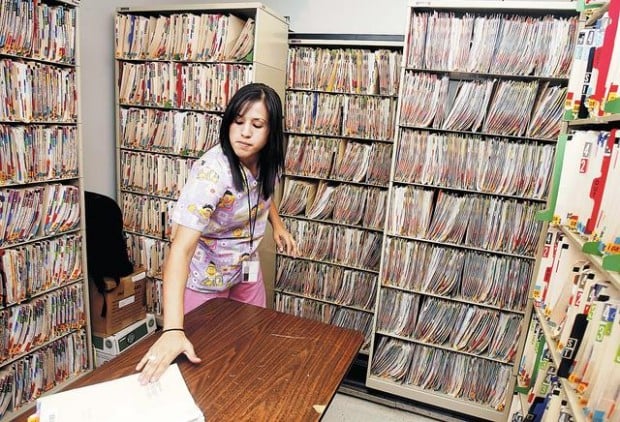
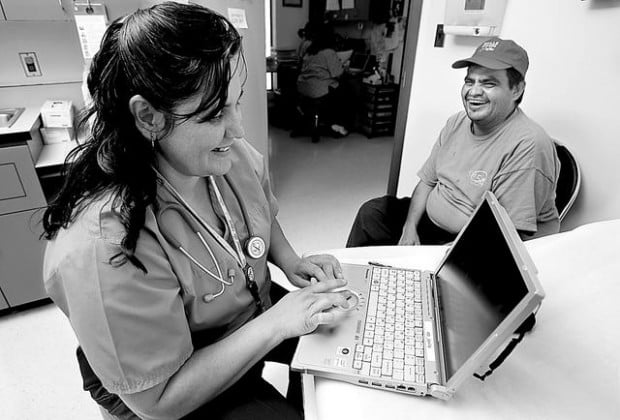
More than 70,000 additional patients in Tucson will have their medical records electronically connected to a regional network this year.
UnitedHealthcare of Arizona announced a $200,000 grant to El Rio Community Health Center to help pay for the cost of an electronic medical records system.
The grant will help El Rio make a leap into the future that few small medical practices can afford to take.
Using the donation and $460,000 of its own, El Rio will connect its system to the Southern Arizona Health Information Exchange, a record locator service for the region, said El Rio executive director Kathy Byrne.
The Exchange goal is to connect all medical records to the service, like a giant filing cabinet that medical professionals across the state could access to look at a patient's medical chart no matter what facility the patient chooses.
People are also reading…
The system will improve accuracy and safety and cut down on unneeded duplicate tests, Byrne said. It will save money over time, although she couldn't say how much.
Kalyanraman Bharathan, project director for the Southern Arizona Health Information Exchange, said electronic records are a good business solution to rising health-care costs, as opposed to a solution that relies on charity.
At least three large groups — Arizona Community Physicians, Carondelet Medical Group and University Physicians Healthcare — already have made the switch.
However, most small medical practices aren't seriously considering electronic records yet.
Electronic medical records are a mixed bag for medical practices, said Steve Nash, executive director of the Pima County Medical Society. He estimates that about 15 percent of Tucson-area doctors use electronic records.
The systems don't pay off in the short-term, the learning curve is steep and limited studies show electronic records are no more accurate than paper records, Nash said.
"If you see your doctor taking handwritten notes, it doesn't mean he's behind the times; it just means he's deciding how best to invest money in his practice," Nash said.
The upside is the records are easier to store and access from a variety of locations, he said. And, in the long run, electronic records will make the health-care system more efficient.
To be able to afford electronic records, El Rio joined with three other health centers in Nogales, Ajo and Yuma to share an information technology staff and key equipment, such as servers.
El Rio's 15 clinics will transition to electronic medical records this year, Byrne said. Its Northwest and El Pueblo sites already have implemented the internal system.
New Pueblo Medicine, a mid-size practice with seven physicians in Tucson, already has switched to electronic records.
CEO Mike Cracovaner said that the staffers still scan in a lot of paper, but the staffers save a lot of time when they don't have to look for or wait for paper charts, and that the system has improved accuracy in medical coding.
Cracovaner compares the convenience to systems used at car dealerships. The computer tells the mechanic when your car is due for an oil change or tire rotation.
Chronic diseases can be managed in much the same way, he said — "and our doctors went to college at least as long as Mr. Goodwrench."
The system will tell a doctor when a patient is due for a test or whether the test has been completed recently. The system won't allow a doctor to prescribe a medication that will have dangerous effects with existing prescriptions in the system.
"From a business point of view, every industry in the world is using computers to know their customers better, provide better customer service, and measure and monitor what's going on in their business," Cracovaner said. "I think there's a lot of resistance because physicians aren't directly paid to make that change."