

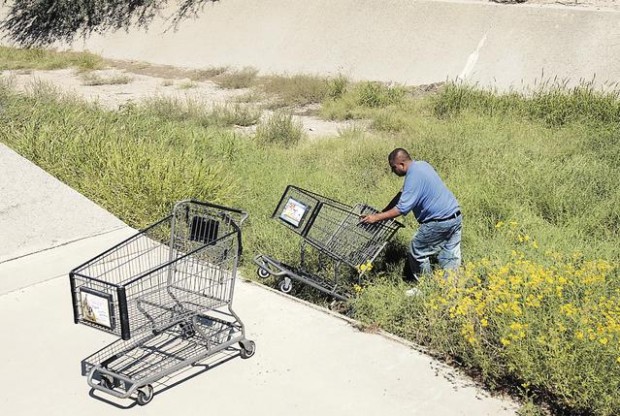
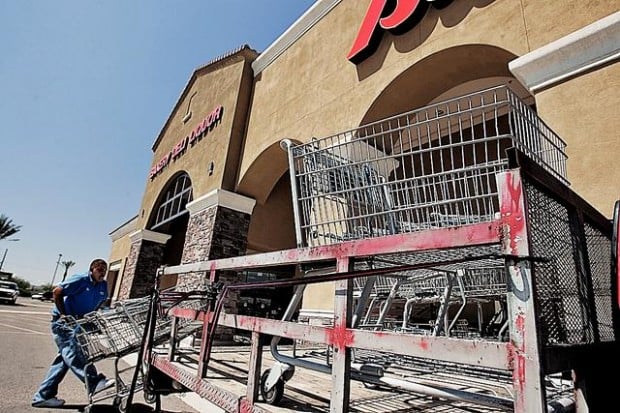
Think of it as the secret life of shopping carts.
You see them sometimes, abandoned in an apartment complex parking lot or in a wash, and you wonder how they got there. You might even wonder how long they'll be there or if anyone will come looking for them.
What you might not know is that you can hasten the removal process.
There's a state law governing how stores should handle their abandoned carts, and a whole industry revolves around the goal of returning carts to stores.
With new shopping carts costing retailers $100 to $150 apiece, it's important for stores to get their carts back when people are finished with them, said Telleann Dong, who arranges cart retrieval for the Bashas' group of grocery stores.
"Shopping carts are a necessity for our business," Dong said. "We spend lots of money for cart retrieval."
People are also reading…
She would not say how much but acknowledged that it's far less than the replacement cost.
"It is a very major expense, but we budget it as a cost of business," Dong said.
Phoenix-based Arizona Cart Retrieval Co. is one of the bigger cart-retrieval services in the state, running a hot line — 1-800-THE-CART — under the auspices of the Arizona Food Marketing Alliance.
General Manager Greg Colyar didn't have Tucson-specific numbers available, but he said the company's 15 drivers pick up about 7,500 carts a week in Phoenix and Tucson combined.
The drivers have routes they drive each day, but they also respond to reports that arrive on the hot line, which takes about 15 to 20 calls a day, Colyar said.
Arizona Cart Retrieval charges $23 per load, which holds 18 to 20 carts, he said.
For smaller outfits, the company charges $4 per cart.
The state law requiring stores to retrieve their carts — which may be deemed safety hazards — also makes it a crime to remove carts from store property. Stores can be fined for failing to pick up carts impounded by local authorities, and people taking carts without authorization can be hit with a Class 3 misdemeanor.
But local enforcement can be costly, said Lucy Valdez, inspection supervisor for the Tucson Department of Neighborhood Resources.
The city ran a pilot program for a few months in 2004 to test enforcement of rules concerning abandoned shopping carts but found it would be too costly for the city to continue if such rules were written into city code, Valdez said.
When Neighborhood Resources gets a call from a resident about abandoned shopping carts in an area, the department first checks whether that cart's store has a retrieval service, she said.
If it does, the city notifies the service to pick up the cart.
But sometimes the cart belongs to a store that doesn't use a service.
"We do make contact with the stores, and sometimes they will send someone out to remove them, and sometimes they just leave them there," Valdez said.
When that happens, the city will go ahead and remove the carts and send them to the landfill, she said.
While shopping-cart complaints do come in with some regularity, Valdez said, she wouldn't classify them as an "ongoing issue."
"It's not a situation where we get a call every single day or even once a week. It just depends," she said.
Glendale-based Triton Shopping Cart Retrieval Service handles retrieval for nine Bashas' and Food City stores in the Tucson area. Triton charges by the week instead of by the load or by the cart.
Sometimes it's frustrating when someone asks the company to pick up carts from other retailers, Triton co-owner Norma Gutierrez said.
By law, "every driver has to have a written consent from all the stores that we service," she said.
The two drivers who work the Tucson area make a sweep of their assigned areas in the morning, go to lunch, and then make another sweep in the afternoon, she said.
Last week they gathered about 280 carts a day, Gutierrez said.
"Our main concern is keeping the cart inventory so the customers can have carts," she said.
Sometimes it's interesting to see what the carts become after they leave the store premises.
Gutierrez said that one time her husband and the company co-owner, Raul Gutierrez, found a cart by the railroad tracks that had been converted to a barbecue grill by homeless people.
Raul Gutierrez has been in the cart-retrieval business for 16 years, originating in Los Angeles, his wife said.
The homeless population in Arizona is smaller and less aggressive, she said.
Her husband has been known to offer a homeless person a cart from a store he doesn't service in trade for a cart the homeless person has that belongs to the store he services, but that's rare, she said.
Colyar, at Arizona Cart Retrieval, said his drivers don't approach people for their carts, citing safety issues.
But the company takes its work seriously, he said.
"The loss to the retailer is huge right now. Mostly all the retailers are losing shopping carts," Colyar said.
Retrieval costs a pretty penny
FOR CART REMOVAL
• Call 1-800-THE-CART (1-800-843-2278), or call the store the cart belongs to.
Arizona Cart Retrieval Co., which runs the hot line, will let you know if the cart does not belong to a store the company services.
• For carts belonging to Bashas' or Food City, call Triton Shopping Cart Retrieval Service toll-free at 1-866-701-6060.