

Fannie Mae, the largest U.S. mortgage finance company, couldn't find a buyer who would pay $6,900 for the three-bedroom house at 1916 Prospect St. in Flint, Mich. So broker Raymond Megie, who is handling the foreclosure sale, advised cutting the price to $5,000, and he still couldn't sell the house, which sold in 2005 for $110,000.
"There's oversupply," Megie said.
As home prices decline, unsold properties are a problem for creditors like Fannie Mae because taxes, insurance and repairs drain their cash. Fannie Mae acquired twice as many homes through foreclosure as it sold in the first quarter, regulatory filings show, and late payments on its home loans — a harbinger of foreclosures — almost doubled in the past year.
"Progress on this is probably one of, if not the single most important economic process right now," said Moshe Orenbuch, managing director of equity research at Credit Suisse Group AG in New York. "With prices decreasing, it's better to get rid of houses quickly."
People are also reading…
Fannie Mae's stock lost half its value in seven weeks and the glut of unsold properties may weigh on it further, Orenbuch said. He predicts the Washington-based company will sink to $10 a share, about 13 percent lower than its $11.55 closing price Friday.
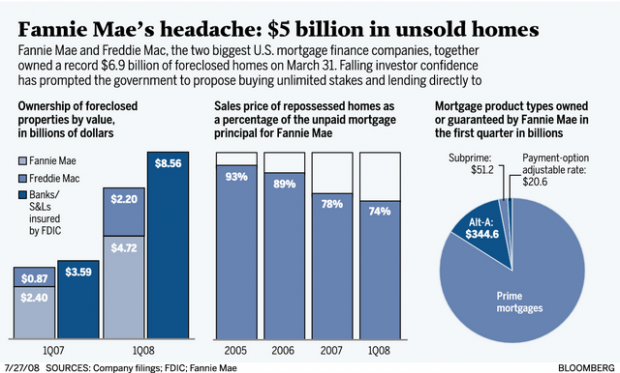
Fannie Mae and Freddie Mac, the country's second-biggest mortgage finance company, together owned a record $6.9 billion of foreclosed homes on March 31, compared with $8.56 billion held by all 8,500 U.S. commercial banks and savings and loans. Foreclosed houses sell at an average discount of about 20 percent, according to economists Ethan Harris and Michelle Meyer at New York-based Lehman Brothers Holdings Inc. At that rate, the two mortgage companies stand to lose $1.39 billion on the foreclosed houses they currently own.
"It's a no-win for the housing market," said Ron Peltier, chief executive officer of Berkshire Hathaway Inc.'s HomeServices of America Inc., the second-largest U.S. residential real estate brokerage. "Where there are pockets of distressed real estate, it does have an adverse effect on the surrounding properties."
Foreclosed homes losing value
Fannie Mae's goal in selling its properties is to get the highest possible price, even if it means hanging on to them longer, said Gabrielle Harrison, a vice president at the company.
"We want to treat that home as if it was your own, or as if you were living next door to it," Harrison said. "You wouldn't want that home to bring down your property value."
The typical price Fannie Mae received for foreclosed homes sold in the first quarter fell to 74 percent of the unpaid mortgage principal from 93 percent in 2005, according to Harrison. The number of borrowers whose payments were late by 90 days or more rose to 1.15 percent in the first quarter from 0.62 percent a year earlier, according to Fannie Mae regulatory filings.
Fannie Mae, led by CEO Daniel Mudd, contracts with up to 5,000 real estate agents to manage and sell the houses, Harrison said.
Shares of Fannie Mae and Freddie Mac plunged on July 7, pushing Fannie Mae to its lowest in 16 years, after Lehman Brothers analysts said an accounting change may force them to raise a combined $75 billion.
The companies fell another 35 percent during the next four trading days, prompting the Federal Reserve to authorize lending to them directly. On July 13, a Sunday, Treasury Secretary Henry Paulson said he would ask Congress for authority to buy unlimited stakes in the two mortgage companies.
Both companies were chartered by Congress and bundle home loans into securities to sell to investors and use cash from the sales to fund mortgage lenders. Together, they own or guarantee about half of the $12 trillion of mortgages in the U.S.
Many properties are in disrepair
The home on Prospect Street in Flint needs a new roof and carpeting, and the plumbing has been ripped out, said Megie, a broker with Realty Executive Main Street LLC in Lapeer, Mich., who sells Fannie Mae-owned homes. The house was originally listed for sale in April, he said.
"Two years ago I didn't have any Fannie Mae properties, and now it's probably pushing 50 percent of what I have listed," Megie said. Fannie Mae is fixing vandalized homes instead of "just dumping them to investors," he said.
Bruce Norris, a builder and real estate investor in Riverside, Calif., estimates about 15 percent of foreclosed houses have been intentionally damaged.
"Banks can't fix all the homes because they just have too many," said Norris, president of Norris Group, referring to all owners of repossessed homes and not specifically to the government-sponsored enterprises.
The longer it takes to sell a house, the lower the profit will be, said Dean C. Williams, chief executive officer of Williams & Williams Worldwide Real Estate Auction in Tulsa, Okla. It costs creditors such as Fannie Mae 2 percent of the value of the property every month in taxes, insurance, utilities, lost revenue, maintenance, management and cleanup after vandalism, Williams estimates.
"We use the word 'blight,' " Williams said. "It becomes a reinforcing vicious circle in terms of the value of ownership. Now the value of ownership is increasingly a negative return."
Local angle
The Tucson area had the 37th-highest foreclosure rate in the country during the second quarter of 2008, according to a report by RealtyTrac. During the April-June period, one out of 148 households in Tucson was in foreclosure. That was a 51 percent increase from first quarter and a 138 percent increase from the second quarter in 2007.