

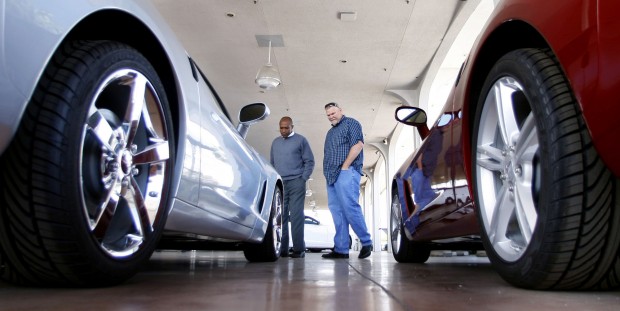
A potential sales-tax increase won't have a devastating effect on local businesses, but it's a tough time to be adding to consumers' costs. That's what Tucson business owners are saying in interviews about Proposition 100.
The measure, which goes before Arizona voters May 18, calls for a temporary 1-cent sales-tax increase to help offset the state's $3 billion budget deficit.
It's expected to raise about $950 million in the first year of its three-year life, with the money supposed to go to education, health and human services and public safety.
The Tucson Metropolitan Chamber of Commerce endorses the measure because education is integrally tied to the economy, said its president, Jack Camper.
Camper said the loss of jobs if the tax fails would have a greater impact on businesses than additional cost to consumers.
People are also reading…
"A higher unemployment rate is not going to help our businesses," Camper said.
But Farrell Quinlan, state director of the National Federation of Independent Businesses, is against the tax increase, citing surveys by his group that show 71 percent opposition to it among small-business owners.
Tax increases to lower- and middle-income Arizonans will add to job loss and small-business failure, damaging consumer spending, Quinlan wrote in an Arizona Daily Star editorial.
Buck O'Rielly, owner of O'Rielly Chevrolet and president of the Tucson New Car Dealer Group:
The Tucson New Car Dealer group hasn't taken a position for or against the tax, O'Rielly said. Some auto dealers support it while others oppose it.
Some dealers, who have seen sales decrease and have made major cuts to their staffing levels, are skeptical about the way the government spends its money, O'Rielly said.
O'Rielly said if it does pass, it won't have a catastrophic effect, but it definitely won't help car sales.
The tax increase will have a more noticeable impact on those who buy with cash, as those who finance would have the cost spread over years of payments, he said.
Personally, O'Rielly said he supports the increase, even though it won't be enough to cover the state's budget deficit.
"Sometimes you have to put the public good in front of your own personal good," O'Rielly said. "It's better to think what's best for the majority."
Joanne Tudor, co-owner of House 'N Garden:
Tudor said the potential sales-tax increase won't severely decrease sales at her store, which sells medium- to high-end outdoor furniture. But she added, "We already have a high sales tax, so I think it's definitely a negative."
Last year, her sales dropped considerably and, while the situation has improved this year, Tudor said a sales-tax increase won't help - especially considering outdoor furniture isn't an essential expense for people.
It's hard not to support money going to schools to educate children, but there's little indication the government is spending the money responsibly it's getting now, Tudor said. "It's allowing the government to be out of control," she said.
Tudor, who co-owns House 'N Garden with her husband, Tom Tudor, also said she doubts that any increase would really be temporary.
"They're never going to take it away," she said.
Bob McMahon, chairman of Metro Restaurants:
Any tax increase in an economic climate as fragile as this one could have negative consequences, McMahon said. Metro's restaurants include Metropolitan Grill and Old Pueblo Grille, and the company is partnered with El Charro Grill.
Business has been improving a bit in the restaurant industry, but any extra costs could chill consumer spending, McMahon said.
"You worry about any increase when times are tight," he said. "It's been tough on the restaurant business. It's just a tough economy to ask for more from customers." McMahon said he would fully support the tax if he knew for certain the revenue would go to education, but exactly where the money is going hasn't been made clear.
Chris Edwards, owner of Tucson Appliance Co.:
"I don't think I'll lose any business over it if it does pass," Edwards said.
Most appliance purchases are made out of necessity, he said. When clothes washers or refrigerators break, they need to be replaced. Still, a tax increase would have a larger, more noticeable impact on the costs of big-ticket items like appliances.
If it does pass, Edwards said he wouldn't want the tax to become permanent and he'd want to see the money put to good use.
Bernard Silverberg, owner of S. Silverberg & Sons Jewelers:
A penny increase in the sales tax isn't likely to affect his customers' spending habits, Silverberg said. Inflation has recently added more to his products' cost than the tax would, he said.
People in upper-income levels have recently scaled back on their purchases of luxury items, but the decrease in sales has begun to ebb, Silverberg said.
Business from customers with lower incomes virtually dried up last year, but S. Silverberg & Sons weathered the times largely because Silverberg runs his business debt-free, he said.
He supports the tax increase, he said, because the state needs money to pay for education and public safety.
How much plan would cost
The proposal would raise the state sales tax by a penny per dollar, to 6.6 percent from 5.6 percent.
With local taxes added on, the sales tax in Tucson is now 8.1 cents per dollar. If the increase passes, Tucsonans buying an item for $1 will pay a tax of 9.1 cents.
Contact reporter Dale Quinn at 573-4197 or dquinn@azstarnet.com
