

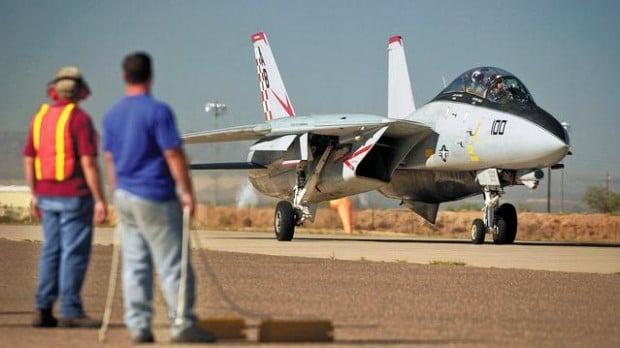
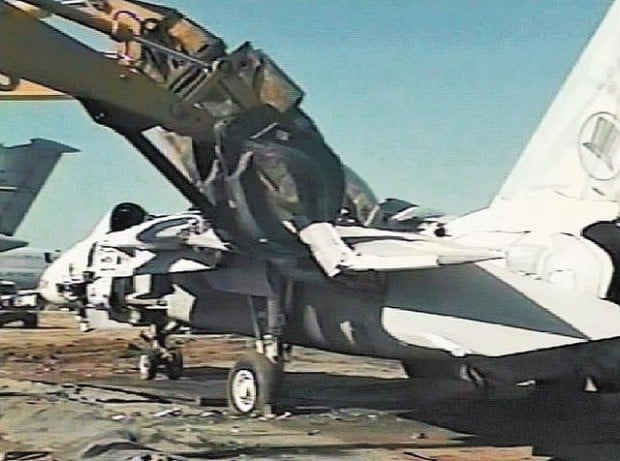
A mechanical monster grabs the F-14 fighter jet and chews through one wing and then another, ripping off the Tomcat's appendages before moving on to its guts. Finally, all that's left is a pile of shredded rubble — like the scraps from a Thanksgiving turkey.
Within a workday, a $38 million fighter jet that once soared as a showpiece of U.S. air power can be destroyed at Davis-Monthan Air Force Base, home to the military's "boneyard" for retired aircraft.
The Pentagon is paying a contractor at least $900,000 to destroy old F-14s, a jet affectionately nicknamed "the turkey," rather than sell the parts at the risk of their falling into the wrong hands, including Iran's.
"There were things getting to the bad guys, so to speak," said Tim Shocklee, founder and executive vice president of TRI-Rinse Inc. in St. Louis. "And one of the ways to make sure that no one will ever use an F-14 again is to cut them into little 2-by-2-foot bits."
People are also reading…
The Defense Department had intended to destroy spare parts unique to the F-14 but sell thousands of others that could be used on other aircraft. It suspended sales of all Tomcat parts after The Associated Press reported in January that buyers for Iran, China and other countries had exploited gaps in surplus-sale security to acquire sensitive U.S. military gear, including F-14 parts.
Among other tactics, middlemen for the countries misrepresented themselves to gain access to the Defense Department's surplus sales or bought sensitive surplus from U.S. companies that had acquired it from Pentagon auctions and weren't supposed to allow its export.
Investigators also found some sensitive items accidentally slipping into surplus auctions rather than being destroyed as they were supposed to be.
Iran is the only country trying to keep Tomcats airworthy. The United States let Iran buy the F-14s in the 1970s when it was an ally, long before President Bush named it part of an "axis of evil."
Shocklee's company won a three-year, $3.7 million contract to render surplus equipment useless for military purposes. The work includes the recent demolition of 23 Tomcats in Arizona, accounting for about $900,000 of TRI-Rinse's contract. The military is considering using the same process on its other F-14s.
The company has developed portable shredding machinery so the Pentagon can have sensitive items destroyed on a base instead of shipping them long distances to be shredded.
The Tomcat was a strike fighter with a striking price tag: roughly $38 million. By the 1980s it was a movie star with a leading role in the Tom Cruise classic "Top Gun." But as the planes are mangled into unrecognizable metal chunks, the jets with a 38-foot wingspan appear small and vulnerable.
The shearing machine, which uses pincers to rip apart the planes, weighs 100,000 pounds. The shredder is 120,000 pounds. An F-14 weighs about 40,000 pounds.
Among the shredded victims in Arizona: a plane flown by the "Tophatters" squadron, which led the first airstrike in Afghanistan when the U.S. invaded in October 2001.
The Pentagon retired its F-14s last fall. At last count, the military's boneyard in Arizona held 165 Tomcats, believed to be the only ones left out of 633 produced for the Navy. The others were scavenged for parts to keep others flying, went to museums or crashed, said Teresa Vanden-Heuvel, spokeswoman for the Aerospace Maintenance and Regeneration Group.
As powerful as the grinding machinery is, it can't shred all of the F-14. The landing gear — built to withstand the force of slamming onto an aircraft carrier's deck — must be cut by hand with a demolition torch.
local angle
The Aircraft Maintenance and Regeneration Group, or AMARG, at Davis-Monthan Air Force Base is a major employer in Tucson.
AMARG ranks 60th in the Star 200 ranking of the biggest employers in Southern Arizona, with 801 full-time-equivalent workers at the end of 2006. The facility reported an annual payroll of $37.8 million.
The operation formerly was called the Aerospace Maintenance and Regeneration Center. In May, it was officially redesignated as the 309th Aerospace Maintenance and Regeneration Group, under the 309th Maintenance Wing located at Hill Air Force Base, Utah.
On the civilian side, several local companies provide aircraft storage, repair and maintenance.
They include Evergreen Air Center Inc., located at Pinal Airpark, just north of Marana off Interstate 10; Hamilton Aerospace Technologies Inc., an aircraft repair facility at Tucson International Airport, 6901 S. Park Ave.; and Bombardier Aerospace, which has a factory service center at the airport at 1255 E. Aero Park Drive.
— Arizona Daily Star