

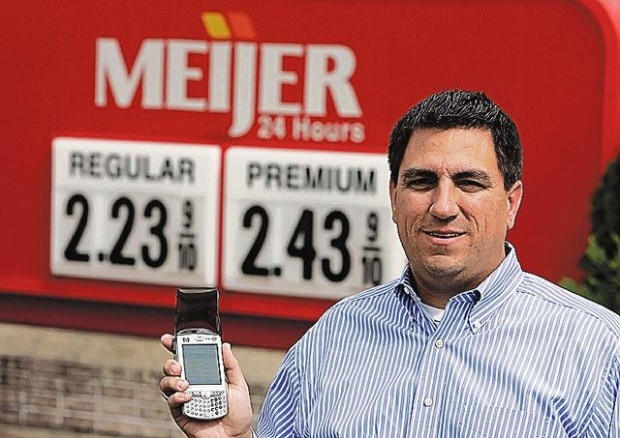
CHICAGO — Like any normal consumer, Tom Gruss was leery about the idea of a company sending promotional text messages straight to his cell phone. Who needs a bombardment of sales pitches in yet another format?
But he found one offering a heads-up about changing gasoline prices at Meijer Inc. stores benign enough to sign up, especially since he could opt out at any time. Now, he says, "I'm a fan."
"In my eyes, this is an easy way of getting 'passive marketing' and having it pan out as actual savings," the Indianapolis-area resident said.
Get ready for the inbox on your phone to fill up faster. From fast-food chains to carmakers to consumer-goods manufacturers and sports franchises, more and more companies are adopting text messaging as a way to target consumers on the move.
The practice has taken off in the past year and appears to be a trend ready to explode, according to Gerry Purdy, an analyst for Frost and Sullivan.
People are also reading…
"Probably the most important medium for advertising in the 21st century is going to be the cell phone, not print media, not billboards. It's just a matter of time — there are just too many of them," Purdy said.
Globally, the number of cell phones in use recently crossed 2.5 billion, an increase of a half billion in just 12 months, according to Wireless Intelligence, a joint venture of the GSM Association industry group and the research firm Ovum.
It's also a matter of companies going where consumers are. After all, more than 95 million Americans are considered active text messagers, according to the Yankee Group research firm. And marketers see it as low in cost and high in effectiveness.
Pay coming and going
Unlike in other nations, where cell users typically pay for messages they send but not those received, most U.S. cell subscribers pay for both outgoing and incoming messages, often buying plans with a monthly allowance. It's unclear, then, how many will "opt in" to a marketing campaign unless the marketer foots the bill for the incoming promotional message.
That is the approach wireless carriers themselves often take when text messaging account information or promotions to their own customers.
Verizon Wireless says marketers have shown tremendous interest in arranging text-messaging campaigns in which recipients wouldn't be charged, though no deals have been cut as yet.
Text messaging "provides anytime, anywhere access to the consumer, because the mobile phone is always on and always available," said Laura Marriott, executive director of the Mobile Marketing Association.
Contests and sweepstakes that require consumers to enter via text message are among the most popular campaigns so far, said Marriott, citing McDonald's, Burger King, Procter & Gamble Co., General Motors Corp. and CBS Corp. among the corporate giants that have used them.
Meijer, the Grand Rapids, Mich.-based grocery retailer with 179 stores in Ohio, Illinois, Indiana, Michigan and Kentucky, decided to be more direct — with consumers' permission.
During a time of frequent gasoline price spikes, it launched an opt-in program in the Indianapolis market in July with mobile-marketing firm SmartReply Inc. Consenting customers of its gas and convenience stations are sent text messages whenever Meijer is about to raise pump prices by 5 cents a gallon or more, giving them two to four hours to fill up at the lower price.
The big run-up in gas prices has reversed of late, but Meijer says the enthusiastic response in Indianapolis has prompted plans to roll out the program across its entire chain by the end of the year.
It started overseas
Text-message marketing campaigns took root first in Europe and Asia, where corporations found it easier to connect.
McDonald's Corp., one of the world's most prolific advertisers, cited success with its "Win World Cup Chicken" game in the United Kingdom last spring. Thousands of customers text-messaged a code they received when ordering products in the restaurants for the chance to win World Cup soccer tickets.
Use of the tactic in the United States was delayed by technical obstacles to running the campaigns on different carriers and mobile-phone platforms. With those problems resolved, McDonald's is among the companies looking at making text-messaging a significant part of their U.S. marketing, beyond just promotions and games.
Dean Barrett, senior vice president of global marketing, said the Oak Brook, Ill.-based chain is developing a system that would allow customers to order by text message before arriving at a restaurant, with automatic billing through their phones.
Consultant Frederick Newell says companies using text messaging should move carefully because of privacy concerns and must get customers' permission first.
"I think the potential for it is enormous, but it puts a lot of responsibility on marketers to use it in a responsible way," said Newell, CEO of the marketing consultancy Seklemian/Newell in Miami Beach, Fla. "If they misuse this in any way, every congressman in the country is going to be up screaming."
● Recent examples of corporate marketing campaigns using text messaging:
l Meijer Inc. offered consumers who opted in a chance to get advance notice of impending gasoline price increases at its stores, in order to take advantage of the lower price.
l Starbucks Corp. ran a text-based scavenger hunt and trivia game this year, "Starbucks Summer Pursuit," with consumers opting in to receive a series of SMS questions on their cell phones. Replies with pictures of the answer gave senders a chance to participate in a scavenger hunt in New York City and win a trip to Costa Rica.
l McDonald's Corp. gave away World Cup soccer tickets to customers who text-messaged a code they got with products ordered in its restaurants in the United Kingdom.
l Church & Dwight Co. Inc.'s Close-Up toothpaste offered iPods to texters who flirted with fictitious characters in its "Rock, Paper, Kiss" game.
l Hershey Co. ran a promotion in which purchasers of Hershey's candy bars could text their UPC code numbers to enter a sweepstakes for a trip to the X Games.
l Burger King and the Baltimore Ravens offered free tickets to future NFL games and the right to toss the coin at midfield before the game to fans texting in the word KING.