

The CEO of a global drug company laid out big plans Tuesday for Oro Valley-based Ventana Medical Systems — including an increase in work force by roughly 250 employees over the next year and an expansion of research-and-development facilities.
Ventana plays a key role in pharmaceutical giant Roche's vision of personalized health care, Roche Holding AG CEO Severin Schwan said at a luncheon attended by about 50 people.
Switzerland-based Roche bought Ventana Medical Systems Inc. earlier this year. The acquisition was completed in February and, since then, Ventana has purchased 17.1 acres for $8.9 million to expand its campus.
Ventana is now the headquarters of one of Roche's global business units that focuses on diagnostics, Schwan said.
Schwan, in his fourth visit to Tucson, said Roche has plans to expand research and development laboratories at Ventana's campus and increase staffing levels from about 750 to more than 1,000.
People are also reading…
The global drug maker chose Ventana because it's a leader in tissue diagnostics, Schwan said. Ventana's technology can examine cell structure to determine if certain drug treatments will be effective for patients suffering from cancer or infectious diseases.
"The combination of drugs and diagnostics will get much more important as we progress," Schwan said.
Ventana President and CEO Chris Gleeson said Roche will invest $100 million in the Oro Valley company in 2009, which is more than twice what Ventana spent in 2007. Also, Roche has allowed Ventana to remain innovative since the purchase, Gleeson said.
"The entrepreneurial spirit has stayed at Ventana," he said.
Gleeson is retiring at the end of the year, Schwan announced at the luncheon. He is being replaced by Chief Operating Officer Hany Massarany, who has worked for Ventana for 10 years.
Oro Valley Mayor Paul Loomis said at the luncheon that the town remains committed to attracting and retaining industrial leaders like Roche to help build a strong economic base. While many cities and towns have links to the bioscience industry, few can boast having a global leader such as Roche, he said.
It was the innovation at Ventana that led Roche to the Tucson area, Schwan said.
As an example, Schwan mentioned a genetic test Ventana developed that can show how effectively a certain drug would fight breast cancer.
The drug, Herceptin, is highly effective in 20 to 30 percent of patients, Schwan said. It works when there is a presence of a gene known as HER2 in breast cancer tissue specimens.
Ventana's test can detect the presence of the gene after breast-cancer tissue specimens are processed on automated slide-staining instruments.
The presence and quantity of the HER2 gene indicates whether a patient may benefit from Herceptin, which is sold in the United States by Genentech Inc. Roche owns a majority of California-based Genentech's stock and has made a bid to buy the rest, but Schwan didn't address that transaction at the luncheon.
Schwan acknowledged that much work needs to be done to find treatments that will work for patients.
"Realizing our vision of personalized health care is an enormous challenge," he said. But it's one that needs to be addressed, he said, because half of patients don't respond to the drugs that are used to treat their illnesses. In addition to not working for some patients, those drugs can have severe side effects, he said.
Knowing how drugs will work on a patient also saves money, he said.
"You save the unnecessary and costly treatments for those who need it," Schwan said.
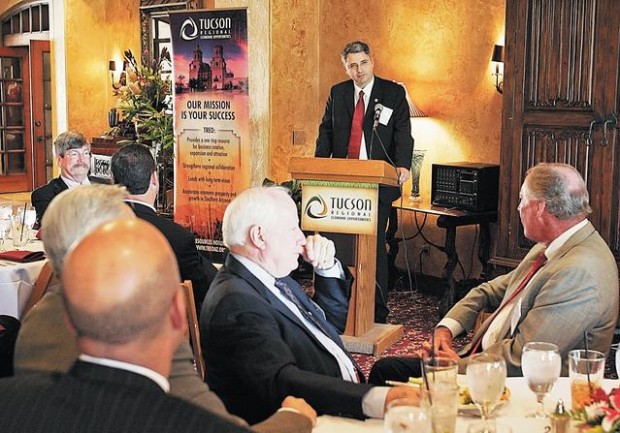
Representatives from the biotechnology industry, members of Tucson Regional Economic Opportunities and university and elected officials attended the luncheon. It was hosted by The Stone Canyon Club, a recreational club in an upscale Oro Valley community.
"The combination of drugs and diagnostics will get much more important as we progress."
Severin Schwan, CEO of Roche Holding AG