


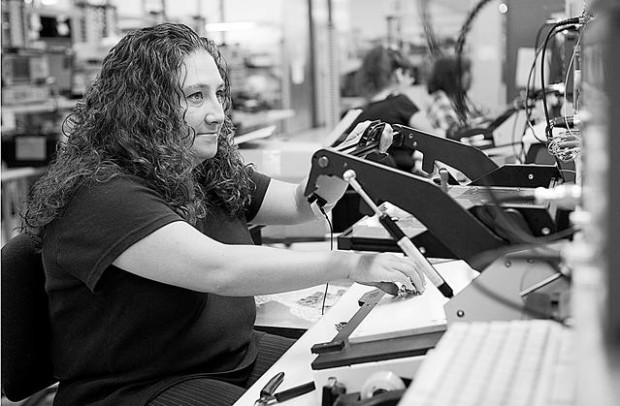
MILWAUKEE — Antoinette Lucero figured she'd never find a job. Unemployed and on welfare for five years, she wondered who would hire a deaf woman with little training.
But the 29-year-old single mother learned about a free program sponsored by staffing company Manpower Inc. to earn certification in electronics assembly. She's now an inspector and assembler at Sennheiser Electronic Corp. in Albuquerque, living in her own apartment and saving for her daughter's college education.
"It's a career for me, it's not just a job," Lucero said. "So there's a big difference. I never felt before that I had a career."
Companies are starting to get creative when it comes to filling jobs, looking to hire people who may be underemployed, or sometimes disabled like Lucero, or luring back retirees by offering flexible hours. Staffing companies like Manpower and others say it's already tough to find skilled labor. Things are only going to get worse with the nearing retirement of the baby boomer generation, they say.
People are also reading…
The U.S. Bureau of Labor Statistics estimates 10 million jobs will be unfilled in 2010, when the first wave of boomers retires.
There are an estimated 78 million American boomers, who were born between 1946 and 1964. Worldwide shortages are expected for sales representatives, engineers, carpenters, plumbers and other jobs, according to Manpower, which last year placed 4.1 million people on permanent, temporary and contract positions in 72 countries.
Clients of the Milwaukee-based company are starting to plan for the impending shortage, often by first asking their employees about their retirement plans, said Jonas Prising, president of Manpower's North American operations. He estimates people 55 and older make up 15 percent to 20 percent of the work force.
"They can't just ignore it. They have to think about it and then decide how to plan for it," Prising said of the shortage.
Express Personnel Services is telling its 75,000 clients about the upcoming shortage and ways they can prevent it, said Linda Haneborg, spokeswoman for the Oklahoma City-based staffing company. She said the company's 500 franchises want clients to realize that there are now several different generations in the workplace and they all must be made happy if companies are to survive.
"We have every mix imaginable within the workplace," Haneborg said. "It's the most unique time in the history of the American workplace that we have ever experienced."
Manpower, Express Personnel and other staffing companies identify and create candidates for jobs through various free training programs.
Manpower has worked for years with the Department of Labor and public and private groups to identify people who are on welfare, unemployed or disabled who might be candidates for employment, said Melanie Cosgrove Holmes, vice president of corporate affairs for Manpower's North American operations.
Lucero entered a two-month Manpower-sponsored program called TechReach in March, taking courses in electronics with many other deaf people. At the end of May she was placed at Sennheiser, though she still works for Manpower.
Some 10,000 people were trained by TechReach last year alone. Since it began in 2000, the program has taught people skills in machinery and those necessary for keeping any job, such as arriving on time and dressing appropriately.
"It all boils down to diversity because we need to utilize every person that is able to work," Cosgrove Holmes said. "Diversity used to be the right thing to do. Now it's a business imperative."
U.S. Labor Secretary Elaine Chao encouraged attendees of a Hispanic-rights convention in Milwaukee this summer to consider working for the government, which will have 60 percent of its work force eligible for retirement in the next 10 years.
Chao later told the AP that companies should consider retirees, who are often healthy and still want to contribute and earn money when they leave the work force.
That's exactly what Principal Financial Group has noticed with its program called "Happy Returns," which brings retirees back on a temporary or permanent basis, said Kathleen Souhrada, director of employment for the retirement fund and asset manager, based in Des Moines, Iowa.
The program through the local Manpower branch has brought between 35 and 40 retirees back to the company, though they become employees of Manpower. Because they don't come back as employees of Principal Financial Group, they're able to continue withdrawing from their retirement plans.
The employees are offered flexible hours and need little training because they're used to the company's culture, Souhrada said.