

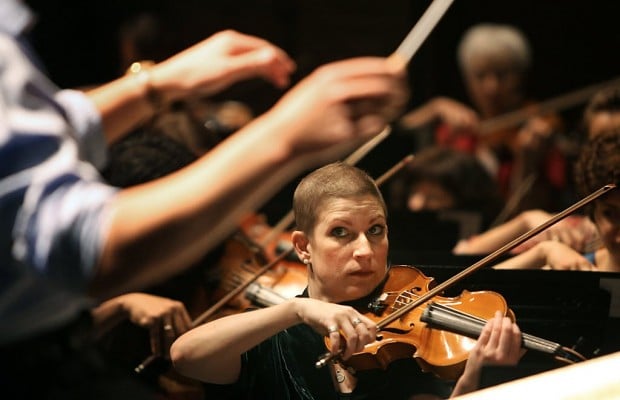
For a brief second, it looked like Carla Ecker might turn around and leave the stage as quietly and as quickly as she came.
But she didn't.
She strode out that Thursday evening in early April and took her place in the Tucson Symphony Orchestra - third seat in, front row of the first violin section.
Gone was the brown wig she had worn since January, the one that touched her shoulders and covered her bald head dotted with tufts of peach fuzz.
Those who know Ecker or have watched her over the dozen years she has played with the TSO were not surprised. She has never been one to hide behind something as transparent as a wig.
"It's funny. Before I lost my hair, people didn't know I had cancer," she said. "I thought I just have to get people used to it. Then they wouldn't be afraid."
People are also reading…
On Saturday, Ecker will sit among many of her TSO peers performing in Music & Memories, a concert that until last August she had never really considered would hit so close to home. The event raises money to help the working poor pay for cancer treatments. Many of the people who directly benefit, to no one's surprise, are artists like Ecker.
A lump leads to a journey
Carla Ecker had just turned 40 last summer and was finishing up her 16th season with the renowned Santa Fe Opera Orchestra in New Mexico. She was a week away from returning to Tucson to begin her 11th season here.
That morning in the shower, she felt something on her right breast. She looked down and saw it: a lump visible beneath the skin.
"I kind of knew right then it was cancer," she recalled, nibbling on salad and an open-faced chicken-breast sandwich recently at a downtown restaurant.
She drove herself to an urgent-care center near her Santa Fe apartment. The doctors there sent her the next day for a mammogram and ultrasound that confirmed her fears.
The doctors began mapping out her alternatives in a flurry of terms she had never experienced before: surgery, mastectomy, radiation, chemo, reconstructive surgery.
"I didn't know what I was doing; I didn't know how to have cancer yet," Ecker said.
That's when she made a call home to Tucson to the only person she knew who could help her make sense of it all: Alice F. Chang.
Assembling the home team
Chang is a household name among the region's breast cancer survivors. She's one herself, and she literally wrote the handbook on survival and regaining your life.
She was 50 when she was diagnosed with advanced inflammatory breast cancer in 1994. She went through the rigors of treatment and recovery, and was left with a few lasting aches and pains.
In late 1995, Chang, a licensed clinical psychologist, launched The Academy for Cancer Wellness, a nonprofit support network for cancer patients. Five years later, she wrote "A Survivor's Guide to Breast Cancer."
Ecker's and Chang's paths had crossed through Chang's annual Music & Memories concert. The poor have access to public-sponsored health care; the working poor are those folks who fall in the middle, with incomes too large to qualify for government help but too low to pick up the tab not covered by insurance.
Since the first concert in 2003, Chang's academy has raised $100,000. She said the goal is to raise $50,000 more by year's end to fully endow the fund.
When Ecker called her last August, Chang mobilized her resources. She called on oncologists and surgeons, and came up with a list of referrals.
Ecker had barely unpacked when she was swept into the labyrinth of cancer treatment and recovery.
"She was a little upset, but she had already set her mind to 'I've got to figure out what I've got to do,' " Chang recalled.
"I'm telling you, you would have thought she was one of her doctors," added TSO colleague and longtime friend Jeremy Reynolds. "She was so strong and educated. She knew exactly what she was going to do."
"I'm getting better"
Throughout her treatments - a double mastectomy followed by chemo - Ecker never let her mind wander to the cancer's worst-case scenario.
"I don't think I ever let myself think 'I'm going to die,' " she said, sipping ice water over lunch.
But she was certain she would lose her hair. Her doctors and nurses had told her: Expect it to fall out at Day 14 of chemo.
Like clockwork on Day 14, her hair came out in clumps.
That's when she called Reynolds and asked him to bring his shaver. The self-described follically challenged TSO principal clarinetist had been shaving his head shiny-bald since he joined the orchestra in 2003.
Ecker bought a few wigs, including a hot-pink one, and began wearing them to concerts. It was hardly noticeable from the audience; she had always been one to play with hair color and styles. No one outside her close circle knew what she was going through.
"She actually did a morning rehearsal, went and had a chemo treatment, then returned for an evening rehearsal," recalled TSO conductor George Hanson.
By last month, though, Ecker had become tired of the wigs. They were hot, itchy. So she took it off at that concert in early April and hasn't worn one since. Her hair is coming back in fits. The fuzz is filling out, leaving only a few visible patches that she rubs occasionally almost as a reflex, like someone reaching for a limb that is no longer there.
TSO fans have come up to her lately to ask about her hair and the cancer that led to it. She tells them; she has nothing to hide.
"I got sick, you know. And now I'm getting better."
If you go
• "Music & Memories VIII: John Milbauer & Friends."
• Featuring: Pianists Milbauer and Michael Dauphinais; violinists Emma Noel Votapek and Carla Ecker; clarinetists Jeremy Reynolds and Andrew Braden; bassoonist Rebecca Cain; cellist Mark Votapek; and the Arizona Repertory Singers, conducted by Jeffry Jahn.
• When: 6 p.m. Saturday.
• Where: Grace St. Paul's Episcopal Church, 2331 E. Adams St.
• Cost: Free; donations accepted to benefit the Under-Insured Cancer Patients Endowment Fund of the Academy of Cancer Wellness.
• Details: Contact Dr. Alice Chang at the Academy of Cancer Wellness, 722-4581.


