

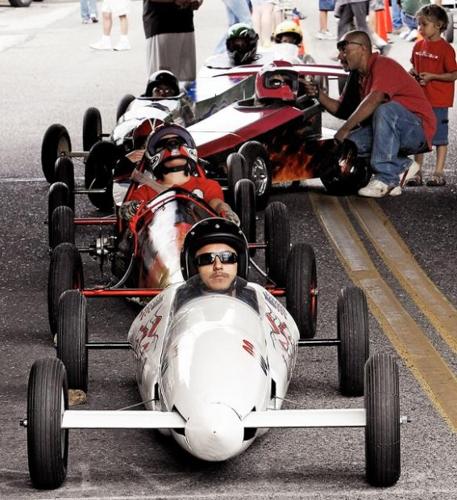
Jaime Curiel, 15, taps the steering wheel with his finger tips, waiting for his turn to speed downhill.
It's the Tucson High Magnet School student's first time driving the coaster that his grandfather Bennie Scott, a retired police officer and a member of the Bisbee City Council, borrowed for him.
Today is just practice. Riders have gathered for a mandatory run down the hill, so they can get used to the course's twists and turns and so race organizers can inspect the cars and lecture the drivers about safety.
The starting-line official loudly counts down from three, Curiel pulls his foot from under the back wheel, and the coaster slowly rolls down the hill.
The Bisbee Coaster Race has been a tradition since 1914 and is billed as the oldest, longest and probably fastest gravity-powered race in the world. It is beloved by locals but is not without its share of controversy, including several injuries and more than one death.
People are also reading…
On Fourth of July weekend, the population of this charming hilly town swells from 6,400 to 10,000. That's when many of the people who grew up in Bisbee and left after the Phelps Dodge Corporation halted its mining operations in 1975 return.
"It's a homecoming weekend for our town," says Mayor W.J. "Jack" Porter.
Independence Day festivities include mucking, rock-drilling competitions and fireworks, but the most popular and longest-running tradition is the Bisbee Coaster Race.
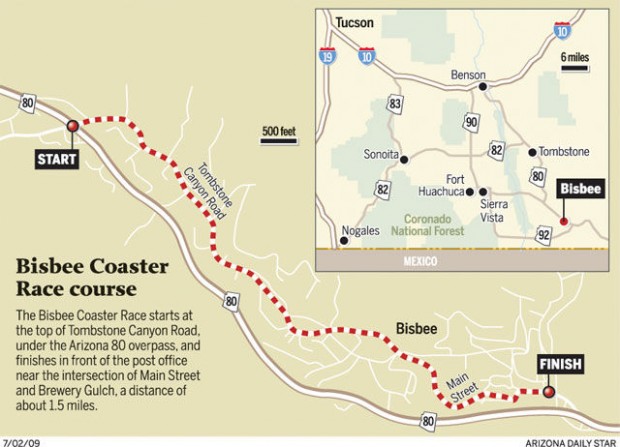
At 8:30 a.m. on the Fourth of July, racers meet at the top of Tombstone Canyon Road, under the Arizona 80 overpass. Brakes are inspected, cars and drivers are weighed.
In the junior division, cars and drivers must weigh no more than 300 pounds, total. Senior drivers and their cars must stay below 350 pounds.
The racers finish in front of the post office on Main Street, a distance of about 1.5 miles.
This year, 29 boys and girls have signed up to compete, up from 26 in 2008 but a far cry from the years when 60 or 70 kids would take part and the newspapers would post odds on the racers.
"Because you can't participate beyond 16, a lot of the kids who were perennial winners have aged out and are too old to participate now," says Pat Porter, who is married to the mayor and helps organize the race.
Last year's winner in the junior division, Dennis Cope, drove a car called "The Bomb," which was made out of an aircraft drop tank.
Cope, 11, just graduated from the sixth grade and wants to be a jet pilot or a NASCAR driver, in that order. He says racing isn't that big of a deal at his school, nor does it help him get girls.
"They're not impressed by me, but other guys maybe," he says.
Cope's dad, the elder Dennis Cope, says his son has always had a need for speed.
"I bought him a dirt bike when he was 5 or 6, and before he could ride it he wanted to race it," he says.
Blake Roberts, who lives in Broken Arrow, Okla., says his son Brodi and Brodi's best friend, Michael Morton, both 10, love to race motocross. The three have traveled to Bisbee to compete in the race.
"There's a coaster race in Sand Springs, Okla., but it's shorter and the track is straight," Roberts says. "When I heard about this one that goes almost two miles and is the oldest, longest and fastest, we just couldn't resist."
Roberts went to work building two coasters, one for Brodi and one for Michael. They got to Bisbee last week, in time for the orientation run that all new drivers are required to attend.
"I spent this week making some improvements to the cars," Blake Roberts says. "There were some steering issues and brake issues, and I spent all week fixing them."
Evolution
The first downhill race was held on Thanksgiving Day 1914. Back then, cars carried two passengers: a driver, who could be no older than 14, and a mechanic, who could be no older than 16 and who was allowed to get out and push.
More than 60 "pushmobiles" participated in that first race, and the course measured nearly 3.5 miles, from the top of the divide to Main Street. The winners received a three-pound box of chocolates.
Those first pushmobiles used ax handles for brakes, and the mechanics would drag them in the dirt to slow the car.
Today, most coasters are made from either lightweight steel or synthetic materials, though a few are still made from wood.
"The last new car I can remember, it cost $3,500 to build," says the elder Dennis Cope. "It's just not like it used to be, where you could hang out in your garage and build it and have fun."
The coaster that Pete Fullerton built for his two sons hangs on the wall of his Congdon Street repair shop, Bisbee Precision Machine.
Named "The Spirit of Bisbee," the car's shell is made of transparent Lexan, a highly durable plastic, and the whole thing weighs 127 pounds.
"This is probably the lightest coaster that has been built," Fullerton says.
It's also one of the fastest. Fullerton has taken his coaster on the highway early in the morning with his son following close behind in a pickup truck.
"I rolled all the way down the hill, around the lavender pit," he says. "Got it up over 60 miles per hour."
Safety
Jack Porter points to the remnants of an old coaster that have been left to rust on a patch of land adjacent to his repair shop, the Bisbee Bug.
"Try and lift it," he says.
The rusted frame won't budge. Not an inch. Porter says the frame was made from steel rails and weighs several hundred pounds. It's a remnant from a time when the coasters were much heavier.
In the years following World War II, race organizers made a couple of major changes. They allowed adults to race, and they did away with the weight limits on cars. In 1951, the winning boy's coaster weighed more than 700 pounds, and the winning men's coaster weighed nearly 1,000 pounds.
Heavier cars led to more accidents.
In 1952, Art Belise's coaster had to brake sharply to avoid a spectator in the finishing area and was hit by another car, driven by Teddy Holmes. Two spectators, Mr. and Mrs. Bliem, were injured when they were struck by the coasters. Cochise County Attorney Wes Polley, the brakeman on Belise's car, suffered a broken leg and shoulder. He never regained full use of his shoulder and limped the rest of his life.
In 1980, the race suffered its most tragic accident. Brad Sullivan's left rear wheel dropped into a drain grate, knocking loose a brake cable. After he crossed the finish line he applied his brakes, but only the right brake worked and he veered into the spectators. The wife and son of U.S. Army Capt. Luis DiDonato were killed, and several others were injured.
Today, Bisbee residents refer to the deaths as "the accident" or "the incident."
"We don't talk about that," Jack Porter says.
DiDonato sued the city and the group that organized the race, the Energy Free Racing Association. He received a $1 million settlement that he used to start an endowment for secondary-school teachers.
From 1981 to 1992 there were no coaster races.
Renaissance
In 1992, Lucille Owen started a movement to resurrect the coaster race. She formed the Bisbee Community Coaster Race Committee, which instituted a number of measures intended to make the race safer, including a weight limit for cars. Moreover, all cars needed a live rear axle and a specific tire and wheel combination. The required wheels were similar to a wheelbarrow wheel.
The city agreed to racing's return but insisted on a minimum $1 million insurance policy.
Despite the new safety rules, there was an accident at the 1993 race, the first race in more than a decade. Spectator Andy Mendez was hit by an out-of-control car and sued the city. He settled out of court in 1995 for $20,000.
In 1994, the rules were tweaked once more:
• Cars were required to have disk brakes.
• The starter was instructed to wait two minutes before sending another car down the hill.
• All cars were required to attend a "shake-down run" a week before the race, where they were weighed and inspected and drivers were given safety tips.
• All coasters had to pass a safety check prior to the race.
• The course was lined with additional hay bales.
• Safety guidelines for spectators were created.
"The inspectors have to be able to take the top of the car off," Pat Porter says. "We have to be able to see the brake cables and the brakes."
For the last 15 years, the rules have remained the same, and they have been strictly enforced.
Preparation
Pat Porter says this is the last year that she and her husband will organize the race. Of course, she's said that before.
"This is the sixth year in a row that this is going to be our last race," she says. "We move 499 tires prior to the start of the race. We set up 1.4 miles of safety fencing. We work our tails off."
The Porters have a lot of help. They estimate it takes 80 adults to send down a field of 29 drivers.
Dennis Cope stands at the starting line, and every two minutes he sends a car down the hill.
Pete Fullerton stands at the bottom of the hill and keeps track of what time each car crosses the finish line, down to the hundredth of a second.
First prize in the junior and senior divisions is $200. Second place gets $100 and third wins $50.
After he finishes his practice run, Curiel is ready to go again. But he'll have to wait a week. In the meantime, he and his grandfather will take the truck and drive the course, paying close attention to the turns.
"I can't wait until the Fourth," Curiel says.
Jordan, Curiel's 9-year-old brother, will watch him race next weekend.
And next year, they plan to both race in a car that they will build this winter.
"Jordan was supposed to race this year, but he couldn't because of summer school," Curiel says. "I told him I'd try to win for him."
Curiel's got a good shot.
After all, finding a car is the hard part. After that, it's all downhill.
If you go
• What: The Bisbee Coaster Race.
• Where: Old Bisbee. The race starts at the top of Tombstone Canyon Road and ends in front of the post office, 6 Main St.
• When: 8:30 a.m., Saturday.
• Cost: Free.
• Tip: The best view is at the finish line, near the post office. Spectators must stay behind the barriers, off the road.


