


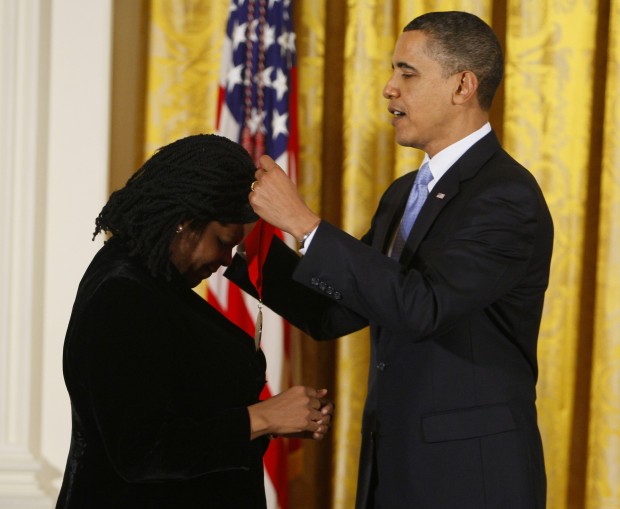
The United States is still dealing with the effects of the presidency of Andrew Johnson, consistently ranked among the worst presidents.
"Johnson was an important president at a pivotal moment in history," Pulitzer Prize-winning author Annette Gordon-Reed said in a recent telephone interview from New York. Gordon-Reed's biography on Johnson, part of Times Books' The American Presidents Series, was released last month.
Gordon-Reed's exploration of our nation's 17th president - the man who stumbled into the office six weeks after Abraham Lincoln was assassinated - reveals the strengths, weaknesses, prejudices and philosophies of a man forced into reconciling and reconstructing a nation recovering from the Civil War.
Gordon-Reed, a historian and law professor, is known for her groundbreaking research on the relationship between Thomas Jefferson and slave Sally Hemings. Her analytical conclusions were confirmed by DNA evidence.
People are also reading…
She is the author of "Thomas Jefferson and Sally Hemings: An American Controversy" (1997). Gordon-Reed won the 2009 Pulitzer Prize in History and the 2008 National Book Award for her book "The Hemingses of Monticello: An American Family."
She was named a 2010 MacArthur Fellow - commonly referred to as a "genius" grant - for "dramatically changing the course of Jeffersonian scholarship."
In the Johnson biography, Gordon-Reed examines Johnson's reputation, actions and decisions.
With the future of about 4 million black people in his hands, Johnson was hostile and racially prejudiced, Gordon-Reed said.
"He had a vision of a white man's government," Gordon-Reed said. Johnson did not view blacks as citizens, but as a group to be looked down upon.
"The president is the energy, the symbol of the nation's leadership," said Gordon-Reed. Johnson's actions emboldened whites and excluded blacks. Johnson did not see former slaves as having civil rights.
Johnson felt empathy with the injustices on poor white people, according the Gordon-Reed. For example, he supported land reforms and homesteading for whites, but not blacks.
The long-term economic outcome may have been much different had blacks been able to become self-sufficient and landowners, rather than sharecroppers, in the 1860s.
Despite his problems and weaknesses, Gordon-Reed said in many ways Johnson was an extraordinary, intelligent person. He grew up in poverty in the South, apprenticed as a tailor, was largely educated by his wife and rose to serve in the nation's highest offices.
President Andrew Johnson matters
Annette Gordon-Reed selected the last three paragraphs of the introduction to her book on Andrew Johnson in The American Presidents Series for Star readers. A portion follows. For the entire excerpt go to azstarnet.com
"Andrew Johnson took office at a time when the country was in acute need of effective presidential stewardship, and when the president's character mattered immensely. Perhaps at another moment in American history, when the stakes were not so high as they were in the aftermath of the bloodiest war the nation had ever known, a war that ended slavery for 4 million people whose lives and futures hung in the balance, having Johnson at the head of the government would not have mattered so much."
President Andrew Johnson matters
Annette Gordon-Reed selected the last three paragraphs of the introduction to her book on Andrew Johnson in The American Presidents Series.
"Andrew Johnson took office at a time when the country was in acute need of effective presidential stewardship, and when the president's character mattered immensely. Perhaps at another moment in American history, when the stakes were not so high as they were in the aftermath of the bloodiest war the nation had ever known, a war that ended slavery for 4 million people whose lives and futures hung in the balance, having Johnson at the head of the government would not have mattered so much. He could have simply joined the succession of merely lackluster and nearly forgotten presidents who shuffled across the national stage during the nineteenth century. Fate did not allow that.
"After Lincoln's successful prosecution of the war, and his initial steps toward dismantling the system of chattel slavery that had propelled the nation into conflict, Johnson was faced with the herculean task of putting things back together with a good and workable plan for how that might be done. It is always easier to destroy than to build, or even rebuild on a sound basis. In many ways, Johnson faced circumstances that were trickier to maneuver than Lincoln had faced. The American populace had been traumatized by war, and supporters of the Union were reeling from the murder of their leader. The white South had been battered into submission (seemingly) and had to be reincorporated into the country, somehow. And there were the millions of formerly enslaved African Americans still living among whites who viewed them either as their lost property or as property they had hoped to possess someday as part of their version of the American dream, a dream that had died with the defeat of the rebel army. It is a useless enterprise, for we can never know, but one wonders what Lincoln would have done in these circumstances. It would have taken every ounce of his intelligence, humanity, and political skills to make his way through Reconstruction after the Civil War. Instead, there was Johnson.
"And that is precisely why Andrew Johnson's life matters so much. He may not have been the right man at the right time, but he was there at a time so critical to the American story that we simply cannot turn our eyes from him, no matter how painful the view. History is not just about the things we like or the people we want to love and admire - a fantasy date with our favorite dead person. It is about the events in the past that have mattered greatly to a given society and its culture. At the core of Johnson's life is the story of class and race in America, how they shaped the country in ways familiar and unfamiliar. It is also a story of roads not taken, by him and by the country as a whole. It is a useful, though often maddening, thing to see the choices that were available to people in the past and why they chose one route over another. Through the benefit of hindsight we are able to see the results, good and bad, of those decisions. They have made us who we are. And for better or worse the poor tailor boy from North Carolina and Tennessee helped to make us who we are. We should get to know him."


