

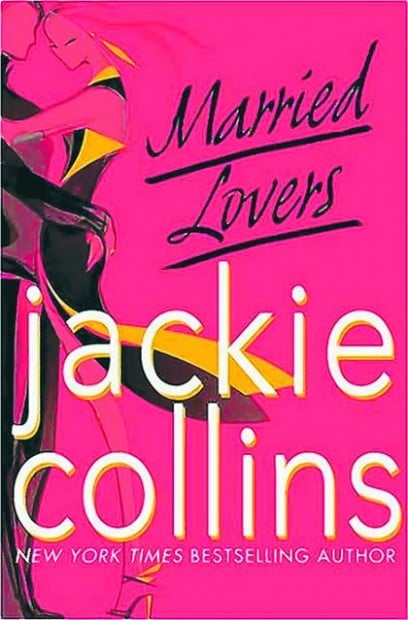
Jackie Collins' novels, including "Hollywood Wives," "Lucky" and her latest, "Married Lovers," could be considered guilty pleasures for light summer reading. Here's what the steamy novelist picks as her top choices in that category:
1. "The Godfather," by Mario Puzo (Putnam, 1969)
One reason why Francis Ford Coppola was able to make such a spellbinding movie version of "The Godfather" was the richness of the source material. Mario Puzo's novel is a brilliant study of a gangster family, a book that succeeds in creating such stunningly detailed portraits of each and every character that you find yourself rooting for people you should hate, but end up loving.
It's a book about family ties (the closest kind) and bitter rivalries (the lethal kind). The sex ratio is pretty high, too — nothing wrong with that!
People are also reading…
2. "The Adventurers," by Harold Robbins (Trident, 1966)
This story of playboy Dax Xenos, from a fictional South American country called Corteguay, is my favorite Robbins novel. Dax avenges the murder of his diplomat father at the hands of the country's despotic ruler — but not before Dax takes plenty of time out for polo, sports cars and silk-sheet calisthenics. This rollicking tale from the mid-1960s shows Harold Robbins at his best.
3. "The Love Machine," by Jacqueline Susann (Simon & Schuster, 1969)
Susann was the first female author who got out there and wrote popular fiction that could compete with the million-selling big boys. Her novels featured plenty of sex, some hard-hitting women, the truth about recreational drugs — and all of it wrapped up in a hell of a story.
"The Love Machine" concerns an industrial-strength womanizer named Robin Stone who drinks straight vodka and runs a television network. Susann managed to capture the truth about Hollywood way before the tabloids did. The novel shows her at the top of her game, in my mind — possibly because I know some of the people she based her characters on, and when the book came out they were furious!
4. "The Fan Club," by Irving Wallace (Simon & Schuster, 1974)
The "fan club" that gives this novel its title consists of four delusional losers who kidnap a beautiful Marilyn Monroe-type movie star named Sharon Fields in order to use her for their own pleasure. The descriptions are extremely graphic — another book way before its time. But what I found most interesting, and influential, about Irving Wallace's writing was his skill at keeping the plot driving from page to page, so that putting the book aside in midstory was almost unthinkable. But Wallace was also adept at getting inside the minds of his characters in "The Fan Club" — not only the kidnappers but also Sharon Fields, who turns out to be smarter than all of them.
5. "The Other Side of Midnight," by Sidney Sheldon (Morrow, 1974)
This one has it all: passion, fear, love, revenge and terror. It is the story of a handsome, vibrant war hero and two beautiful heroines — both in love with him. Dramatic, suspenseful and of course very sexy, the book takes the reader from Washington to Hollywood, Nazi-occupied Paris and post-World War II Athens. Sheldon was a marvelous storyteller who understood women — perhaps because he had worked with so many actresses during his former career as a TV producer.
The novel opens with a bravura description of the first 20 years in the life of Catherine, one of the heroines. As a teenager, Sheldon writes, "Catherine had discovered Thomas Wolfe, and his books were like a mirror image of the bittersweet nostalgia that filled her, but it was nostalgia for a future that had not yet happened, as though somewhere, sometime, she had lived a wonderful life and was restless to live it again." And the reader, as usual with a Sidney Sheldon novel, is restless to find out what happens next.


