

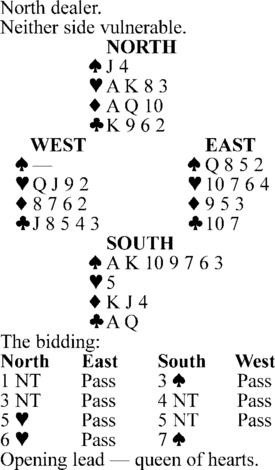
Webster defines a coup as a sudden, successful move or action; a brilliant stroke; a clever stratagem. It is therefore not at all surprising that a bridge play that satisfies this definition is also called a coup. Indeed, there are several different types of coups in bridge. Today's hand features the one known as a trump coup.
Let's say South gets to seven spades as shown, and West leads the heart queen. Declarer sees immediately that his only concern is whether or not he'll lose a trump trick.
He starts by winning the heart with dummy's king and leads a spade to the ace. If both defenders follow low, South plans to continue with the king, the normal percentage play. But when West fails to follow to the first round of spades, it appears declarer must ultimately lose a trump trick and go down one.
However, our hero, South, is familiar with trump coups and realizes he still might be able to bring the slam home. To achieve this goal, though, he must first reduce his trump length to that of East.
People are also reading…
Accordingly, at trick three he leads a low diamond to the 10, finesses the jack of trumps, then ruffs a low heart. Next comes the jack of diamonds to the queen and another heart ruff, followed by the king of diamonds to the ace.
At trick nine, declarer ruffs dummy's ace of hearts, reducing his trump holding to the K-10, while East has the Q-8. South then cashes the club ace and overtakes the club queen with the king.
Declarer's mission is now accomplished. When he leads the six of clubs from dummy at trick 12, East's Q-8 of trumps succumb to the K-10, and the grand slam is home.


