

HARSHAW — Un cementerio en este pueblo fantasma -encerrado como un secreto encrustrado en las montañas al sur de Patagonia- es un lugar rico en memorias gracias al trabajo incansable de uno de los hijos del pueblo.
Miguel Soto, quien nació en Harshaw en 1922 y murió en el 2012, pasó sus últimos años realizando una meticulosa investigación sobre la vida de sus ancestros y otras personas que descansan en ese cementerio.
Escribió resúmenes de sus historias de vida, algunas de ellas de los años 1800s, y colocó las pequeñas biografías con cubierta laminada en las tumbas.
"Mi papá iba al cementerio y hablaba con la gente", dijo Juan Soto, hijo de Miguel. "Se convirtió en algo así como un historiador del lugar, hablando de ello con la gente. Después le surgió la idea de escribir biografías de sus familiares y de personas de otras familias a las que les pedía autorización".
People are also reading…
Los documentos biográficos que publicó sobre las tumbas se desgastaron en los años posteriores al fallecimiento de Soto, quien murió a los 90 años de edad.
"Ya las hemos remplazado varias veces, dos o tres veces", dijo Juan, quien ya se jubiló como vicepresidente de desarrollo estudiantil del Colegio Comunitario Pima. "No les hemos cambiado ni una palabra. Están tal como él las escribió.
LEJANO PER RECORDADO
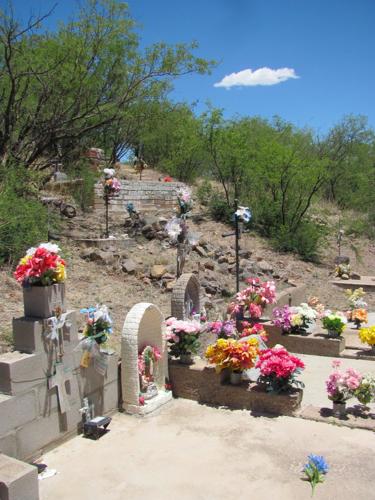
El cementerio, a pesar de su ubicació remota en un largo de un camino de tierra y bordes a unas 8 millas al sur de Patagonia, da muestras de que es un lugar importante y visitado por personas que recuerdan a sus seres queridos.
Los descendientes de los fallecidos ponen coloridas flores artificales en muchas de las decenas de tumbas.
Se han agregado nuevas marcas en algunas lápidas en las que las originales no resistieron.
Y las biografías colocadas por Soto le confieren un sentido de inmortalidad a este lugar lleno de muertos, aun cuando un infarto en sus últimos años de vida le impidió continuar con el proyecto hasta el final de su propia vida.
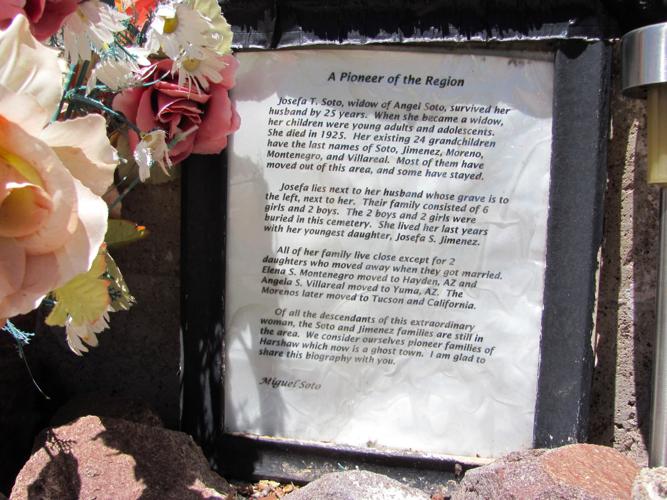
Un ejemplo de las minibiografías de Soto sobre sus ancestros:
“Josefa T. Soto, viuda de Angel Soto, sobrevivió a su esposo 25 años. Cuando envuidó, sus hijos eran adultos jóvenes y adolescentes. Murió en 1925. Sus 24 nietos actuales llevan los apellidos Soto, Jiménez, Moreno, Montenegro y Villarreal. Muchos de ellos han salido de esta área y algunos permanecen aquí.
“Josefa descansa a un lado de su esposo, cuya tumba está a la izquierda de la de ella. Su familia se integra por seis hijas y dos hijos. Los dos varones y dos mujeres fueron enterrados en este cementerio. Pasó sus últimos años con su hija menor, Josefa S. Jiménez.
“Toda su familia vive cerca, excepto por dos hijas que se fueron lejos cuando se casaron. Elena S. Montenegro se mudó a Hayden, AZ, y Angela S. Villarreal se mudó a Yuma, AZ. Los Moreno se fueron después a Tucsón y California.
"Todos los descendientes de esta extraordinaria mujer, las familias Soto y Jiuménez, siguen en el área. Nos consideramos entre las familias pioneras de Harshaw, que ahora es un pueblo fantasma. Me complace compartir esta biografía con ustedes.
— Miguel Soto”
UNA FAMILIA DE HARSHAW
Angel y Josefa T. Soto se instalaron en el área en los años 1800, en el tiempo en el que Harshaw era un pueblo minero de plata con quizá hasta unos dos mil habitantes.
En ese tiempo, el pueblo tenía un molino, casas, tiendas, hoteles y salones.
"Mi papá nació ahí en 1922, y yo viví ahí cuando era muy chico, antes de que nuestra familia se mudara a Tucsón en 1956", dijo Juan Soto.
Miguel Soto trabajó como minero cerca de Harshaw y por todas partes en Arizona, y se sentía muy orgulloso de los logros académicos de Juan y sus otros hijos.
El abandonado pueblo de Harshaw y el cementerio están en tierras que ahora son operadas por el Servicio Forestal de Estados Unidos.
Dado que esa dependencia ya no permite sepulturas en el cementerio, Miguel Soto está enterrado en otra parte, dijo su hijo Juan.
ENGLISH VERSION
HARSHAW — A graveyard in this ghost town — tucked away like a secret deep in the mountains south of Patagonia — is a place of rich remembrance thanks to the tireless efforts of one of the town’s native sons.
Miguel Soto, who was born in Harshaw in 1922 and died in 2012, spent his later years carrying out meticulous research on the lives of his departed ancestors and others now resting in the cemetery.
He wrote up summaries of their life stories, some dating back to the 1800s, and posted the brief biographies under laminated covers atop the graves.
“My father visited the cemetery and talked to people there,” said Juan Soto, Miguel’s son. “He became a sort of historian of the place, telling people about it. Eventually, he had the idea to write biographies of his family and other families after getting permission from them.”
The biographical documents he posted atop graves weathered in the years after the elder Soto’s passing at the age of 90.
“We’ve replaced them several times, two or three times,” said Juan, a retired vice president of student development at Pima Community College. “We haven’t changed a word. They are just the way he wrote them.”
REMOTE BUT REMEMBERED
The cemetery, in spite of its remote location along a bumpy dirt road about eight miles south of Patagonia, shows signs that it is cared for and visited by those who remember loved ones there.
Descendants of the departed have placed colorful artificial flowers on many of the several dozen hillside graves.
New markers have been added to some gravestones on which the original ones weathered away.
And the biographies posted by Soto lend an enduring sense of life to this place of the dead, even though a stroke in his final years kept him from continuing the project to the end of his own life.
A sample of one of Soto’s postings about his ancestors:
“Josefa T. Soto, widow of Angel Soto, survived her husband by 25 years. When she became a widow, her children were young adults and adolescents. She died in 1925. Her existing 24 grandchildren have the last names of Soto, Jimenez, Moreno, Montenegro, and Villareal. Most of them have moved out of this area and some have stayed.
“Josefa lies next to her husband whose grave is to the left, next to her. Their family consisted of six girls and two boys. The two boys and two girls were buried in this cemetery. She lived her last years with her youngest daughter, Josefa S. Jimenez.
“All of her family live close except for two daughters who moved away when they got married. Elena S. Montenegro moved to Hayden, AZ, and Angela S. Villareal moved to Yuma, AZ. The Morenos later moved to Tucson and California.
“Of all the descendants of this extraordinary woman, the Soto and Jimenez families are still in the area. We consider ourselves pioneer families of Harshaw, which now is a ghost town. I am glad to share this biography with you.
— Miguel Soto”
A FAMILY OF HARSHAW
Angel and Josefa T. Soto settled in the area in the 1880s, around the time when Harshaw was a silver-mining town with perhaps as many as 2,000 residents.
In those days, the town had a mill, houses, stores, hotels and saloons.
“My dad was born there in 1922, and I lived there when I was very young before our family moved to Tucson in 1956,” Juan Soto said.
Miguel Soto spent his working years as a miner near Harshaw and elsewhere in Arizona, and he took pride in the educational achievements of Juan and his other children.
The abandoned Harshaw townsite and the cemetery are on land that is now managed by the U.S. Forest Service.
Because the agency isn’t allowing additional burials in the hillside cemetery, Miguel Soto is buried elsewhere, Juan said.
