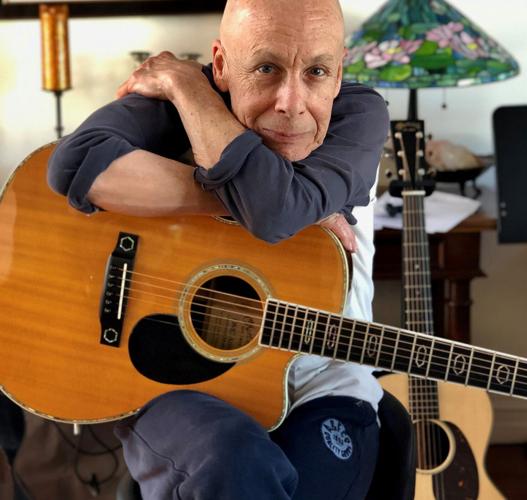
Christopher Cross doesn’t need to overpower a room. He only has to begin singing.
There are voices that become inseparable from a particular period of our lives, and Cross has one of them. Within a few notes, you know exactly who it is. More importantly, you remember how this music made you feel.
I had seen him about three years ago at the Saban in Beverly Hills, California, and I already knew that hearing these songs live can be a surprisingly moving experience. This Aug. 14 performance at the Long Beach Amphitheatre was no different.

Dr. Barton Goldsmith
“Never Be the Same,” only the second song of the set, immediately established what made everything special. It sounded like Christopher Cross. Not an approximation of an old record, but the musical character we remember from it.
A large part of that came from the band. Cross’s voice is the signature, but the three women singing behind him were essential to recreating the richness of this music. Those layered vocals are woven deeply into the records, and hearing them reproduced so beautifully gave the live songs their familiar dimension.
People are also reading…
The keyboard player and saxophonist were equally important. This was an exceptionally tight band, but tightness alone wasn’t the point. They understood the architecture of the songs.
During “I Really Don’t Know Anymore,” backing vocalists Bella Hicks, Lisbet Guldbaek and Stephcynie became a more prominent part of the arrangement, adding another dimension to the performance. It was one of those moments that justified hearing a familiar artist live: The song was recognizable but not imprisoned by the record.
The balance continued throughout the set. Cross’ music often has been described in terms of smoothness, but that word doesn’t quite capture what happens when the songs are played well. There is enormous precision underneath that apparent ease. Chords have room to breathe. Vocal parts overlap without competing. Saxophone and keyboards color rather than crowd the melody.
And then there are the songs themselves.
When “Arthur’s Theme (Best That You Can Do)” arrived — the song forever connected with the moon and New York City — the entire band seemed deeply engaged in the performance. It was one of the evening’s most complete musical moments.
A song like that carries considerable memories with it. For some listeners, these records accompanied marriages, breakups, long drives, first apartments, children, careers and all the innumerable events that accumulate into a life.
That makes performing them decades later a delicate proposition. Play them mechanically, and the audience hears an old hit. Play them with feeling, and the audience hears part of its own history. Cross and his band chose the second path.
Cross was supported throughout by an outstanding touring band: Curtiss Brengle on keyboards, Andy Suzuki on saxophone and flute, Kevin Reveyrand on bass, Joel Rosenblatt on drums, and backing vocalists Bella Hicks, Lisbet Guldbaek and Stephcynie. Their musicianship helped recreate the rich, layered sound that defines these songs.
“Ride Like the Wind” produced one of the evening’s happiest audience moments. The crowd joined in enthusiastically on the familiar “da-da-da” vocal figure, turning what began as a performance into a room full of people participating in the record.
Then Cross closed with “Sailing.”
Before beginning, he asked the audience to sing along. They did, and something changed. Thousands of individual voices softened into one collective sound beneath a song that spent decades becoming part of people’s lives.
There was no need for spectacle. The emotional power was in the simplicity of the moment.
It was magical.
I have spent much of my professional life interested in the places where psychology and music intersect. One of those places is memory. We tend to think we remember events, but often what we actually remember is how those events made us feel. Music has an unusual ability to retrieve that feeling intact.
Christopher Cross’s performance did exactly that.
“Sailing” wasn’t simply the last song of the set. For a few minutes, the years between when many of us first heard it and the night we heard it again seemed to collapse.
And perhaps that is why Christopher Cross continues to move audiences. He doesn’t merely remind us of the past.
He gives us a chance to feel it again.