The UA Opera Theatre audience this weekend will be seated on the Crowder Hall stage.
The performers will be on platforms in the hall.
Behind them, a large screen will show projections depicting Hades, the Greek underworld.
Welcome to Cynthia Stokes’ 21st century vision of Christoph Willibald Gluck’s landmark Baroque opera “Orfeo ed Euridice.”
“This is a very, very special project,” said Stokes, who directs the University of Arizona Opera Theatre program.

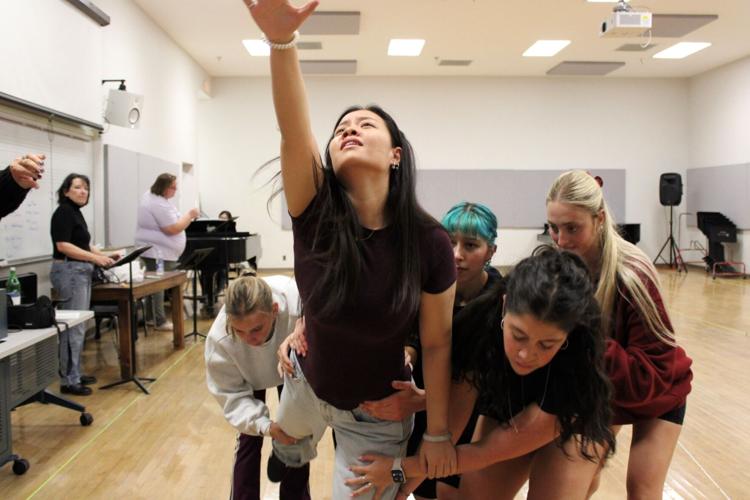
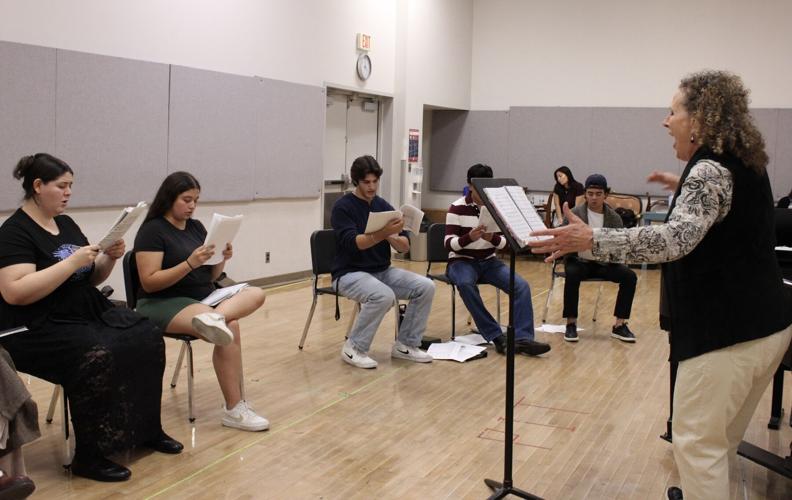
UA Opera Theater students rehearse a scene from Gluck's “Orfeo ed Euridice,” coming to Crowder Hall Nov. 18-21.
Her vision goes well beyond reimagining the staging.
The production, with nightly performances through Saturday, Nov. 21, is a collaborative effort involving the Arizona Symphony Orchestra, Opera Theatre, UA School of Dance and UA School of Theatre, Film & Television.
People are also reading…
“I'm really hoping that this becomes a larger opportunity for collaboration between Theater, Film & Television, dance and the opera program,” said Stokes, who has held the UA Opera Theatre’s Amelia T. Rieman Endowed Chair since fall 2017.
The student actors will make up the non-singing chorus in the opera, based on the tragic love story from Greek mythology of Orpheus descending to the Greek underworld to retrieve his wife, Eurydice, who died after being bitten by a snake.
“It taps into the very essence of what it means to be human,” Stokes said. “If we live and we love, we are going to grieve, and when we grieve, we are changed and changed forever by remembering the people that we love.”

Cast members rehearse Gluck’s “Orfeo ed Euridice,” the UA Opera Theater’s first production of the school year.
Gluck originally composed the role of Orfeo for a tenor, but for the show’s Paris premiere eight years later in 1774, he rewrote it for high-tenor. Contemporary productions usually cast a counter tenor or a mezzo-soprano, who plays a “trouser role” — a woman playing a male character.
For the UA production, Stokes decided to ditch the trouser role and instead cast Orfeo and Eurides as a “couple of women who are married.”
“It gives this kind of beautiful color to the story itself,” she said. “It feels so tender in this version of the telling of the story.”
Flipping the script when it comes to this sort of reverse staging — putting the audience where the performance should be and the performers in the audience — creates an immersive experience for those watching and those performing.
Performers will at times be so close to audience members that they will be able to experience what Stokes has experienced at rehearsals when she is “close to the singers and seeing just how incredible it is to watch a singer, to watch how they breathe, the way they're thinking, what they're watching, what they're thinking about.”
“To be within 10 feet, literally, of a singer and see just how extraordinary that is, the beautiful voices, the beautiful acting, the beautiful storytelling,” she said.
The top stories from the Arizona Daily Star’s Caliente section for this week.
“At its heart, ‘Orfeo ed Euridice’ is a celebration of music’s ability to transcend grief and illuminate our shared humanity,” Julie Desbordes, who joined the UA School of Music in June as director of orchestras, said in a written release. “Gluck transformed opera by placing emotional truth at the center of the drama, and I am excited for our students and audiences to experience the beauty, intimacy and enduring relevance of this remarkable work together.”
Stokes has double-cast the work’s three roles with Diana Peralta and Suyan Ma as Orfeo; Sophia Su and Beth Jargstorf as Euridice; and Hailey Trump and Esther Jung as Amore aka Cupid.
Contact reporter Cathalena E. Burch at cburch@tucson.com. On Bluesky @Starburch

Cathalena E. Burch
Reporter