PHOENIX — Rebuffed by a trial judge, the Goldwater Institute is now trying to convince the state Court of Appeals that it's illegal for the state to give tax credits to companies that make their movies and even their commercials in Arizona.
In court filings, attorney Parker Jackson said it is clear that what are billed as incentives to the film industry to do business in Arizona are little more than a giveaway of state tax dollars.
He said the program, approved by lawmakers in 2022, allows the Arizona Commerce Authority to not just forgive taxes that are owed to the state but actually can result in the state writing out a check to any company whose accumulated credits exceed what they owe the state — up to $35 million to any one company and $125 million a year for all who qualify.
And that, Jackson is telling the state Court of Appeals, runs afoul of the Arizona Constitution.
People are also reading…
Only thing is, that wasn't the conclusion reached last year by Maricopa County Superior Court Judge Adele Ponce.
The trial judge acknowledged the Gift Clause in the Constitution bars the state from providing grants or subsidies to any individual or corporation.

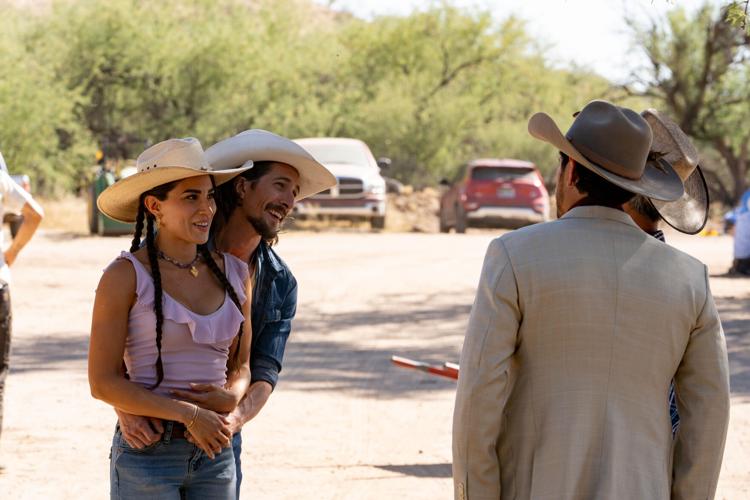
Televisa, a Mexican production company, films "Tierra de Amor y Coraje" in Tucson in April.
But Ponce said there is no Gift Clause violation with what are labeled as "tax credits'' because the state isn't giving away anything. Instead, the judge ruled, the program simply allows people and corporations to pay less of their own money to the state.
Ponce went on to say her conclusion is not changed by the fact that the credits are "refundable,'' meaning someone whose credits exceed the taxes owed actually can get a check from the state.
Jackson, in his filing with the Court of Appeals, said the trial judge got it wrong.
What is not in dispute is that lawmakers approved the credits in an apparent effort to jump-start what at one time had been a thriving movie industry in Arizona.
The credits can be generous.
The top stories from Sunday's Home+Life section in the Arizona Daily Star.
Companies that spend up to $10 million in production costs can receive up to $1.5 million. And there's a sliding scale for more expensive films, with credits going up to $7 million for a $35 million production.
There are some conditions.
A company can use a "qualified production facility'' in the state, meaning studios of at least 10,000 square feet that have the necessary technology. Alternately, the credits apply when a production is "filmed primarily at a practical location'' in Arizona.
But at that point, Jackson said, "the state must provide the subsidies.''
Proponents contend the state gets the benefit of additional business and exposure. But Jackson said the law doesn't have anything that spells that out.
What does it have?
"The statute merely requires the film companies include an acknowledgment that the film was shot or produced in Arizona,'' he told the appellate court. "That's it.''
Jackson acknowledged that the credits are being promoted as an "incentive'' to produce movies, videos and commercials in Arizona. But he said that, whatever they are called, they do not pass muster.
"Arizona's Gift Clause ... prohibits the depletion of the public treasury by allocating public resources for private enterprises, and/or the conferring of special advantages on private, special interests by subsidy or otherwise,'' he said. "The payments provided under the program do both of those things.''
Jackson also rejected the concept that these are credits that offset someone's tax liability.
There, the key is that "refundable'' part.
Consider a company that is entitled to a $1,000 credit.
"If a taxpayer owes the government $5,000 at the end of the year, a $1,000 credit will reduce the taxpayer's liability to $4,000,'' he explained to the court. But all that changes if the credit exceeds the liability.
"For example, if a taxpayer owes the government $500 at the end of the year, a $1,000 tax credit will not only reduce the taxpayer's liability to $0, but it will also result in a $500 payment to the taxpayer,'' Jackson said.
Courts have concluded that the Gift Clause does not apply when the state gets something in return that is of comparable value. But Jackson said there are guideposts around that.
"The court must compare the public expenditure to what the government receives,'' he said. And that means judges have to decide for themselves what is the "fair market value'' of the benefit, not simply accept the state's word about the value.
What's also important, Jackson said, is that "anticipated indirect benefits,'' like economic improvements the government hopes may result from the project, like anticipated new tax revenues, cannot be included in this analysis.
He said what that leaves is the requirement that the subsidized production acknowledge that it was produced in Arizona. But that, said Jackson, is not enough.
First, he said, the law is worded in a way that the company gets the credits even if the film is never actually released or distributed.
"In such cases, even assuming that a 'filmed in' credit can constitute a benefit to the state, that benefit will be nonexistent,'' Jackson said.
And even if a film is released, figuring out the value of that credit is something else.
He cited testimony of Michael Thom of the University of Southern California, who he said is an expert on film subsidy programs and their economic impact. And he said Thom said that any assumption of benefits is built on "speculative assumptions.''
"Namely, a viewer would have to observe the acknowledgment, understand its meaning, and plan to travel to the state that he or she would not have otherwise taken in order for the state to see any benefit from such an acknowledgment,'' Jackson said.
The law creating the credits does say that one purpose is to "maintain the motion picture production company's production-labor positions in the state.'' But Jackson said that does not meet the definition of the "consideration'' the state needs to provide subsidies because they are indirect, speculative, and not actually mandated by an enforceable contract.
And he said that anticipated taxes from productions also can't legally count because the producers were already liable for the taxes.
The 2022 law wasn't the first time the state has approved such credits. Lawmakers enacted a similar program in 2005 and expanded it in 2007.
A report on that program said that the credits generated 317 full-time jobs in the industry in 2008. And another 413 were created indirectly from spending by filmmakers in the state.
All totaled, according to the report, that generated about $2.3 million in additional state and local taxes.
But it turned out that Arizona actually gave out more than $8.6 million in credits to get that gain. And a similar report for 2007 showed a $1.7 million loss to the state.
Lawmakers repealed the program in 2015.
Sen. David Gowan, R-Sierra Vista, who championed the new credits in 2022, has insisted these are different than the prior program. He said it requires those seeking the credits to actually show, subject to a state audit, that they have actually spent the money in Arizona.
No date has been set for a hearing.
Photos: The Antiques Roadshow makes a stop in Tucson
Antiques Roadshow in Tucson

David Rago, right, an appraiser of pottery and porcelain, talks about a vase during a filming of the Antiques Roadshow at Old Tucson, 201 S Kinney Rd on May 19, 2026.
Antiques Roadshow in Tucson

Collectors and enthusiasts walk with their prized pieces to meet with an appraiser during visit of the Antiques Roadshow at Old Tucson, 201 S Kinney Rd on May 19, 2026.
Antiques Roadshow in Tucson

Lark Mason Jr., right, gets a second opinion from Howard Nowes, both appraisers, on a piece during a taping of the Antiques Roadshow at Old Tucson, 201 S Kinney Rd on May 19, 2026.
Antiques Roadshow in Tucson

Participants take a break in the shade during visit of the Antiques Roadshow at Old Tucson, 201 S Kinney Rd on May 19, 2026.
Antiques Roadshow in Tucson

A painting of Miguel Hidalgo is carried by David, who brought it to the taping of the Antiques Roadshow to get a appraised at Old Tucson, 201 S Kinney Rd on May 19, 2026. David said a friend found it in a dump and gifted the painting to him back in the 1980’s.
Antiques Roadshow in Tucson

Lucas Papavasiliou, a jewelry appraiser, takes a closer look at a ring during a taping of the Antiques Roadshow at Old Tucson, 201 S Kinney Rd on May 19, 2026.
Antiques Roadshow in Tucson

Crew members for the Antiques Roadshow set up to capture collectors and enthusiasts during a taping of the show at Old Tucson, 201 S Kinney Rd on May 19, 2026.
Antiques Roadshow in Tucson

Deborah Miller, left, an appraiser of clothing, talks to Elisa about the two dresses she brought for appraisal during a filming of the Antiques Roadshow at Old Tucson, 201 S Kinney Rd on May 19, 2026. Elisa bought three garbage bags full of clothing and shoes from an estate sale and wanted to know more about two dresses that looked vintage to her.
Howard Fischer is a veteran journalist who has been reporting since 1970 and covering state politics and the Legislature since 1982. Follow him on X, formerly known as Twitter, Bluesky, and Threads at @azcapmedia or email azcapmedia@gmail.com.