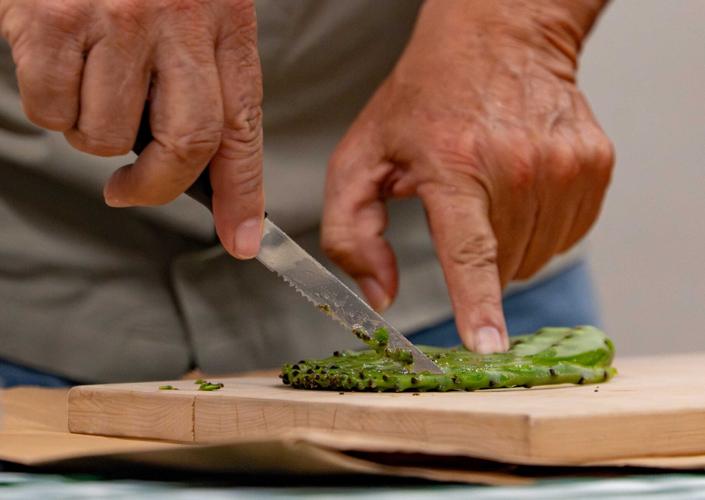
A dozen people bend over cutting boards, gripping flat, thorny cactuses with plastic tongs. In deep focus, they remove all the thorns.
Stems from the flat, bright-green pads harvested days before are the main ingredient of stew, soup and cold salad the group samples minutes after. They toast with prickly pear cactus lemonade.
The summer evening experience — on how to select, harvest and clean prickly pear pads for cooking — was the first workshop offered by the Orchard Community Learning Center, an organization based in South Phoenix, and their recently inaugurated eco-shop, Tres Hermanas Eco-tienda.
Prickly pear cactus pads, known as nopales in Spanish, are a well-known food for some and can be purchased at nearly any Mexican grocery store. For many other people, they are still a rarity.
Deja Bailey, who recently moved from the Midwest and signed up for the workshop, didn’t know they were edible.
People are also reading…
“I went into their store the first time, I was looking around, and I came across this,” she said, pointing to the tender pad on her cutting board. The green cactus stems filled plastic crates and were sold to customers for cooking, Bailey found out.
Nopales haven’t found widespread acceptance in the mainstream U.S. diet, but some believe they could play an important role in helping Arizona transition to drought-adapted agriculture that also promotes culture and healthy eating.
Farmers, researchers, chefs, and prickly-pear fans across the state are engaged in small efforts to cultivate the cactus as a crop. Federal dollars meant to incentivize planting and research on the potential of climate-smart crops were pulled back, but many projects continue independently and several predate the funded program.
Nopales sold at grocery stores and taco stands, or the ones handled at the South Phoenix workshop, are very different from the wild cactus species found in desert lands.
“Can you eat all prickly pears? You could, potentially, if you are really hungry,” says Raul Puente-Martinez, a researcher and curator at the Phoenix Desert Botanical Garden, who has been volunteering with the Orchard Community Learning Center for some years.
There are about 300 species of prickly pear in the world. Eating the pads or fruit of wild plants will not kill you, but it’s not appetizing either, Puente-Martinez told the group at the evening workshop. For thousands of years, Indigenous communities bred cultivars of prickly pear cacti to have fewer spines, be more tender and produce sweeter fruit. That careful and persistent selection over generations resulted in a wide variety of domesticated varieties and crops.
“I think it’s important for people to know that the Sonoran Desert has fed many cultures for millennia, and whatever we have here is not only food but medicine. One of those foods is the prickly pear cactus,” said Yolixotiani Angeles-Wann, co-founder of Orchard Community Learning Center and Tres Hermanas Eco-Tienda.
Hundreds of tons of the vegetable are imported every month from Mexico to be consumed in the United States, mainly among the Mexican-American community. But growing some nopales hyper-locally would be good for families, Angeles-Wann suggested. Any effort neighborhoods can make to cultivate some builds food security, she added.

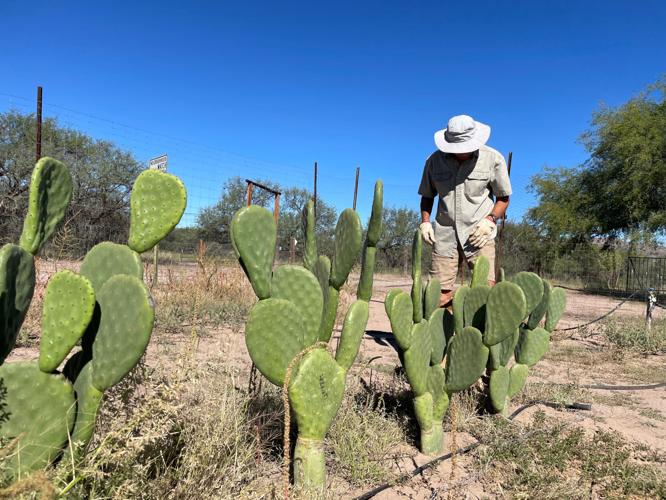
John Rueb, co-owner of Forever Yong farm in Amado, inspects a row of prickly pear cactus. He began experimenting with the crop two years ago through an incentive for climate-smart commodities of the University of Arizona.
John Angeles-Wann, her partner and organization co-founder, is hopeful their work can motivate others and be “a reference for what is possible” when it comes to local food systems. They stock their store weekly with tomatoes, peppers, squash, blue corn, carrots and jujube grown a couple of feet away at the Healthy Roots garden. As they slowly propagate their prickly pear cactus plantings, the emphasis remains on bringing "awareness to the plant and his uses," he said.
Ultimately, Angeles-Wann said, communities could flip “food deserts,” like the one in South Phoenix, into neighborhoods that thrive on “desert foods.”
Not just flavors in a margarita
Prickly pear-derived foods are commonplace in Arizona, but education on the source and uses of these cacti is sparse, and the fruit remains more popular than the rather viscous — but antioxidant and fiber-rich — cactus pads.
In Arizona, many people add nopales to salsa and scrambled eggs, but the possibilities are plentiful. Some people grill, boil, sauté, pickle, ferment, dehydrate, candy or even blend the tender, green cactus pads. Prickly-pear cacti evolved to have leaves converted into spines to protect themselves from predators, so the tender pads eaten as nopales are actually flattened stems or branches.
Natalie Saucedo, a Phoenician who attended the summer workshop, said she eats nopales regularly in stew, or blends them with sugar to make popsicles. She had never considered harvesting the prickly-pear cactus plant in her backyard instead of buying the imported pads from grocery stores.
Domesticated a long time ago, several varieties of Opuntia ficus indica are grown as crops.
An older pad, planted in soil and given minimal water, can produce tender pads in just a year or two. After that, harvesting young, newer palm-sized pads can happen every one to two weeks, depending on climate and irrigation. Plants can survive without supplemental water but don’t produce as much in arid regions.
Prickly pear cactus selected for nopal production are different from those selected to produce a fruit crop, Puente-Martinez explained. Wild-harvested tunas, or prickly-pear fruit, are better known in Arizona than the varieties cultivated in Mexico, but they have a fraction of the juice and sweetness as those that have been selected over generations.
In Arizona, nopal cultivation is still small and scattered, but some farmers and gardeners sell fresh, locally grown cactus pads. In Phoenix, the Ruebs regularly sell at their store and are in the process of adding their nopales to the online inventory of Sun Produce Co-op and Pivot Produce, local-food aggregators and distribution services operating in Tucson and the Valley. In southern Arizona, a handful of growers have small-scale prickly pear plantings for pads and fruit in the process of getting established. Up north in Glendale, Jesus Muñoz, from TJ Farms, takes at least four dozen nopales every Saturday to Arrowhead Farmers Market.
“He really doesn’t sell that many. A lot of people don’t know how to cook with them and don’t really buy them,” said Christa Esquibel, owner of Get Local Arizona Events, which hosts the weekly market. Despite low demand, Muñoz takes a small tray every week for frequent customers.
“It’s not a staple that most farmers have.”
Tucson-area gardeners and growers sell minimal quantities of pads to co-ops and restaurants. Some have seen value in adding them to food-based health programs or benefited from incentives to boost climate-smart agriculture.
Rise and fall of climate-related funding
John and Yong Rueb have tried all sorts of crops since they moved from Chicago to Southern Arizona in 1996. Over time, through yearly trial and error and a constant search for niche markets, gourmet garlic varieties and butternut squash were crowned champions for their soil type and high-desert climate of their farm in Amado.
Rueb hopes he can put the 20 varieties of prickly pear cactus that he planted two years ago at the corner of the field to the same test.
For several months last year, the farm sold some 15 pounds of pads, bright green and nearly spineless, to a fine-dining restaurant in Tucson focused on Sonoran Desert heritage foods.
The Ruebs are still testing whether they can find regular buyers, and which prickly-pear cactus varieties will be able to handle their cold winter temperatures.

Raul Puente-Martinez, a research botanist, shows how to clean prickly pear cactus pads during a community workshop last month at Orchard Community Learning Center in Phoenix.
“I’m always looking for something to tweak my interest. Something new, challenging maybe,” Rueb said. So far, the nopales barely make “a little fledgling operation” with meager earnings, he told The Republic last fall. But he is having fun experimenting.
Nopalea, with bright-green tongued pads, is the favorite so far. It’s thin, tender, has a citrus taste, and is favored by the restaurant buyer. However, the plants struggled with the winter frost, and Rueb had to replant them in spring. His hope is on the Cumeral, a variety with thick, round pads, that might do better because his farm shares the same altitude as the Sonoran town after which the cactus variety is named.
Both the varieties and the initial push to experiment with the desert crop came from a program led by the University of Arizona that provided farmers an initial $5,000 stipend to try “climate-smart crops” and use at least one conservation practice on their land.
Fifty miles north, Jesús García and Erin Riordan tested and propagated the varieties for dozens of farmers to plant.
In 2023, the U.S. Department of Agriculture granted $4.7 million to the UA, the Arizona-Sonora Desert Museum, Local First Arizona, and the University of Maryland to research and promote climate-smart commodities; enroll farmers, take field data, develop a logo, and do marketing and awareness campaigns. The funding was drawn back in April 2025 after the sweeping federal budget cuts by the Trump administration.
In the early hours of a hot summer day in 2025, García and Riordan walked around mixed rows of prickly pear and agaves at UA's Campus Agriculture Center, selecting mature pads to propagate in new plots. Trying several varieties gives them the best chances of finding drought-tolerant, cold-hardy breeds.
Some of these cactus crops, closer to wild relatives than semi-industrial varieties, aren’t as appetizing as other varieties used for high-scale production, said Riordan, an ecologist and conservation research scientist at the Arizona-Sonora Desert Museum. But they are often better prepared to battle pests and tough environmental conditions.
“Often as you are selecting some traits like high production, fewer seeds, longer shelf life, you might be losing some of the hardiness,” Riordan explained.
They want to see which varieties are able to produce fruit and tender pads while resisting the high heat, dry conditions and cold winter of Arizona — climate conditions very different from the biggest producing regions in Mexico.
Right now, keeping a diversity of prickly-pear cactuses in the farm is more desirable than standardizing production, she said.
“Variability across your plants is going to help so that maybe some of your plants do a little bit better in this colder winter or some do better in this hotter summer, so you are less prone to having your whole field fail,” she said.
García, a longtime member of Tucson’s Mission Garden and retired researcher from the desert museum, has been collecting and propagating different varieties for years. Each has different qualities for their resistance to the environment or the pads and fruit they produce; some have juicier fruit, others have value for the color, others for the size and texture of pads.
Chinapa, from Sonora, produces some of the best-tasting fruit but is more prone to disease than others and ripens fast. Tortilla de harina variety has a “gorgeous, big, beautiful fruit with bright color, but they don’t taste like anything,” he said. “What is their value? Color.”
Finding the right varieties and growing technique to make a prickly pear crop in Arizona is the challenge. But the market opportunity, García suggests, is hard to miss:
“We know that Mexicans living in the U.S. consume these products at a great level.”
Crop potential tested a decade ago
It’s not the first time farmers start a prickly pear crop in the copper state — let alone in the Southwest. In California, the D'Arrigo Bros. Co. engaged in a 19-year breeding program to create and sell Andy Boy Cactus Pears.
A decade ago, west of Phoenix on Tonopah farmland, a man grew a full acre of prickly pear crop and sold pads, locally produced and imported, to Mexican grocery stores in the Valley. Puente-Martinez, the researcher with the Desert Botanical Gardens, who consulted with this producer but declined to give his name, also had his brief romance with growing nopales at scale.
Sometime in 2015, Puente-Martinez ordered a truck with 16,000 prickly pear cactus pads from San Luis Potosi, Mexico. The load arrived to the Nogales-Mariposa Port of Entry with the dozen or so documents needed to import the plant material into Arizona.
Puente-Martinez and a business partner planned to produce a large volume of fruit and pads in a rented Gila Bend farm, juice them, and sell them to wholesale buyers.
But the truck didn’t come through. The plastic crates carrying the pads had noxious weed seeds in them, border agents told the transportation company carrying the order. Puente-Martinez hired a team at the border to clean them but the cargo was rejected a second time.

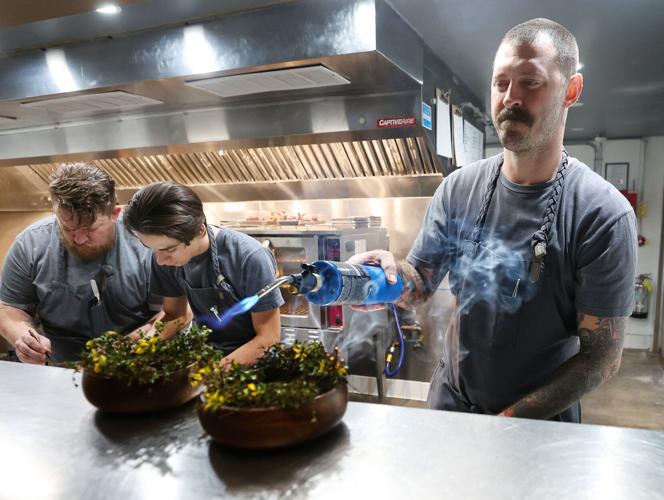
Aaron Lopez, far right, chef and owner of Ursa in downtown Tucson, uses a blowtorch to bring out the fragrance of the creosote on a dish before it goes out to diners. Lopez, who grew up eating nopales, has turned locally sourced cactus pads into juice, ferments, wine, vinegar, ice cream, crunchy candy, chewy candy and tostadas.
That same winter, he visited the producer in Tonopah and found a farm ravaged by winter. Frostbite had killed almost every plant and there were few stacks still standing.
“It was a sad display,” Puentez-Martinez, a native from Veracruz, said in Spanish.
The future of prickly-pear cactus production in Arizona, Puente-Martinez believes, involves controlled agriculture — macro tunnels of plastic or mesh to protect the plants both from the high heat and dry conditions, and from the winter frosts.
Mexico’s strongest nopal-producing regions plan under open sky and are often rain-fed, but they are at much higher altitude and in humid microclimates.

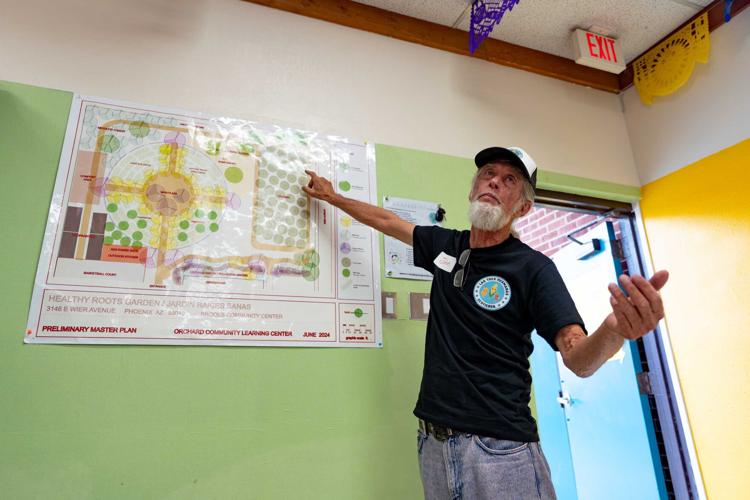
John Wann-Angeles points to a map at Orchard Community Learning Center in Phoenix to show where a community workshop will begin that focuses on how to plant, harvest and cook prickly pear pads.
Prickly pear production in northern Mexico often uses tunnels to keep humidity and lower temperatures. Production of nopalitos can double or triple under these conditions, he explained. In this way, plants are not as stressed trying to hold water in.
“I see potential,” he said of production in Arizona. “But compared with productive regions in Mexico, this would take a long while.”
The UA program, which provided an incentive for farmers to grow the crop, had some 30 growers in the pipeline for enrollment and seven already ahead in the process. Growers could adopt a variety of perennial and annual crops like agave, tepary beans and prickly pear to participate.
The team of researchers involved with the grant took data from a couple of farms to test how much plants were producing with the water given. They were planning to scale the research to 20 farms when funds were cut. The data would have provided the USDA with evidence and useful data on the climate benefit and crop-per-drop of desert, native crops.
What's on the desert menu
In the hot border town of Calexico, California, Chef Aaron Lopez grew up eating nopales with scrambled eggs, nopales with machaca (or shredded dried beef), nopales in red and green chili sauce.
The tender cactus, the seventh most popular vegetable in Mexico, was so ubiquitous in everyday Mexican cuisine that Lopez didn’t consider it as a food to experiment with in the modern and immersive fine-dining experience he designed decades later to help eaters re-imagine desert foods.
Ursa, the new restaurant he opened in downtown Tucson in the fall of 2025, uses ingredients foraged or harvested in the Sonoran Desert, molded and transformed into novel dishes with a modern twist.
"We had now begun this journey of exploration of ingredients that had never been used in a restaurant setting. Why use something that was everywhere?" Lopez told The Republic about his initial reluctance to use nopales in the menu.
Prickly pear pads were used at first in a couple of dishes, sourced from the Ruebs in Amado via a distribution business called Pivot Produce, but it didn't take long for Lopez to take them off the menu.
A woman who was foraging and sourcing ingredients for the restaurant offered Lopez advice: If he wanted to tell the story of the desert, he shouldn’t overlook this plant.
Lopez, looking for versatility, is beginning to see this well-known childhood food with new eyes, and has turned locally sourced cactus pads into juice, ferments, wine, vinegar, ice cream, crunchy candy, chewy candy and tostadas.
"Somebody had to take a risk to make chocolate delicious," he said as an example of the potential in culinary experimentation. Someone had to take cacao beans, ferment it, roast it, age it, add fat and reconstruct it.
"That's what we are doing with cactus right now. We're seeing how far we can push cactus."
Nopales are on the menu at a number of Tucson restaurants including downtown's La Indita at 722 N. Stone Ave., where baby prickly pear is served as an entree; and Tumerico at 2526 E. Sixth St., whose ever-changing menu often features chef-owner Wendy Garcia's popular cactus tacos.