FLORENCE, Italy — Michelangelo’s David has been a towering figure in Italian culture since its completion in 1504. But in the current era of the quick buck, curators worry the marble statue’s religious and political significance is being diminished by the thousands of refrigerator magnets and other souvenirs sold around Florence focusing on David’s genitalia.

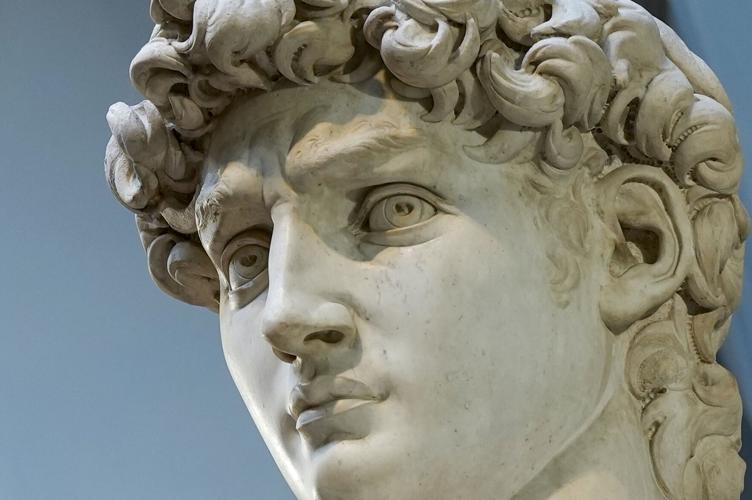
A detail of Michelangelo's 16th-century statue of David is seen on display March 18 at the Galleria dell’Accademia in Florence, Italy. The gallery director has positioned herself as David’s defender and takes swift aim at those profiteering from his image.
The Galleria dell’Accademia’s director, Cecilie Hollberg, has positioned herself as David’s defender since her arrival at the museum in 2015, taking swift aim at those profiteering from his image, often in ways she finds “debasing.”
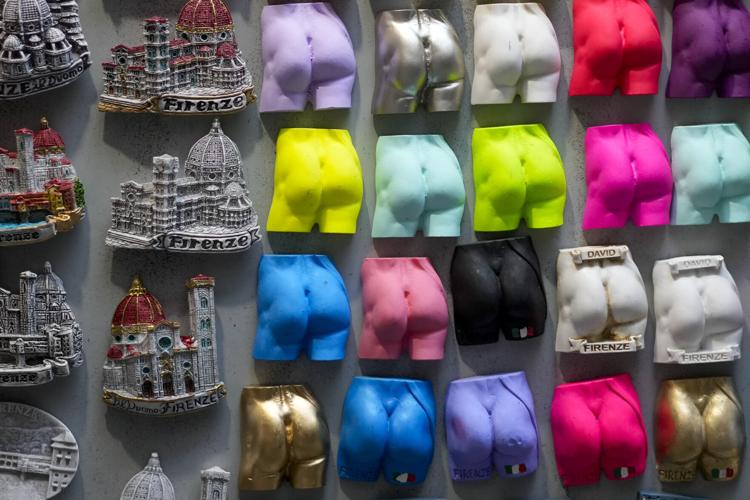
In that way, she is a bit of a David herself against the Goliath of unfettered capitalism with its army of street vendors and souvenir shop operators hawking aprons of the statue's nude figure, T-shirts of it engaged in obscene gestures, and ubiquitous figurines, often in Pop Art neon.
People are also reading…
At Hollberg’s behest, the state’s attorney office in Florence has launched a series of court cases invoking Italy’s landmark cultural heritage code, which protects artistic treasures from disparaging and unauthorized commercial use. The Accademia has won hundreds of thousands of euros (dollars) in damages since 2017, Hollberg said.
“There was great joy throughout all the world for this truly unique victory that we managed to achieve, and questions and queries from all over about how we did it, to ask advice on how to move," she told The Associated Press.

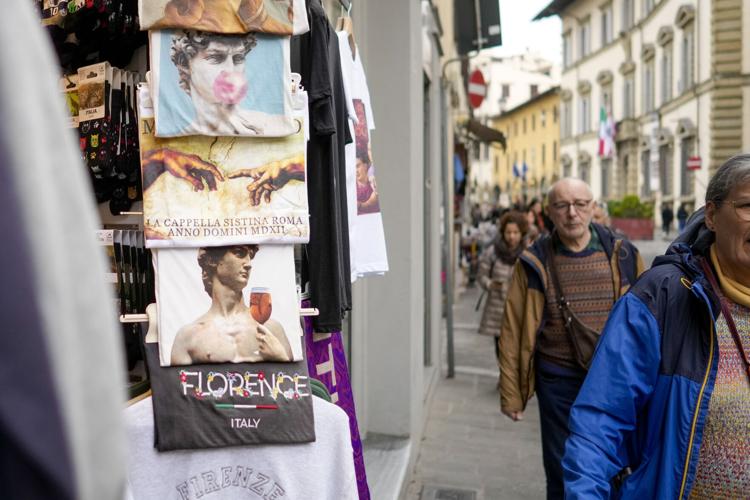
People walk past a shop selling rainbow-colored souvenirs of Michelangelo's David on March 18 in downtown Florence, Italy.
Legal action has followed to protect masterpieces at other museums, not without debate, including Leonardo's “Vitruvian Man,” Donatello’s David and Botticelli’s “Birth of Venus.”
The decisions challenge a widely held practice that intellectual property rights are protected for a specified period before entering the public domain — the artist's lifetime plus 70 years, according to the Berne Convention signed by more than 180 countries including Italy.
More broadly, the decisions raise the question of whether institutions should be the arbiters of taste, and to what extent freedom of expression is being limited.
“It raises not just legal issues, but also philosophical issues. What does cultural patrimony mean? How much of a stranglehold do you want to give institutions over ideas and images that are in the public domain?’’ said Thomas C. Danziger, an art market lawyer based in New York.

People walk past a shop selling souvenirs of Michelangelo's David on March 18 in Florence, Italy.

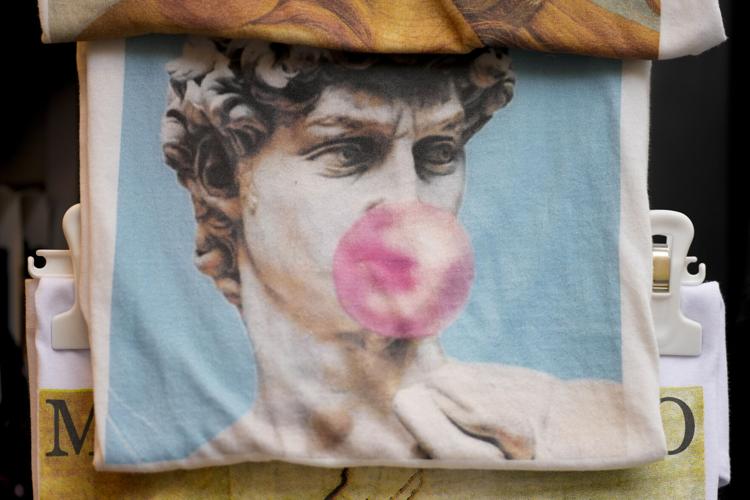
A souvenir bag showing Michelangelo's 16th-century statue of David blowing a bubble gum on sale among other souvenirs March 18 in a shop in downtown Florence, Italy.
He pointed to Andy Warhol’s famous series inspired by Leonardo’s “Last Supper.” “Are you going to prevent artists like Warhol from creating what is a derivative work?’’ Danziger asked. “Many people would view this as a land grab by the Italian courts to control and monetize artworks in the public domain that were never intended to be charged for.”
Italy’s cultural code is unusual in its scope, essentially extending in perpetuity the author’s copyright to the museum or institution that owns it. The Vatican has similar legislative protections on its masterpieces, and seeks remedies through its court system for any unauthorized reproduction, including for commercial use and for damaging the dignity of the work, a spokesman said.
Elsewhere in Europe, Greece has a similar law, adopted in 2020, which requires a permit to use images of historic sites or artifacts for commercial use, and forbids the use of images that “alter” or “offend” the monuments in any way.
France's Louvre museum, home to some oft-replicated masterpieces like the “Mona Lisa” and Venus de Milo, notes that its collection mostly dates from before 1848, which puts them in the public domain under French law.

Souvenirs of Michelangelo's David are seen on sale among other souvenirs March 18 in a shop in downtown Florence, Italy.
Court cases have debated whether Italy's law violates a 2019 European Union directive stating that any artwork no longer protected by copyright falls into the public domain, meaning that “everybody should be free to make, use and share copies of that work.”
The EU Commission has not addressed the issue, but a spokesman told the AP that it is currently checking “conformity of the national laws implementing the copyright directive” and would look at whether Italy’s cultural heritage code interferes with its application.
Hollberg won her first case against ticket scalpers using David’s image to sell marked-up entrance packages outside the Accademia’s doors. She also has targeted GQ Italia for imposing a model’s face on David’s body, and luxury fashion brand Longchamp’s cheeky Florence edition of its trademark “Le Pliage” bag featuring David’s more intimate details.
Longchamp noted the depiction was “not without irony” and said the bag was “an opportunity to express with amused lightness the creative force that has always animated this wonderful city.''
No matter how many lawsuits Hollberg has initiated — she won’t say how many — the proliferation of David likenesses continues.
“I am sorry that there is so much ignorance and so little respect in the use of a work that for centuries has been praised for its beauty, for its purity, for its meanings, its symbols, to make products in bad taste, out of plastic,” Hollberg said.
Excavation offers ‘exceptional’ look at a stratum of Roman history

People walk Wednesday in the excavation site of the ancient Roman Emperor Nero's Theater, 1st century AD, in Rome. The ruins of the imperial theater referred to ancient Roman texts but never found, have been discovered under the garden of the future Four Season's Hotel, steps from the Vatican, after excavating the walled garden of the Palazzo della Rovere since 2020, as part of planned renovations on the Renaissance building.

A fresco is seen Wednesday on a wall in the excavation site of the ancient Roman Emperor Nero's Theater, 1st century AD, in Rome.

Archeologists work Wednesday at the excavation site of the ancient Roman Emperor Nero's Theater in Rome. Referred to ancient Roman texts but never found, the theater was discovered under the garden of the future Four Season's Hotel, steps from the Vatican.

People walk Wednesday in the excavation site of the ancient Roman Emperor Nero's Theater in Rome.

A double-faced Junus head, dating approximately to the 1st century A.D., is seen Wednesday among other findings coming from the excavation of ancient Roman Emperor Nero's Theater in Rome.

1st Century AD Roman artifacts coming from the excavation of ancient Roman Emperor Nero's Theater, 1st century AD, are seen Wednesday in Rome.

Medieval artifacts, dated between the 10th and 14th century A.D., coming from the excavation of ancient Roman Emperor Nero's Theater, are seen Wednesday in Rome.

An archeologist shows pieces of bone used to carve Christian rosary beads, approximately dated to the 14th century A.D., that came from the excavation of ancient Roman Emperor Nero's Theater in Rome.

An archeologist shows a medieval glass Wednesday that dates to the 14th century A.D. that came from the excavation of Roman Emperor Nero's Theater in Rome. The ruins were discovered under the garden of the future Four Season's Hotel, steps from the Vatican, after excavating the walled garden of the Palazzo della Rovere since 2020, as part of planned renovations on the Renaissance building.

Archeologists work Wednesday on findings coming from the excavation site of the ancient Roman Emperor Nero's Theater, 1st century AD, in Rome.