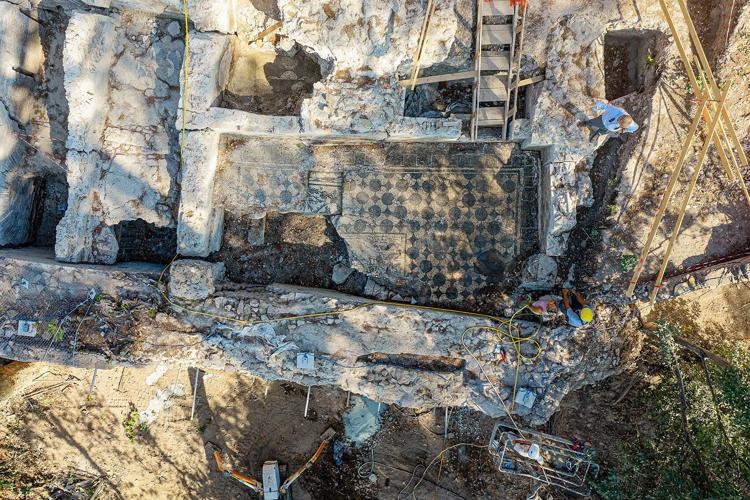
ROME, Italy — Archaeologists uncovered a 2nd-century building with mosaics and frescoes near the Colosseum that may have been barracks used by ancient Roman firefighters, the city's archaeological office said.
Five of the building's eight rooms were fully excavated in the Villa Celimontana park, a former noble residence that dates back to the 16th century on the Caelian Hill, one of the seven hills of ancient Rome.

A worker on July 30 cleans a mosaic floor uncovered during archaeological excavations at Villa Celimontana in Rome, Italy.
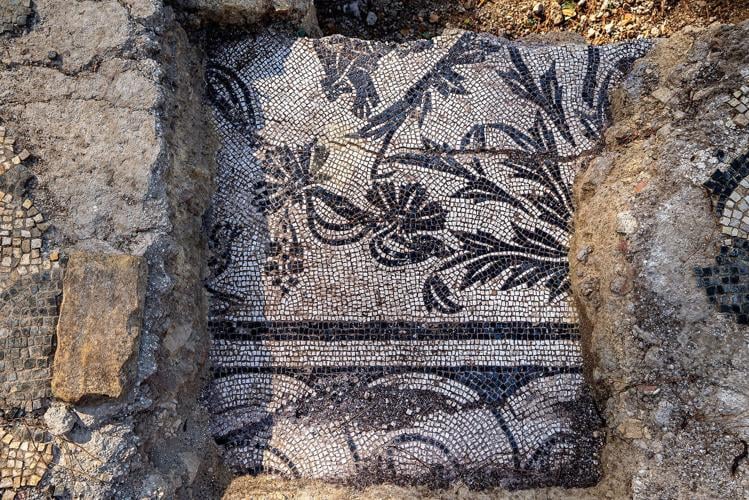
Archaeologists found a mosaic that depicts a dolphin, a fish, a lobster and a crab surrounding a large two-handled vase, as well as the remnants of a painted ceiling decorated with large red and blue circles.
The mosaic's design closely resembles one previously discovered in a firefighters' barracks in Ostia, the ancient port of Rome, about 19 miles from the capital, the archaeological office said this past week.
People are also reading…

A marine-themed mosaic uncovered in an imperial-era Roman building at Villa Celimontana is displayed July 30 in Rome, Italy.
This suggests the building may have belonged to the nearby barracks of the Fifth Cohort of the Vigiles, the firefighters of ancient Rome, the office, known as the superintendency, noted.
"If this hypothesis is confirmed, the discovery would help reassess the extent of one of the most important military complexes of imperial Rome," the statement said.

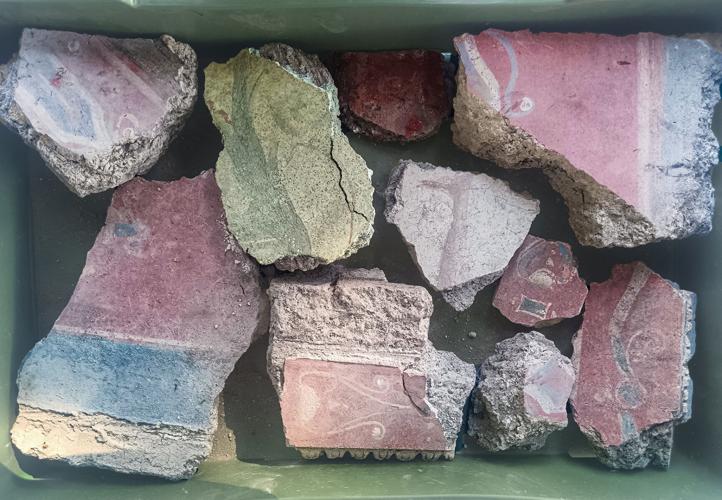
Fragments of painted plaster, recovered from an imperial-era Roman building uncovered at Villa Celimontana, are displayed July 31 in Rome, Italy.
Under the Roman Empire, the Vigiles were responsible for firefighting and maintaining public order at night. Their barracks next to the building in Villa Celimontana used water from a nearby aqueduct.
However, an alternative hypothesis is that archaeologists uncovered a patrician residence, or domus, similar to many others found atop the Caelian Hill. The presence of sophisticated decorations would back this interpretation.

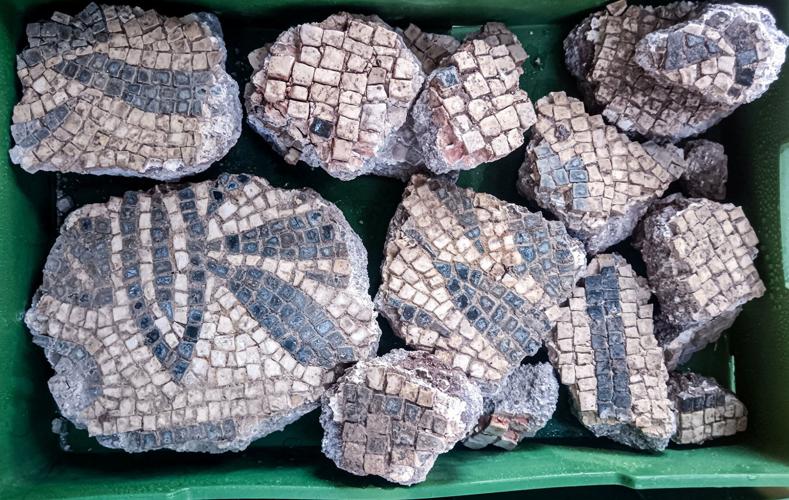
Fragments of a mosaic, recovered from an imperial-era Roman building uncovered at Villa Celimontana, are displayed July 31 in Rome, Italy.
"Only a thorough study of the excavation materials and the structures exposed will provide further information on the newly discovered structure," the superintendency said.
European Union post-COVID-19 pandemic economic recovery funds funded the excavations.