

Writers write, and if they are good or lucky enough, what they write gets published, increasingly online but still, for many, the old-fashioned way: ink on paper in hardcover books.
I reconnected with two writers and their new books in a recent edition of the New York Times Book Review, the last remaining dedicated, stand-alone print book review section in a major United States newspaper.
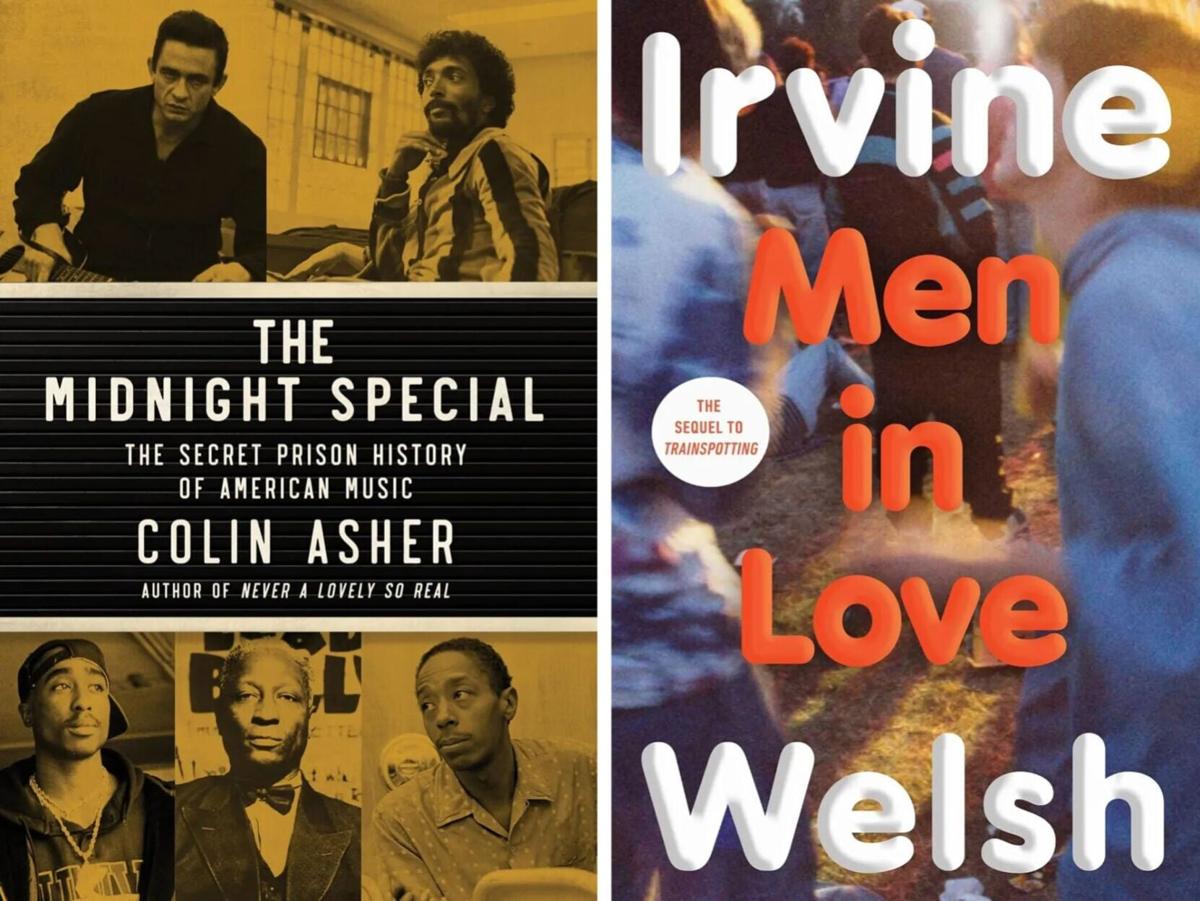
Of Colin Asher’s “The Midnight Special: The Secret Prison History of American Music,” critic Dwight Garner wrote that it is “a fog-piercing down-bound train of a book, better than it had to be.” Of Irvine Welsh’s “Men in Love,” James Lasdun is less than enthusiastic, offering, “It makes for a cynically entertaining ride, but it leaves you feeling a bit battered.”
People are also reading…
As Asher writes in his book’s introduction, “Trying to write the definitive history of American prison music would be quixotic. This book isn’t that. Instead, it focuses on five albums and the lives of five musicians who made them, each of which has something distinct to say about the ways that policing and incarceration have shaped our musical culture.”
Only one of those five is widely known: Johnny Cash. He effectively cultivated an outlaw image, thanks to such bad boy lyrics as “But I shot a man in Reno just to watch him die,” and recording seminal live albums in California’s Folsom and San Quentin prisons. But, as Asher details, though he was arrested often, he never spent more than one night in jail.
Not so the others in the book.
Huddie Ledbetter (aka Lead Belly) was in jail plenty, which is no excuse for the shabby treatment and nasty manipulation he suffered at the hands of the generally admired musicologist John Lomax. Elmo Hope, an ebullient personality, bebop pioneer and pianist collaborator with such giants as the late Sonny Rollins, was brought down by his heroin addiction. Ike White went to prison at 19 after a murder during a robbery, found salvation of sorts in music and would end up playing with bands and recording an album while still incarcerated. Tupac Shakur’s life began with his mother pregnant with him in prison, and Asher shows how her personality shadowed his life and work.
The profiles of these men are artfully peppered with compelling minor characters, and we get a disturbing history of the American so-called justice system. There are dark shadows aplenty. As Garner puts it, “Taken together, the profiles … amount to a multilayered indictment of America’s prison system, the largest in the world.”
Reading this book reminded me of getting to know Asher when he spent time here in 2014 researching a biography of Nelson Algren.
“Algren was a very complicated man,” he told me then. Reading about his latest led me to his 2019 “Never a Lovely So Real: The Life and Work of Nelson Algren,” which led me to local journalist Mary Wisniewski’s exceptional 2016 “Algren: A Life” and the Algren books of Richard Bales.
Then, it was on to Welsh’s “Men in Love.”
He hit it big with his first novel, 1993’s tale of a group of heroin addicts and thieves in Edinburgh. It was titled “Trainspotting” and became a movie three years later, directed by Danny Boyle, starring Ewan McGregor.
The new novel is a sequel of sorts, or spin-off, that puts us back in the company of familiar characters and their escapades and troubles.
Kinder than the New York Times review was one from The Guardian: “There are plenty of moments that showcase Welsh at his best, impertinent and loose and attuned to the poetic cadence of everyday speech. When his writing hits these heights, most often during flights of knowing, referential, rhetorical fancy, it is hard not to be charmed by its flair and insolence.”
I am only halfway through, finding good things and some not so. Your call, of course, but be aware that it comes in at more than 500 pages.
It did evoke for me memories of the time Welsh lived here for a few years starting in 2009, much of it in the creative company of writer/teacher Don De Grazia, with whom he was collaborating on a theatrical musical titled “Creatives.”
During this time, De Grazia told me, “Irvine is a role model for any writer.” I can say the same of De Grazia. He was a former bouncer at Metro and for many years a professor of creative writing at Columbia College. He created the annual live music storytelling event called “Come Home Chicago,” and for some years hosted a monthly literary series at the Soho House. He was also a novelist of great talent.
I realized that again within the first pages of De Grazia’s 1998 novel, “American Skin,” a tremendously powerful coming-of-age story set in Chicago in the 1980s. Publishers Weekly called it a “powerful debut (that) fearlessly explores racism, adolescent rage and terrifyingly violent youth movements … a graphically violent novel (that) will not be to every taste, but it rings true with poignant clarity.”
De Grazia died in June 2024, following a softball game, a game he loved. He was only 56, and the city literary community was understandably shocked and offered all manner of reactions.
Randy Albers, professor and chair emeritus of fiction writing at Columbia College, was De Grazia’s first fiction teacher. He told me, “Don could write the grittiest, most hard-assed street stories, but at their heart, they were incredibly humane tales of people trying to make their way through a challenging, often threatening world. … He was honest, reflective, a writer’s writer.”
Toya Wolfe, author of the prize-winning novel “Last Summer on State Street,” was a student of De Grazia’s at Columbia. She said, “He was a champion of me and my work. He took me from a baby writer to a professional.”


