NEW YORK — "Country" Joe McDonald, a hippie rock star of the 1960s whose "I-Feel-Like-I'm-Fixin'-To-Die Rag" was a four-lettered rebuke to the Vietnam War that became an anthem for protesters and a highlight of the Woodstock music festival, died Sunday. He was 84.
McDonald, who performed with his band, Country Joe and the Fish, died in Berkeley, California. His death from complications of Parkinson's disease was reported by Kathy McDonald, his wife of 43 years, in a statement issued by his publicist.
McDonald was a longtime presence in the Bay Area music scene, where peers included the Grateful Dead, the Jefferson Airplane and his onetime girlfriend, Janis Joplin. He wrote or co-wrote hundreds of songs, from psychedelic jams to soul-influenced rockers, and released dozens of albums. But he was known best for a talking blues he completed in less than an hour in 1965 — the year President Lyndon Johnson began sending ground forces to Vietnam — and recorded in the Berkeley home of Arhoolie Records founder Chris Strachwitz.
People are also reading…

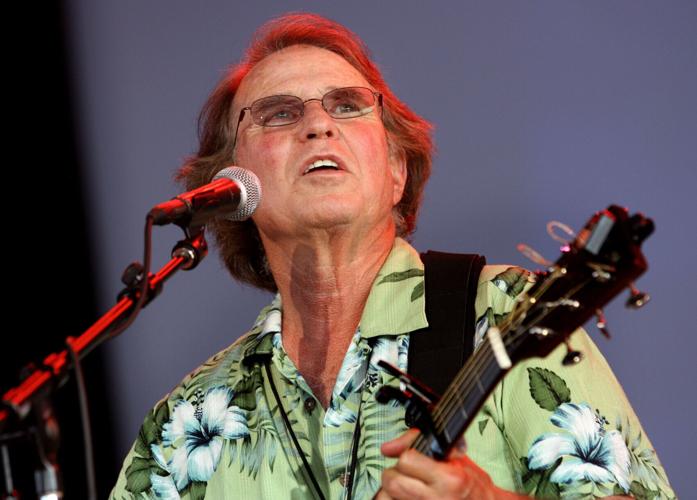
Country singer Joe McDonald plays during the Heroes of Woodstock concert at Bethel Woods Center for the Arts in Bethel, N.Y., Saturday, Aug. 15, 2009, marking the 40th anniversary of the original 1969 Woodstock concert.
In the deadpan style of McDonald's hero, Woody Guthrie, "I-Feel-Like-I'm-Fixin'-To-Die Rag" was a mock celebration of war and early, senseless death, with a chorus that concertgoers and others would learn by heart:
And its 1, 2, 3 what are we fighting for? Don't ask me I don't give a damn, Next stop is Vietnam, And its 5, 6, 7 open up the pearly gates, Well there ain't no time to wonder why, WHOOPEE we're all gonna die
At the time he wrote "I-Feel-Like-I'm-Fixin'-To-Die Rag," McDonald was co-leader of the newly formed Country Joe and the Fish and he added a special "F-I-S-H" chant before the song: "Give me an F, give me an I, give me an S, give me an H." By the time his group appeared at Woodstock in 1969, the Fish were on the verge of breaking up, the chant was a different four-letter word beginning in "F" and McDonald was performing before hundreds of thousands. Many would stand and sing along, a moment captured in the Woodstock documentary released the following year. (For the film, the song's lyrics appeared as subtitles, a bouncing ball on top).
"Some people alluded to peace and stuff (at Woodstock), but I was talking about Vietnam," McDonald told The Associated Press in 2019. He called the opening chant "an expression of our anger and frustration over the Vietnam War, which was killing us, literally killing us."

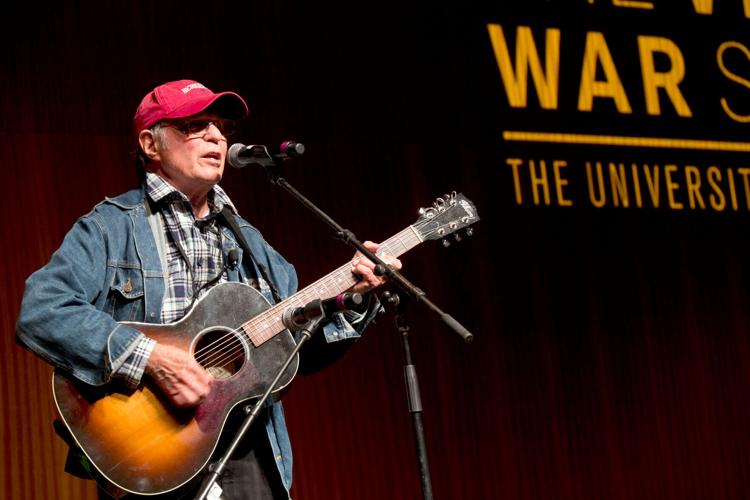
Singer-songwriter Country Joe McDonald performs at the Vietnam War Summit at the LBJ Presidential Library in Austin, Texas, April 28, 2016.
The song helped make him famous, but brought legal and professional consequences. In 1968, Ed Sullivan canceled a planned appearance by Country Joe and the Fish on his variety show when he learned of the new opening cheer. Soon after Woodstock, McDonald was arrested and fined for using the cheer at a show in Worcester, Massachusetts, an ordeal which helped hasten the band's demise.
McDonald even performed the song in court. His friendships with such political radicals as Abbie Hoffman and Jerry Rubin led to his being called in as a witness in the "Chicago Eight (or Seven)" trial against organizers of anti-war protests at the 1968 Democratic National Convention in Chicago. On the stand, he explained how he had met with Hoffman and others and told them about "I-Feel-Like-I'm-Fixin'-To-Die Rag." When he began performing it, the judge interrupted and told him, "No singing is permitted in the courtroom."
McDonald recited the words instead.
In 2001, the daughter of the late jazz musician Edward "Kid" Ory sued McDonald, alleging that his song's melody closely resembled Ory's 1920s jazz instrumental "Muskrat Blues." A U.S. district judge in California ruled in McDonald's favor, citing in part the "unreasonable" delay between the song's release and the suit being filed.
A man of the '60s
McDonald continued touring and recording for decades after Woodstock, but remained defined by the late 1960s, a time period he openly longed for in the late 1970s rocker "Bring Back the Sixties, Man." His albums included "Country," "Carry On," "Time Flies By" and "50," and he would continue writing protest songs, notably the 1975 release "Save the Whales."
Although defined by his anti-war activism, McDonald would acknowledge conflicted feelings about Vietnam. He had served in the Navy in Japan in the late 1950s and found himself identifying with both the protesters and those serving overseas. In the 1990s, he helped organize the construction of a Vietnam Veterans Memorial in Berkeley, formally unveiled in 1995.
"Many remembered the ugly confrontations that had happened during the war years in the city," McDonald later wrote of the ceremony. "Yet the atmosphere proved to be one of reconciliation, not confrontation."
McDonald was married four times, most recently to Kathy McDonald, and had five children and four grandchildren. He was involved off and on with Joplin over the second half of the 1960s, two young hippies whose careers and temperaments drove them apart. When McDonald told her he thought they should break up, she asked him to write a song, which became the ballad "Janis":
Even though I know that you and I
Could never find the kind of love we wanted
Together, alone, I find myself
Missing you and I
You and I
___
Raised on politics, and music
Country Joe McDonald did not come from the "country." He was born on Jan. 1, 1942, in Washington, D.C., and grew up in El Monte, California. He was the son of onetime Communists who named him for Josef Stalin and otherwise encouraged him to love music and identify with the working class. He was still in his teens when he began writing songs, playing trombone well enough to lead his high school marching band and teaching himself folk, country and blues songs on guitar.
After returning from the Navy in the early 1960s, he attended Los Angeles State College, but soon moved to Berkeley and became immersed in folk music and political activism. He founded an underground magazine, Rag Baby, for which "I-Feel-Like-I'm-Fixin'-To-Die Rag" was written to help promote, and helped start such local groups as the Instant Action Jug Band and the Berkeley String Quartet.
In 1965, he formed Country Joe and the Fish with fellow singer-guitarist Barry "The Fish" Melton, later adding Bruce Barthol on bass, organ player David Bennett Cohen and Gary "Chicken" Hirsh on drums. The name was suggested by magazine publisher Eugene "ED" Denson, who cited a quote from Mao Zedong that revolutionaries are "the fish who swim in the sea of the people." McDonald was dubbed "Country Joe" because Denson had heard that Stalin was known as "Country Joe" during World War II.
Like the Jefferson Airplane, the Byrds and other bands, the Fish evolved from folk to folk-rock to acid rock. "Electric Music for the Mind and Body," their debut album, was released in May 1967 and featured a minor hit, "Not So Sweet Martha Lorraine," along with numerous long jams. A month after the album came out, they appeared at the Monterey Pop Festival, the first major rock gathering and a highlight of the so-called Summer of Love.
"I think the 'Summer of Love' thing was manufactured by the media or something, because I don't remember us thinking, 'Wow, this is the "Summer of Love,' " he told aquariandrunkard.com in 2018. "(But) I was just thrilled to be a part of this new counterculture and new tribe because I had never really felt comfortable in the other tribes that I was a part of growing up and in the Navy. My parents were actually Jewish Communists. I never felt a part of it, but I was really thrilled and happy to be a hippie."
Photos: Notable deaths in 2026
Diane Crump

Diane Crump, who in 1969 became the first woman to ride professionally in a horse race and a year later became the first female jockey in the Kentucky Derby, died Jan. 1. She was 77.
Ahn Sung-ki

Ahn Sung-ki, one of South Korean cinema’s biggest stars whose prolific 60-year career and positive, gentle public image earned him the nickname “The Nation’s Actor,” died Jan. 5. He was 74.
Eva Schloss

Auschwitz survivor Eva Schloss, the stepsister of teenage diarist Anne Frank and a tireless educator about the horrors of the Holocaust, died Jan. 3. She was 96.
Glenn Hall

Glenn Hall, a Hockey Hall of Famer whose ironman streak of 502 starts as a goaltender remains an NHL record, died Jan. 7. He was 94.
Bob Weir

Bob Weir, the guitarist and singer who, as an essential member of the Grateful Dead, helped found the sound of the San Francisco counterculture of the 1960s and kept it alive through decades of endless tours and marathon jams, died Jan. 10. He was 78.
Scott Adams

Scott Adams, whose popular comic strip “Dilbert” captured the frustration of beleaguered, white-collar cubicle workers and satirized the ridiculousness of modern office culture until he was abruptly dropped from syndication in 2023 for racist remarks, died Jan. 13. He was 68.
Sly Dunbar

Two-time Grammy Award-winning reggae drummer Sly Dunbar, who fueled countless tracks from Bob Marley to Bob Dylan and was one-half of the influential reggae rhythm section Sly & Robbie, died Jan. 26. He was 73.
John Brodie

John Brodie, who won an MVP award and was one of the NFL's most prolific passers during a 17-year career with the San Francisco 49ers, died Jan. 23. He was 90.
Claudette Colvin

Claudette Colvin, whose 1955 arrest for refusing to give up her seat on a segregated Montgomery bus helped spark the modern civil rights movement, died Jan. 13. She was 86.
Valentino Garavani

Valentino Garavani, the jet-set Italian designer whose high-glamour gowns — often in his trademark shade of “Valentino red” — were fashion show staples for nearly half a century, died Jan. 19. He was 93.
Catherine O'Hara

Catherine O'Hara, the Emmy-winning actor known for comedic roles across the decades — from Kevin's beleaguered mom in “Home Alone” to the iconic Moira Rose in “Schitt's Creek” — died Jan. 30. She was 71.
Demond Wilson

Demond Wilson, who found fame in the 1970s playing Lamont on “Sanford and Son” and went on to become a minister, died Jan. 30. He was 79.
LaMonte McLemore

Singer LaMonte McLemore, a founding member of vocal group The 5th Dimension, whose smooth pop and soul sounds with a touch of psychedelia brought them big hits in the 1960s and ’70s, died Feb. 3. He was 90.
Sonny Jurgensen

Sonny Jurgensen, the Hall of Fame quarterback whose strong arm, keen wit and affable personality made him one of the most beloved figures in Washington football history, died Feb. 6. He was 91.
James Van Der Beek

James Van Der Beek, a heartthrob who starred in coming-of-age dramas at the dawn of the new millennium, shooting to fame playing the titular character in “Dawson’s Creek” and in later years mocking his own hunky persona, died Feb. 11. He was 48. Van Der Beek revealed in 2024 that he was being treated for colorectal cancer.
Robert Duval

Robert Duvall, the Academy Award-winning actor known for his roles in Hollywood classics such as "The Godfather" and "Apocalypse Now," died Feb. 15. He was 95.
Frederick Wiseman

Frederick Wiseman, the celebrated director of “Titicut Follies” and dozens of other documentaries whose in-depth, unadorned movies comprised a unique and revelatory history of American institutions, died Feb. 16. He was 96.
Jesse Jackson

The Rev. Jesse L. Jackson, a protege of the Rev. Martin Luther King Jr. and two-time presidential candidate who led the Civil Rights Movement for decades after the revered leader's assassination, died Feb. 17. He was 84.
Eric Dane

Eric Dane, the celebrated actor best known for his roles on “Grey’s Anatomy” and “Euphoria” and who later in life became an advocate for ALS awareness, died Feb. 19. He was 53.
Robert Carradine

Robert Carradine, the youngest of his prolific Hollywood family and whose biggest hit was the 1984 comedy “Revenge of the Nerds,” died Feb. 23. He was 71.
Neil Sedaka

Neil Sedaka, the hit-making singer-songwriter whose boyish soprano and bright melodies made him a top act in the early years of rock ‘n' roll and led to a second run of success in the 1970s, died Feb. 27. He was 86.
Alexander Butterfield

Alexander Butterfield, the White House aide who inadvertently hastened Richard Nixon’s resignation over the Watergate scandal when he revealed that the president had bugged the Oval Office and Cabinet Room and routinely recorded his conversations, died March 9. He was 99.
'Country' Joe McDonald

“Country” Joe McDonald, a hippie rock star of the 1960s whose “I-Feel-Like-I’m-Fixin’-To-Die Rag” was a four-lettered rebuke to the Vietnam War that became an anthem for protesters and a highlight of the Woodstock music festival, died March 8. He was 84.
Tommy DeCarlo

Tommy DeCarlo (right), who became the lead singer of classic rockers Boston for nearly 20 years based on a Myspace tribute to the band's original singer, died March 9. He was 60. DeCarlo's children said had been struggling for months with brain cancer.
Obit Chuck Norris

Chuck Norris appears Dec. 2, 2010, at a ceremony in Garland, Texas. the martial arts grandmaster and action star whose roles in “Walker, Texas Ranger” and other television shows and movies made him an iconic tough guy — sparking internet parodies and adoration from presidents — died March 19 at age 86.
Robert Mueller Obit

Special counsel Robert S. Mueller III testifies July 24, 2019, on Capitol Hill in Washington before the House Judiciary Committee. The FBI director who transformed the nation’s premier law enforcement agency into a terrorism-fighting force after the Sept. 11, 2001, attacks and later became special counsel in charge of investigating ties between Russia and Donald Trump’s presidential campaign, died March 20 at age 81. “Robert Mueller just died. Good, I’m glad he’s dead,” Trump posted on social media, adding, “He can no longer hurt innocent people!”