

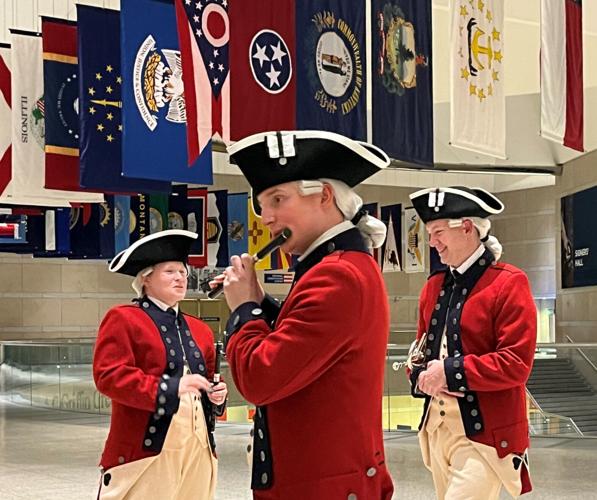

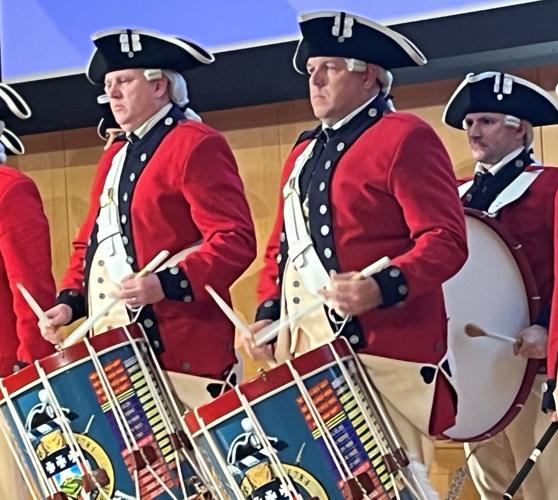

Yankee Doodle was an idiot, a hayseed, a yokel, a hick and a doofus.
When he came riding on his pony, sticking a feather in his cap and calling it macaroni, he was the 18th century equivalent of Steve Martin in "The Jerk."
So how did this English song, written for the British to make fun of clodhopping "yankees," become the defining song of the American side of the Revolution?
"By the time of the Revolution, it's kind of like we're going to turn 'Yankee Doodle' on its head and embrace it," said Kate Egner, Revolutionary War historian and senior manager of digital content for the American Battlefield Trust in Washington.
Repurposed
Like much of the music that served as the soundtrack for the American Revolution, the tune of "Yankee Doodle" was repurposed.
People are also reading…
People gave old songs new meanings or reused old tunes for new songs; the more familiar, the better.
They might sing "The Liberty Song," written by Pennsylvania congressman John Dickinson, to the tune of the British naval song "Heart of Oak."
Or they might sing "Free America," written by Joseph Warren, to the tune "The British Grenadiers."
Or they might sing "Adams and Liberty," a repurposed version of the British drinking song "To Anacreon in Heaven." In 1814, this repurposed tune was again repurposed — Francis Scott Key renamed it "The Star Spangled Banner."
"They would take a common song and put new lyrics to it," said music professor Edmund Cionek, who teaches at New York University.
Before radio, before television, before sound recording — and before copyright infringement lawsuits — repurposing music was commonplace. It's how songs got around.
Most people didn't read or write music. If you wanted your new song to catch on, you had to write it to a tune people already knew. So, you'd write new lyrics and publish them in the paper with a footnote saying, "sing to the tune of ________."
One of the most popular plays of the time, a proto-musical called "The Beggar's Opera," consisted of nothing but familiar songs with new lyrics. George Washington and Thomas Jefferson attended a performance in Williamsburg in 1770. It was later repurposed as "The Threepenny Opera."
"In a lot of popular music, the tune is older than the lyrics," Egner said.
Reclaimed
The tune was traced back as far as 15th century Holland. It started to be heard in the Colonies, apparently, during the French and Indian War, 1754 to 1763.
The British sang it to make fun of Americans. "It's saying these people are country bumpkins," Cionek said.
"Yankee" is thought to derive from the Dutch "Janke" ("Little John"): a condescending term for Americans from Dutch Colonial times. "Doodle" was from the low-German "dödel": "fool."
His transport is preposterous. "He's riding on a pony, he didn't have the money for a real horse," Cionek said.
Then there's the feather in his cap. "He thinks he's stylish," Cionek said.
At the time, "macaroni" was slang for a dandy, a fop. A guy who wears too much cologne, and a wig and clothes that are too fancy.
"The point is, Look at these colonial Americans trying to be cooler than they really know how to be," Egner said. "That we're actually a bunch of backwoods, unsophisticated people."
One story has it that British fifers and drummers, on their way to Lexington in April 1775, taunted the colonists by playing "Yankee Doodle." Then, during the British retreat to Boston, the colonists counterattacked, sniping at them from behind trees and rocks — and singing "Yankee Doodle" back at them, mockingly, as they scattered.
Americans soon reclaimed "Yankee Doodle" as their marching song.
It got new lyrics, too. Some versions dropped the pony and the macaroni, and substituted a seemlier story: "Father and I went down to camp, Along with Captain Gooding, And there we saw the men and boys, As thick as hasty pudding."
Staying power
Why did this song weather the test of time?
The Revolutionary War produced lots of other songs. "Chester," a patriotic anthem by William Billings, was a big hit. So was "The Liberty Tree," a catchier melody with lyrics by Thomas Paine that the Disney studios tried (and failed) to repopularize in the 1957 film "Johnny Tremain."
"Yankee Doodle" survived, indelibly linked with the war in people's minds. People still play it, whistle it, parody it. They quote it in other songs — most memorably, in George M. Cohan's "Yankee Doodle Dandy." In 1978, it became the state song of Connecticut.
The most trite explanation is the most likely: It's catchy.
"It's an easy song, and everyone knew it," Cionek said. "People value melody, whether it's in a video game or a movie score or whatever. And 'Yankee Doodle' is definitely an earworm."


