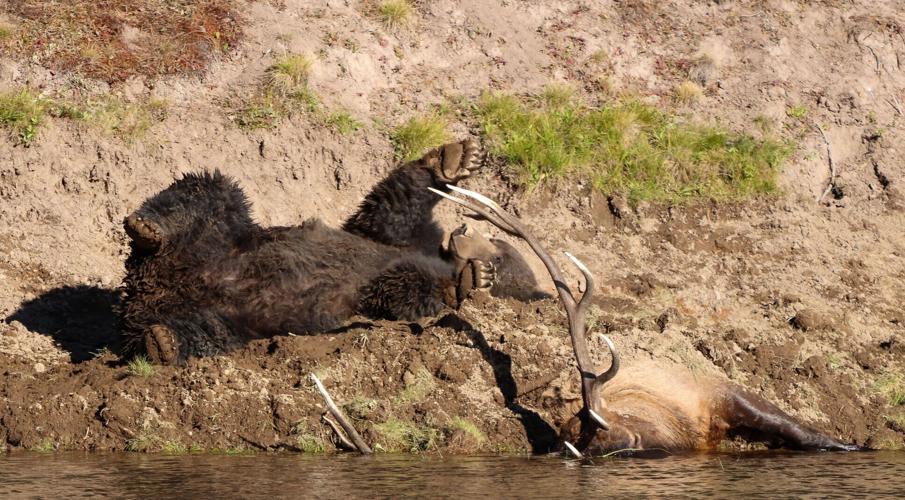
A grizzly bear lolls on its back, its front paws held aloft as if examining his claws, while reclining atop the dirt it has thrown over a partially submerged bull elk carcass.
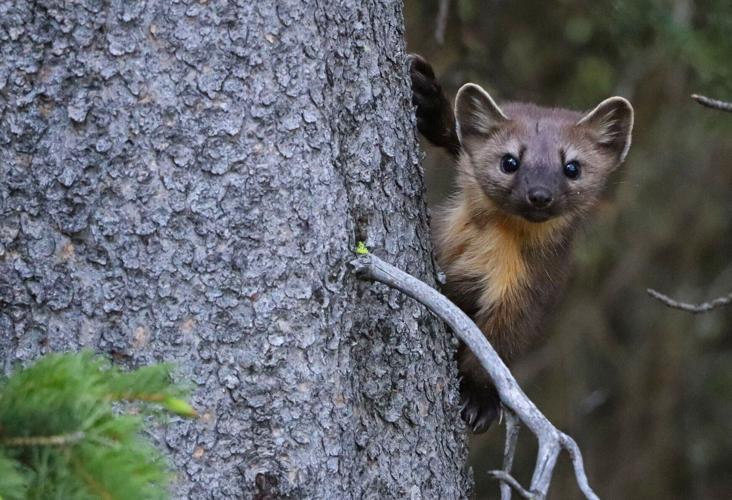
A pine marten peaks curiously around a tree, its brown-eyed gaze piercing.
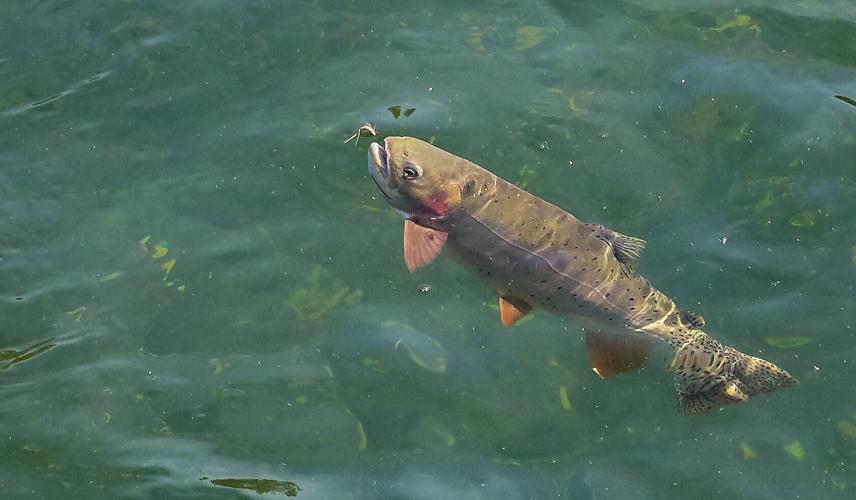
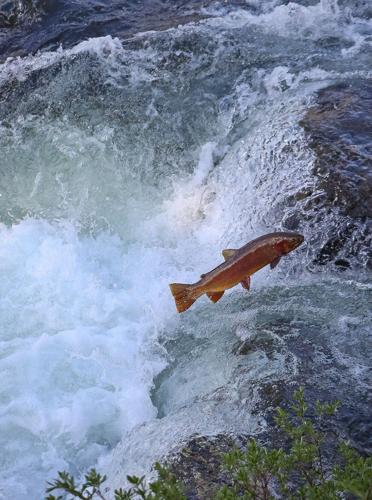
A Yellowstone cutthroat trout leaps to clear a rapid as it swims upstream to spawn.

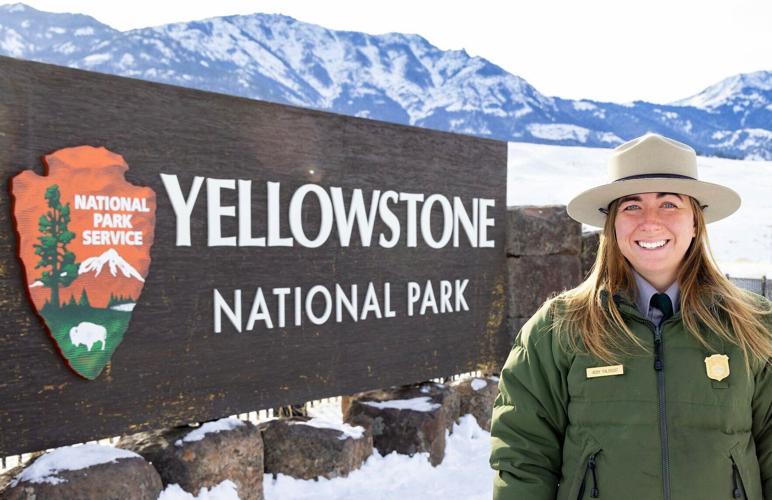
Addy Falgoust works as an interpretive ranger at Fishing Bridge in Yellowstone National Park.
Any one of these photos would be a once-in-a-lifetime shot for most people, but for Addy Falgoust it’s just another day at her office in Yellowstone National Park.
“I feel so fortunate to be working in interpretation in this park,” she said in a phone interview.
Year-round Falgoust is ensconced in the park’s interior at Yellowstone Lake and Fishing Bridge, where she has worked as an interpretive ranger for four years. It’s a long way physically and culturally from Louisiana, where she grew up, and southern Mississippi where she attended college. Yet her photos demonstrate a woman at ease in one of the wildest mountain regions in the Lower 48 states.
People are also reading…

A male grizzly bear relaxes in the afternoon atop the bull elk it killed and then partially buried on the bank of the Yellowstone River.
Bear jamming
It was after helping to police a traffic jam in 2020 that Falgoust took the photo of the grizzly bear. The location was the Hayden Valley along the Yellowstone River. The bear, a 9-year-old male weighing an estimated 600 pounds, had charged into the river after an injured bull elk and brought it down.
Once the elk was dead, the grizzly floated the carcass to the shore, about 100 yards directly across from one of the main roads in the park, in full view of slack-jawed tourists driving past.
“I spent a lot of time there managing the jam,” Falgoust recalled. “It took at least eight days for the carcass to be consumed.”
The food source also attracted other bears, wolves and ravens. To defend his food source, the bear would rebury the carcass after feeding and lay atop the mound, napping away much of the day.
To protect the bear, Park Service personnel established a no-go zone directly across from the river marked off with cones. It was also a way to protect visitors, Falgoust said.
“We didn’t want another bear coming up behind the crowd,” she said.

A marten peers around the side of a tree in June 2020.
Overlooked species
Although large animals like bears, elk and bison are some of the biggest attractions for visitors to Yellowstone, Falgoust finds some of the smaller species just as interesting.
While hiking on Storm Point one afternoon, she saw one of her favorite animals, a marten. She and a coworker excitedly pointed it out to other hikers coming up the trail who seemed confused by their enthusiasm. At first they suspected Falgoust had spotted a bear.
“Then we showed the marten to them and they were like, ‘Oh,’ and were kind of confused and kept going,” Falgoust said.
Martens tend to be more visible in the winter, she said. Although often shy, she occasionally finds one that is curious and will pause long enough for her to snap some photos.

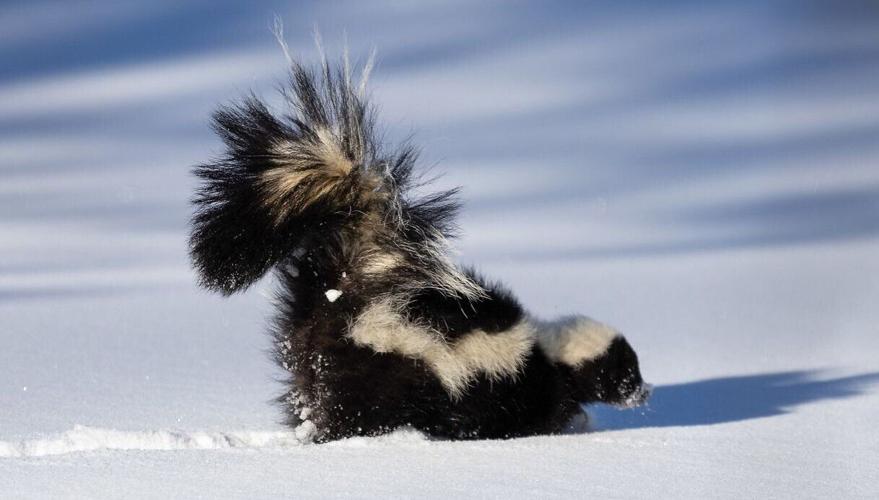
Striped skunks are a rare sight in the park.
Another small mammal that caught her attention was a striped skunk that crossed the road in front of her while she was snowmobiling near LeHardys Rapids last March.
“It’s a pretty common animal in a lot of places, but not so common here, so that made it special,” she said.
LeHardys Rapids on the Yellowstone River is also where she captured a photo of a Yellowstone cutthroat trout attempting to leap over a rapid as it migrated upstream to spawn. It’s the type of image more commonly associated with salmon or steelhead then a trout, yet another testament to the uniqueness of Yellowstone National Park.

A Yellowstone cutthroat trout rises to the river surface to feed on insects hatching near Fishing Bridge in July 2022.
Gear and tactics
Falgoust uses a Canon camera with a 600mm lens for much of her wildlife photography. She’s also a stickler for following park rules, since she wants to set a good example for visitors. That means staying a minimum of 25 yards away from most animals and 100 yards or more away from wolves, grizzly and black bears.
“Although a lot of people get excited about wildlife photography, it’s really important to remember that we don’t want to disturb these animals or encroach in their space,” she said.
After all, Yellowstone is not a zoo where animals are secured behind cages. These are wild, free-roaming creatures that deserve respect, Falgoust said. So don’t try to pet the bison.
“I also think the shots are a little bit more meaningful when the animal is in its natural habitat doing its own thing, and you’re just a bystander, not changing its behavior,” she added.
Using pullouts for parking vehicles rather than stopping in the middle or along the side of the park’s narrow roads is also important to avoid causing traffic jams or accidents.
“A lot of my photos have occurred opportunistically,” Falgoust said. “A lot of it is luck and being in the right place at the right time. But one way you can increase the chances that you are in the right place at the right time is by putting yourself out there. So spending time in the field and routinely going to the same spots.”

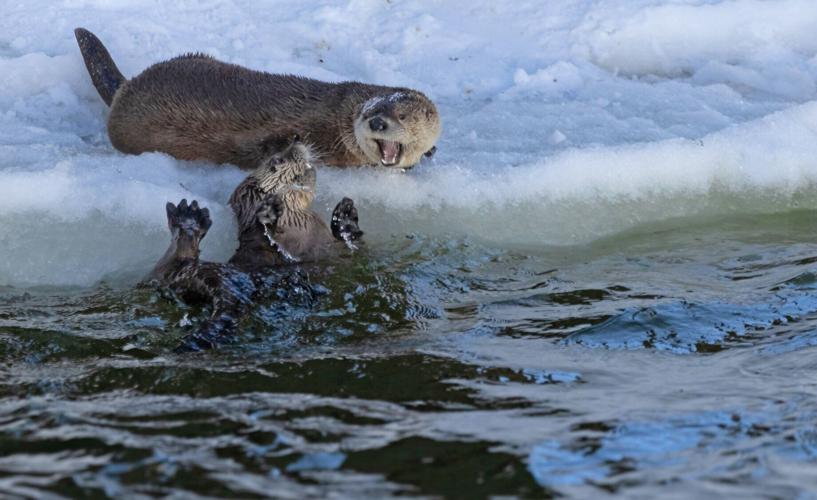
River otters play on the ice near the Brink of the Upper Falls in March 2023.
Scenery locales
Although Yellowstone attracts many wildlife photographers, it’s also a scenic wonderland. One of Falgoust’s favorite spots for such photos is Gull Point Drive. The two-mile spur road is between West Thumb and Lake Village along the shore of Yellowstone Lake.
“There’s a nice sandbar that goes out into the middle of the lake and you have a beautiful view of Stevenson Island and the Absaroka Mountains,” she said. “It can change throughout the seasons as well. Not a lot of people tend to go out there. It is facing east, but in the evenings you can often get a nice alpenglow during sunset.”
She also said the Fishing Bridge area is often overlooked by wildlife watchers.
“There’s a lot of good waterfowl you can photograph from the bridge,” she said, including eared grebes with their long, golden feathers fanning out behind their eyes. “Trumpeter swans are frequent and common there in the winter.”

A cutthroat trout jumps up LeHardys Rapids in June 2022.
“I’ve also actually gotten some photos of cutthroat trout coming up to catch some insects as well. And I think I’ve seen wolves, bears and otters from Fishing Bridge.”
While in college, Falgoust’s senior thesis focused on “Young People’s Perceptions of Nature and Interactions with National Parks." She sees the posting of photos and videos on social media, like hers, as one way to engage young people with parks, as well as those who may never get to visit places like Yellowstone.
In addition to its Facebook page, Yellowstone also has Flickr, Instagram and X social media accounts where Falgoust’s photos and videos can be found. It’s also where two of Falgoust’s favorite photographers, coworkers Jim Peaco and Jacob Frank, often post their photos.
22 animals to look for in Yellowstone (and your odds of spotting them)
Northwestern gray wolf

Likelihood of seeing: Low
Wolves were reintroduced into Yellowstone in 1995 using Northwestern gray wolves from Canada. Previously, Northern Rocky Mountain wolves were native to the park, but were killed off by the mid-20th Century. A debate over which wolf subspecies to use for reintroduction arose, with the larger Northwestern wolves being chosen over the Great Plains wolf native to Eastern Canada and Northern Minnesota and Wisconsin. Surveyed numbers tally about 100 wolves from 11 packs in the park, though numbers fluctuate from year to year.
American bison

Likelihood of seeing: Very high
Bison are among the most common large mammals in the park. Though they look docile, they have been known to gore people on occasion, so keep a safe distance.
Grizzly bear

Likelihood of seeing: Moderate
There are as many as 840 grizzly bears in the Greater Yellowstone Ecosystem and about 150 living within the park, according to recent numbers from the National Park Service. They are most commonly seen on Mount Washburn, in the Hayden and Lamar valleys and near the park's east entrance. Grizzly bears, especially sows, can be dangerous, and park regulations require that you stay a football field's length from bears when on foot.
Black bear

Likelihood of seeing: Moderate
Black bears are far more common in the park than grizzlies, and are spotted frequently in the Mammoth and Tower areas. Though smaller and less aggressive than grizzly bears, black bears can still be dangerous. The bears found in Yellowstone are generally of the cinnamon bear subspecies (Ursus americanus cinnamomum), and many have rusty brown or reddish fur.
Bighorn sheep

Likelihood of seeing: Moderate
Bighorn sheep numbers are surprisingly low in Yellowstone, with most sightings occurring in the northern part of the park. They can be found along the Gardner River and in northern mountain passes.
Bobcat

Likelihood of seeing: Low
Bobcats are widespread throughout the park, but due to their habits are not frequently seen by visitors. They are most often spotted near rivers and in rocky areas.
Canada lynx

Likelihood of seeing: Low
Like its close relative the bobcat, the Canada lynx tends to live a solitary life. Numbers in Yellowstone are low and depend upon migrations from habitats to the north of the park. They tend to stay at high elevations in conifer forests. Lynx are distinguishable from bobcats by their longer ear tufts, black tails and larger paws.
Coyote

Likelihood of seeing: Moderate
Coyotes are found throughout the park, particularly in open areas where they can forage or find small mammals to prey on. They may also be seen near roads, where then can find roadkill. They are significantly smaller than wolves.
Shiras Moose

Likelihood of seeing: Moderate
Recent surveys have put the number of moose in Yellowstone around 200. They are most often spotted in areas with water, such as rivers, lakes and marshes. Though they aren't abundant, they are large and easy to spot.
Mountain lion

Likelihood of seeing: Very low
Mountain lions, also called cougars, exist in very small numbers in Yellowstone. They are almost exclusively found in the northern portion of the park, and tend to stay in rocky areas or other places that provide adequate cover for stalking prey. They can be extremely dangerous if encountered.
Red fox

Likelihood of seeing: Low
Foxes often struggle to compete with coyotes, who seek the same food sources and are much larger. As a result, they tend to keep to wooded areas. They will seek food from various sources, including visitors' food. Foxes are more active at night but can be spotted in the daytime during the winter months.
North American beaver

Likelihood of seeing: Moderate
Beavers play an important role in the Yellowstone ecosystem, creating natural dams that divert streams and allow water to pool. Beavers are native to Yellowstone, with more than 100 colonies present in the park. They are most easily spotted along river tributaries, particularly in the Mammoth area Beaver Ponds, Harlequin Lake, Bechler River and Slough Creek areas.
Snowshoe hare

Likelihood of seeing: Moderate
Snowshoe hares are common in the park, and have seasonal coats of fur, becoming white in the winter. They are frequently found in forested areas, where they can take shelter under low limbs and fallen branches. They can be found most easily in the Norris Geyser Basin.
White-tailed jackrabbit

Likelihood of seeing: Moderate
White-tailed jackrabbits are common at lower elevations in the park. They are larger than cottontails, with proportionally larger ears and feet. Jackrabbits tend to stay in grasslands, where they feed on grass and shrubs. They are most common in the northern plateau areas of the park.
Jackalope

Likelihood of seeing: Extremely low
The mythical jackalope is perhaps the rarest animal in Yellowstone.
North American porcupine

Likelihood of seeing: Moderate
Porcupines can be spotted in many areas of the park. They prefer forests, where they feed on twigs, berries, bark and needles. Porcupines often climb trees to feed, so they may be found above the ground.
Golden eagle

Likelihood of seeing: Low
Though golden eagles are known to nest in the park, there are very few documented sightings in recent years. Golden eagles are larger than bald eagles, and prey on rodents, rabbits and hares.
Great horned owl

Likelihood of seeing: Moderate
Great horned owls are surprisingly common in Yellowstone. The owls can grow to be more than two feet tall and may have a wingspan of up to five feet. Despite their large size, they can sometimes be easy to miss, as they are often well-camouflaged and can sit very still. Look for great horned owls in forest areas.
Trumpeter swan

Likelihood of seeing: Moderate (higher in winter)
Trumpeter swans are found near the West Entrance at Seven Mile Bridge, and on Swan Lake, south of Mammoth Hot Springs. They can also be found on portions of the Yellowstone and Madison rivers. They are more common in the winter, during their migration from Canada.
Sandhill Crane

Likelihood of seeing: Moderate
Sandhill cranes are common in wetlands and marshy areas in the park. They are more commonly seen in the warmer months, as most migrate south for the winter. Sandhill cranes are most frequently seen in the Fountain Flats and Bechler areas of the park.