

How many fathers have built a machine whose sole purpose is sending paralyzing electrical current through the arms of small children?
Of those, how many have also kept a menacing hypnotist's wheel around the house? It's a short list.
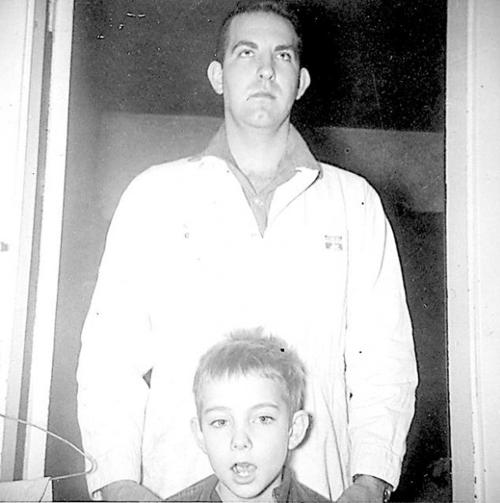
That list includes my father, Darrell C. Durham, who will turn 82 on Halloween.
Although he had only a high school education and a few semesters of night school at Kansas City Junior College, as it was known then, Dad was a brilliant man. He was a talented tinkerer, blessed with a curious and adventuresome mind. He could fix any machine that broke, and, with his crazed assistant Carter Logan at his side, he could build any device he could conceive.
The Shocking Machine was such a device. It comprised a squat, brass cylinder with a hand crank on one end and wires leading to two lengths of copper tubing on the other. It worked on the basic scientific principle that a magnet turning in coil of wire will generate an electric current. Turning the crank generated voltage that ranged from tingling to muscle-freezing, depending on how fast the holder cranked.
People are also reading…
While it was the science that fascinated Dad, he was also intrigued by the opportunity to semi-electrocute hapless test subjects.
His trick was to start with a light, ticklish current to lure the uneasy individual holding the copper into a false sense of security. This led the subject to grip the tubes a bit more, at which time Dad would begin turning the crank furiously, locking the victim's grip. Pleas for mercy were usually pointless, but he knew to stop when the holder began to twitch or lose control of a bodily function.
It was the essence of simplicity, as classic torture devices generally are.
Simple curiosity might explain why we went along with it the first time. However, not even the lure of the unknown can account for the fact that my four sisters and I shocked each other and our friends over and over once Dad tired of the weapon.
As for the bigger question — why anyone would invent such a device in the first place — there is no explaining evil genius.
I suspect I could find the Shocking Machine in Dad's basement among his tube testers, stud-finders, voltmeters and miniature metric socket sets. However, I think it's best to let it remain buried there.
I am not as sure about the fate of the Hypnotic Wheel. This was a thin plywood disk about 3 or 4 feet in diameter. The disk was painted white. A thick black line curled around the white disk, spiraling in from the edge until it curled to a dot in the center. The wheel spun on a silent, electric quarter-horsepower motor, drawing the subject's eyes to the center.
Dad built the Hypnotic Wheel around the same time he created the Shocking Machine. With the mesmerizing wheel at his command, he succeeded in hypnotizing people, including my Aunt Myrna and her brother, John; his boyhood friend Sam; and my Uncle Ben. They all lost themselves in the spiraling disk as Dad murmured, "Are you feeling sleepy? You are feeling sleepy. You are falling into deep, deep sleep. Deeper. Deeper."
Like the mad scientist that he was, he even turned his hypnotic powers on his assistant Logan. Once they were under his hex, Dad would program his subjects to do harmless stunts on command when they awoke — cluck like a chicken, stand on one leg, recite a nursery rhyme, stuff like that.
Dad tried to put a spell on me, too, but my chaotic 10-year-old mind wouldn't let me focus. He gave up, telling me that hypnosis was ineffective on both the very strong-minded and the very weak-minded. I knew this was not a compliment.
Luckily for all of us, we moved to rural Missouri about that time, and Dad was jolted out of this weird stage in his life. It was excavating the clogged septic tank at our new home that did it. In any event, the devices of torment and stupor were put away. Dad concentrated on more civilized activities, like helping make ammunition for the Vietnam War at the nearby Army ordnance plant.
My dad is not aware he has a birthday coming up this week. He is six years or so into Alzheimer's disease, and his electro-mechanical mind has become an abandoned shop of strangled springs, out-of-mesh gears and disconnected wires. The great mind that created the Shocking Machine and the Hypnotic Wheel now confuses the TV remote with the TV listings in the newspaper as the device that changes channels.
Dad has gone on and off a series of drugs that have made him alternately dopey, content, dizzy, sleepy, angry, gentle, paranoid and chatty. But none works for long, and none, of course, is a cure. Scientists haven't invented that pill yet.
I knew a mad scientist once who could build anything he could conceive. As Halloween approaches, I find myself wishing he was here . . . and wondering if he could succeed where these scientists have not.
