
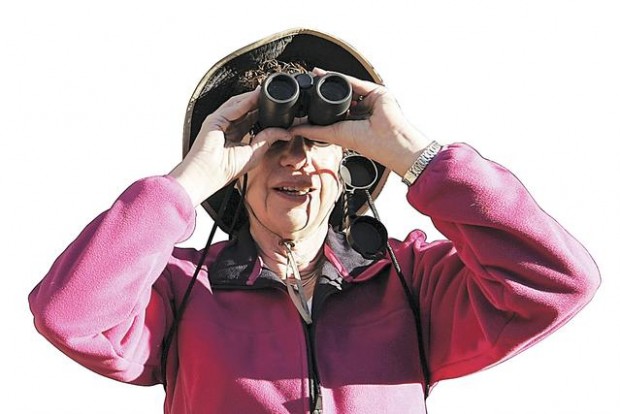
The biggest benefit of bird-watching is — no surprise — seeing lots of beautiful birds and learning all about them. • Ah, but the practice of spying on winged wildlife can also bring a secondary perk: a good physical workout. • One example: "The loop trail in Madera Canyon (south of Tucson) that goes to Bog and Kent springs is a great combination of a workout and birding," says Kendall Kroesen, an avid bird-watcher who serves as restoration program manager for the Tucson Audubon Society. "The birding is best by the springs — and the stretches between the springs really stretch the legs."
Sara Pike, manager of the Audubon Society's Nature Shop in Tucson, notes that bird-watching outings can range from casual walks involving only mild exercise to more vigorous treks.
"While birding itself is not always an aerobic activity, you can definitely expend some energy while hiking to and from a particular birding location," Pike says. "Honeybee Canyon, the loop trails at Catalina State Park and the loop trail in the Ramsey Canyon Nature Preserve (near Sierra Vista) are all good walks for birders who need a little exercise."
People are also reading…
We asked several Tucson-area bird-watchers to share their thoughts on birding's exercise benefits and suggest some sites where you might get your heart rate up even if you don't spot a prized species.
Susan Birky
Birky says she and her husband, Bill, seek out spots where they can find both good bird-watching and invigorating hiking.
"I am an avid birder and hiker, he is a birder and avid hiker," she says. "We try to pick a trail that will satisfy the length of hike he wants and the number of birds I want to see."
Among Birky's favorite sites for getting serious exercise while bird-watching:
● "The Finger Rock Trail (in the Catalina Mountains north of Tucson) is a great trail for a real workout and good birds," she says. The five-mile trail gains about 4,000 vertical feet on its way to the summit of 7,255-foot Mount Kimball.
● Trails in the Santa Rita Mountains — such as the steep, 5.4-mile Old Baldy Trail to the 9,453-foot summit of Mount Wrightson — are "amazing for the mileage and the species that are possible to see," Birky says. Species in the area range from white-throated swifts and red-tailed hawks to Arizona woodpeckers.
Mark Stevenson
"When I moved to Tucson, I was a hiker but not a birder," says Stevenson, who edited an updated edition of a guide called "Finding Birds in Southeast Arizona."
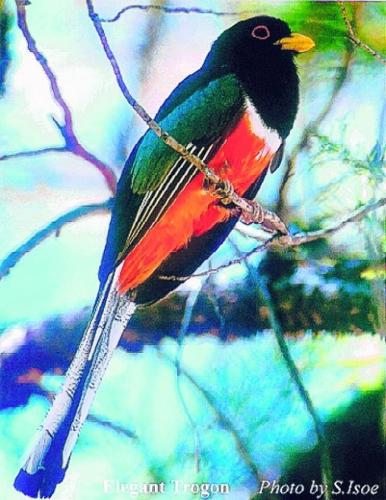
"Within a few years of seeing things like the painted redstart and elegant trogon on hikes in Madera Canyon, I was hooked on birding" as well as hiking, Stevenson says.
Here are some of his suggested sites for getting a workout while spotting colorful bird life:
● "Sycamore Canyon in the Pajarito Mountains (west of Nogales) has been called 'one of the most interesting and most difficult birding areas in Southeastern Arizona' because of the abundant bird life and rugged terrain," Stevenson says. "Many rare and wonderful birds have been found there over the years — from nesting elegant trogons to the fan-tailed warbler."
● "In the warm months, I like the Marshall Gulch-Aspen Trail loop" covering 3.7 miles in the Catalina Mountains, Stevenson says. The area is home to a "variety of birds — including hairy woodpecker, Cordilleran flycatcher, mountain chickadee, red-breasted nuthatch, olive warbler, Grace's warbler, red-faced warbler and painted redstart."
Lawrence Liese
Liese, who has served as an organizer for the annual Tucson Valley Christmas Bird Count, says many group bird-watching trips proceed at a slow pace with lots of stops — resulting in little in the way of serious exercise.
"In contrast, some of the solo birding that people do might entail heading down long canyons, some without trails so it's all bushwhacking," Liese says.
He adds that the Christmas bird counts, in which participants count as many birds as possible in a 15-mile-diameter circle, can include some full-workout excursions. "Adventurous birders sometimes hike far up into canyons within the circle to get bird species that won't be found elsewhere," he says.
Among sites mentioned by Liese as places where birders can get a workout:
● A loop route in Madera Canyon — including the Old Baldy, Agua Caliente and Vault Mine trails. "Many people hiked around that loop when an eared quetzal showed up this year," Liese says.
● Aravaipa Canyon, near Mammoth north of Tucson, "involves slogging up the middle of the creek at times. People usually hike about five miles round-trip there."
Kendall Kroesen
Kroesen's recommendations for good birding workouts include a hike up Miller Canyon in the Huachuca Mountains near Sierra Vista.
The hike "is one of the most beautiful I know of," Kroesen says, "and you pass through changing plant communities as you go up, increasing the diversity of birds. The farther you go, the more exercise you get and the more birds you can see."
Did you know
The Tucson Audubon Society Nature Shop, 300 E. University Blvd., is a good source of bird-watching supplies and information. 629-0510.