

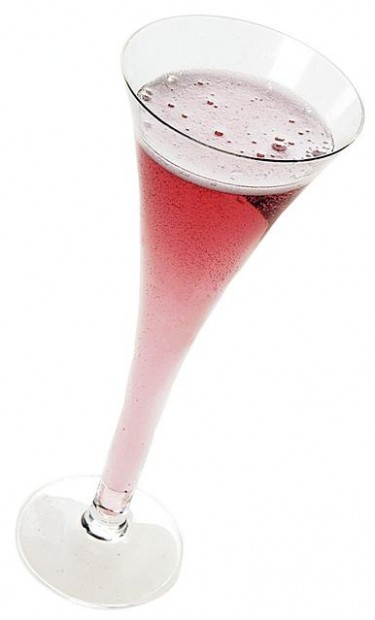
Champagne producers make it sound so complicated.
They call the process "méthode champenoise." They use temperature-controlled underground caves to stow the goods. They give the finished products fancy-schmancy names.
Why spend $50 on one of these bottles — or take a French course to pronounce them?
Just whip up some sparkling wine of your own.
"Sparkling wine" is simply the name for wine that's carbonated. While champagne is sparkling wine made in that particular French region, prosecco is the Italian version and cava the Spanish version.
But homemade sparkling wines are easy to make because they're created with an age-old, basic principle: Start with a white wine, add yeast and sugar, then cork it back up so the carbon dioxide builds up so much, the bubbles get forced back into the wine.
People are also reading…
We asked wine and spirits guru Lynn Hoffman — author of the new book, "The New Short Course in Wine" (Prentice Hall, $16.80) — to show us the process from beginning to end.
With a little planning, a few packets of yeast and a few bottles, you can produce a whole batch of summer's perfect drink in no time.
"We're not making champagne here; what we're making is an absolutely simple sparkling wine," said Hoffman. "It's perfect for summer, and it's so easy it's ridiculous.
"People might ask, why not just go get a carbonating machine? It doesn't taste the same. Making it yourself gives it such a rich flavor. The yeast is crucial to carbonation."
Here is Hoffman's step-by-step method for making a batch of sparkling wine.
● Step 1. Get your supplies together. You will need a bottle of pinot grigio or other acidic white wine, a sanitized champagne bottle or two beer bottles, a packet of home-brew-grade yeast, a pinch of powdered citric acid (or the juice of 1 lemon) and 1 teaspoon of home-brew-grade dextrose sugar (or plain ol' granulated sugar).
Step 2. Get sour. The idea here is to make the wine a little more acidic by bringing it to about 1 percent total acidity before mixing in the sugar and yeast. Acidity gives bubbly wine a crisper, more flavorful texture. Open the bottle of wine, and measure out 25 ounces into a glass pitcher. Add the citric acid or juice of 1 lemon and stir well.
Step 3. Science time. It is time to add sugar and yeast, both of which are necessary to produce carbon dioxide, or carbonation. But it is crucial to be exact when adding the sugar to the wine. Too much sugar can produce too much carbonation — which can lead to exploding bottles.
For every 25 ounces of wine, only 1 teaspoon of sugar should be added.
Once the sugar has been added, generously sprinkle about 1/4 teaspoon of the yeast into the wine. Mix the wine well with a large spoon to combine the yeast and sugar. The carbonation process has already begun.
Step 4. Bottle it up. It is important to properly bottle the mixture. Simply pouring it into a wine bottle and sticking a cork in it isn't going to work.
Hoffman suggested buying "swing cap" bottles, which have a cork attached to a metal rod. The cork is inserted, and the metal rod is locked into place to seal and pressurize the contents. The bottles are available in home-brew stores and online (www.homebrewit.com, www.ebottles.com).
Pour the wine into the bottles, leaving about 2 inches at the top, or neck, of the bottle to allow sufficient pressure to build while the carbonation process takes place. Place in a cool, dry place for 1 to 2 weeks. Once it's ready to drink, chill the wine before serving.