

Think of chickpeas as cream-colored legumes that come only dried or out of a can?
Then you don’t know beans.
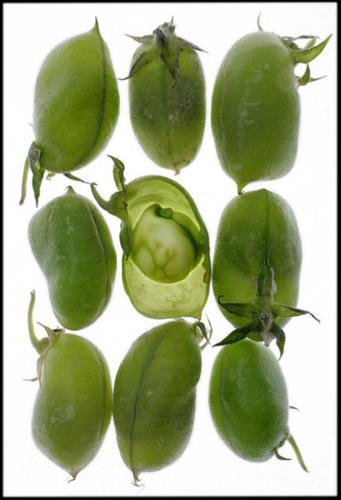
Meet one of the new kids in the produce aisles: fresh garbanzos — tiny emerald-green beans sheathed in downy, papery, pale celadon pods.
Whether called ceci in Italian, channa in India, or garbanzo in Spanish, they are one of the most consumed legumes in the world, as well as one of the oldest, dating back to ancient Egypt.
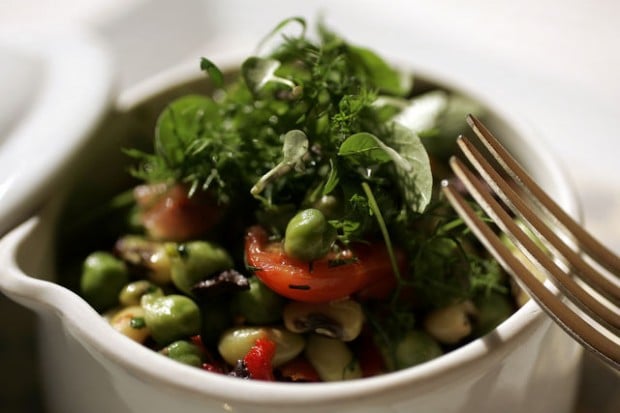
Unlike the more ubiquitous dried version, which takes hours to cook, the delicate, fresh green ones are smaller and can be eaten raw. Just peel off the pod to reveal one — or sometimes two — beans with a sweet, herbal-grassy flavor. Or steam or blanch unshelled garbanzos for just a few minutes and eat out-of-hand like edamame. Or add cooked, shelled fresh garbanzos to salads, soups, vegetable sautes, stews, or in place of canned ones in your favorite hummus recipe.
People are also reading…
With a nutty, almost fresh-picked pea flavor that heightens when cooked, fresh garbanzos have become a darling of restaurant chefs. And thanks to a California producer, they are now available pretty much year-round in a growing number of groceries.
“The difference between fresh and dried is night and day,” says Mark Sullivan, executive chef of the Village Pub in Woodside, Calif. “They’re creamier fresh. And very precious.”
Sullivan double-peels the garbanzos by removing the outer pod as well as the thin membrane that covers each bean. He admits you don’t have to go that extra step to take off the membrane, but he finds the beans just a bit sweeter without it.
At the Village Pub, he serves fresh and dried garbanzos together — to play up their contrast — as an accompaniment to pan-roasted halibut.
At Parcel 104 in Santa Clara, Executive Chef Bart Hosmer uses fresh garbanzos on the menu every summer. This year, he’s been cooking them with olive oil, black olives and garlic confit as a base for meaty porcini mushrooms.
At Manresa in Los Gatos, Executive Chef David Kinch stuffs squash blossoms with fresh garbanzos and a mixture of chopped peppers, eggplant and tomatoes, all tossed in a bright pesto. Playfully, he serves them alongside “french fries” made of chickpea flour.
In San Francisco, A16 serves up fresh garbanzos with braised lamb in white wine and parsley. At Piperade in San Francisco, fresh garbanzos and corn kernels form a bed for succulent veal cheeks. And at its nearby sister restaurant Bocadillos, diners dig into fresh garbanzos spiked with cumin and blood sausage.
“They’re kind of fun,” says Gerald Hirigoyen, executive chef of Piperade and Bocadillos. “People think these can’t be garbanzos.”
That’s the puzzled expression I get whenever I set down a big platter of them at casual dinner parties. My favorite way of preparing them is the method favored by those of Mexican heritage — pan-roasting. It’s also one of the easiest ways to cook them.
Just heat some olive oil in a saute pan on medium-high heat; add fresh, unshelled garbanzos, cover, and cook for about 5-8 minutes. Sprinkle with sea salt before serving.
The papery pods will get charred and almost potato-chip-like. The beans inside will be firm but tender. Have a stack of napkins handy and let guests peel their own pods. Pour a nice chilled bottle of New Zealand Sauvignon Blanc, whose crisp, grassy, gooseberry notes are an ideal match.
Pan-roasted fresh garbanzos make a can’t-miss pre-dinner nibble or perfect bar snack. You’ll get a kick out of watching your once-skeptical guests find they can’t stop eating them.
Fortunately, they are nutritious. A half cup has 120 calories, no cholesterol, 6 grams of protein, 2 grams of fat, and 15 percent of the recommended dietary allowance for iron.
Fresh garbanzo-lovers now can get their fix year-round, too. Sanger-based Califresh of California, one of the world’s leading producers and packers of fresh garbanzos, contracts with California farmers who grow them locally, May through October. Once the local season ends, Califresh works with farmers in Mexico to buy them through the winter.
The company, which now handles more than 750 tons of fresh garbanzos annually, began packing and shipping them to supermarkets and restaurants three years ago. Among the newest converts in Las Vegas are Spago’s, and the Top of the World restaurant at the Stratosphere.
One of Califresh’s biggest clients is Save Mart stores, which sells fresh, unshelled, garbanzos in bulk produce bins or packaged in 8-ounce bags that can be microwaved.
“We call it a baby gourmet bean,” says Morgan Murray, managing member of Califresh. “It all started in the 1980s when I was business manager for ConAgra in the dried bean industry. We noticed that Hispanics would pick the crop fresh, still on the branches, and sell it by the roadside up and down the coast. We thought a better way would be to get it into the grocery stores.”
Fresh garbanzo fanatics like myself couldn’t be more grateful that they did.
Recipes
FAVORITE-WAY, PAN-ROASTED FRESH GARBANZOS Serves 4 as an appetizer
2 cups (about) fresh garbanzo beans in the pod
2 tablespoons olive oil
Sea salt or kosher salt
Place garbanzos in colander, and give them a quick rinse under cold water. Shake off excess water.
Heat olive oil in a 10- to 12-inch non-stick saute pan over medium to medium-high heat. Add garbanzo beans in one layer.
Cover pan and allow to cook 5-8 minutes, stirring beans once halfway through cooking time. Test one by peeling off pod and eating bean. It should be tender; the papery pod should be charred looking.
Sprinkle garbanzos with sea salt. Serve warm or at room temperature, with plenty of napkins for guests to use as they peel off the pods.
Leftovers can be stored in the refrigerator, and enjoyed cold or at room temperature the next day.
MICROWAVED FRESH GARBANZOS Serves 4 as an appetizer
2 cups (about) fresh garbanzos in the pod
Sea salt or kosher salt, optional
Chili powder and fresh lime juice, optional
Place fresh garbanzos in colander and give a quick rinse under cold water. Shake off excess water.
Place garbanzos in microwavable bowl and loosely cover. Cook on high 1 minute. Test one by shelling it and eating the bean. It should be tender. If not, return garbanzos to microwave and cook on high for 25 seconds.
Once cooked, you can shell and use cooked beans in salads, soups and stews. Or serve straight from the microwave, warm, with a sprinkling of salt, a sprinkling of chili powder and lime juice, or all three.
FRESH STEWED GARBANZOS WITH CHORIZO AND CALAMARI Serves 4 as an appetizer
3 tablespoons olive oil
1/2 teaspoon garlic, chopped
1/3 cup onions, chopped
1/4 cup Spanish-style, smoked chorizo, thinly sliced
2 teaspoons fresh thyme
1-1/2 cups fresh, shelled, uncooked garbanzos 2 cups chicken stock
1/3 cup tomatoes, chopped
1/2 teaspoon espelette pepper (see Note)
Salt
12-16 fresh, cleaned calamari tubes and tentacle pieces
1-1/2 tablespoons fresh lemon juice 2 tablespoons parsley
Place olive oil, garlic and onions in a medium saute pan and cook over medium heat for 3 minutes (or until onions are soft).
Add chorizo and thyme, sauteing 3 minutes more. Add garbanzos and saute 1 minute before adding chicken stock and tomatoes.
Bring to boil. Reduce heat and let simmer, stirring occasionally, until almost all liquid is gone (about 15 minutes).
Add espelette pepper and salt to taste.
Add calamari and cook 3 minutes, making sure not to overcook (calamari should be just firm).
Mix in lemon juice and parsley. Serve hot, cold or at room temperature.
Notes: Espelette pepper (Piment d’Espelette) is a spice made from red peppers native to the tiny village of Espelette in the heart of the French Basque region. It has a rich aroma and a gently spicy, fragrant character. In Espelette, it is often used at the table in place of black pepper.
Chef Gerald Hirigoyen, who is Basque, imports the ground pepper. A 1-ounce container is $16.50 on his Web site, www.piperade.com. It is also available at the Spanish Table, www.spanishtable.com, and at Williams-Sonoma stores.
Hirigoyen says you can substitute sweet paprika or chile powder, but neither has the exact delicate complexity.
From Gerald Hirigoyen, executive chef of Piperade and Bocadillos, both in San Francisco
SEARED HALIBUT WITH SUMMER VEGETABLE FRICASSEE OF FRESH AND DRIED GARBANZO BEANS
Dried garbanzos must be soaked overnight before cooking, so be sure to plan ahead.
Serves 4
For vegetable fricassee:
1/4 cup extra virgin olive oil
6 sprigs thyme, 6 sprigs parsley, and 2 sprigs marjoram tied together in a bouquet garni
1/2 cup red onions, sliced into 1/4-inch strips
2 tablespoons garlic, thinly sliced
1 cup red bell pepper strips, €1/4-inch thick by 2 inches long
1 cup peeled, seeded and diced vine-ripened tomatoes
1 cup dry white wine
1 cup chicken stock
2 tablespoons sherry vinegar
2 teaspoons paprika
1 cup zucchini, diced 1/2-inch square by1/8-inch thick
1 cup cooked dried garbanzo beans (see Notes)
1 cup twice-peeled fresh raw garbanzos (5 cups unpeeled garbanzo beans yield 1 cup peeled, see Notes)
3 tablespoons capers, rinsed and coarsely chopped
1/2 cup pitted, halved, green olives, (Castelvetrano, picholine or lucque are best)
12 basil leaves, cut into strips
8 mint leaves, cut into strips
3 tablespoons minced fresh flat-leaf parsley, minced, divided use Zest and juice of 1 lemon
Salt and white pepper to taste
For fish:
4 portions halibut filet, approximately 5 ounces each
Vegetable oil, to coat pan
4 tablespoons butter
2 cloves garlic, smashed
6 sprigs fresh thyme
To finish: 1/2 teaspoon espelette pepper, finely ground Premium extra virgin olive oil, for drizzling
To make vegetable fricassee:
Place 12-inch saute pan over medium heat, add 1/4€ cup extra virgin olive oil, and the bouquet garni.
Stir in 1/2 cup sliced red onion, and 2 tablespoons sliced garlic. Lightly season with salt to taste and continue to do so with each successive step. Turn heat to low and let cook 15 minutes, covered.
Stir in red peppers and diced tomatoes. Add wine, and cook uncovered on medium heat for 10 minutes.
Add chicken stock, sherry vinegar and paprika.
Bring to a low simmer, cover and cook 30 minutes, or until peppers are tender.
Add zucchini, cooked dried chickpeas and fresh garbanzos, and bring to a simmer. Add capers and green olives, and simmer 3 minutes.
Turn off heat; add lemon juice and zest, basil leaves and 2 tablespoons parsley. Adjust seasoning with salt and white pepper to taste
To cook fish: Place large heavy-bottomed fry pan on medium-high heat for 90 seconds. Meanwhile, blot fish dry with a towel and season with salt and white pepper.
Coat bottom of pan with vegetable oil and place filets in pan, shaking pan as you add fish to prevent fish from sticking to pan. After 90 seconds, reduce heat to medium and continue cooking for 3 minutes.
Add cold butter to the pan, along with smashed garlic cloves, and thyme sprigs. Tilt pan slightly, about 15 degrees, and turn down heat to medium; dip a spoon into the pan to scoop butter from edge of pan to ladle over fish. Do this successively for 90 seconds or so. The butter will brown, but don’t let it burn.
Check fish for doneness with a thin metal skewer. Insert skewer into center of fish; if it is at or above body temperature it is done. If skewer is still cold or below body temperature, then continue basting until skewer registers just warm when placed in center of fish. Once fish is cooked, place on pan lined with towels.
To serve: Divide vegetable fricassee among 4 large bowls. Place fish on top of vegetables. Garnish with a sprinkling of espelette pepper and a drizzle of premium extra virgin olive oil. Accompany with sauteed escarole or other hearty greens, if you like.
Notes: Twice peeling the fresh raw garbanzos is optional. But you do want to peel off the papery outer pod no matter what. If you want to go the extra step, then also peel off the membranes from each pea, then split each pea in half.
To cook dried garbanzo beans, soak1/3 cup of them overnight (When cooked, this will yield a little more than 1 cup.)
Drain, then cover with cold water. Bring to a simmer and add a few garlic cloves, onion, garlic, bay leaf and thyme.
Let simmer on very low heat for approximately 2 hours or until beans are tender.
Let beans cool in their cooking liquid. Season cooking liquid to taste with salt and white pepper.
As beans are cooling, add a handful of fresh herbs such as fresh basil sprigs, a squeeze of fresh lemon juice and zest for additional flavor and freshness.
From Mark Sullivan, executive chef of the Village Pub in Woodside, Calif.