

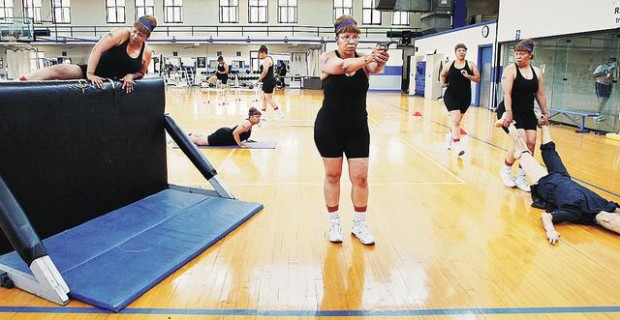
Although agility — the ability to change speed and direction quickly while maintaining control of the body — is vital to sports such as basketball, soccer and even swimming, it also plays a role in everyday life, more than you may think.
Consider the mom toting one kid on her hip while she lunges to catch another child running in front of the swing.
Or think about the waiter who has to balance a heavy tray on his hand while dodging the customer leaping up from her seat.
Then there's the shopper reaching for a product high on the shelves while moving her cart out of the aisle for the hurried shopper passing through.
All of these instances require agility — quickness of action while maintaining balance.
"It's kind of an odd concept," says Meghan Forgy, a sports performance trainer at Vetta Sports and Fitness Hampshire in St. Louis, "but most of us use it in everyday life. No matter what you do, you often have to transfer speed or direction quickly at some time."
People are also reading…
Keath Hausher, trainer and owner of Shark Fitness, a St. Louis-area boot-camp training company, agrees.
"If you think about it, the movement we do is not robotic. We don't step forward and then turn in perfectly 90-degree angles with our arms stretched forward. We move at angles with our upper body doing one thing and our lower body doing another thing. That's where functional training — agility training — comes into play."
Agility training could benefit everyone, but it's especially important for athletes, from high school superstars to weekend warriors.
And it crops up in more sports than you might think. In volleyball and tennis, agility helps you change gears when a ball doesn't go where you expected. In football, it helps you fake out a defender trying to take the ball from you.
"We incorporate agility training in our sports performance sessions," says Forgy.
An agility ladder, laid flat on the floor, is one tool that's used, with athletes going through the rungs as fast as they can.
"As soon as you lose control, you lose the efficiency of your motion, and you could fall and hurt yourself," says Forgy, "so it's about maintaining control."
One of the keys to agility is multidirectional movement, so when training his boot-camp athletes, Hausher makes sure they incorporate forward, backward, side-to-side and even vertical movements, changing directions quickly.
"We'll run quickly in reverse up a hill or do side lunges up a hill, which are great for the hip muscles. Above all else we stress form. In agility drills it's important to keep hips, knees and ankles in perfect alignment."
He says having good core strength is essential to having good agility. So, even with the cadets he trains at the U.S. Military Academy at West Point, N.Y., he starts there: "You have to start in the middle."
Even little kids practice agility in running around in a circle, then someone yells "switch" and they change directions.
Ashley Stanley is a therapist and trainer who notes that your agility decreases as you age. But Stanley says that's no reason to give up on it.
"If you stop, you lose a little every year," she says. "But if you just take the time to get back into it, you'll do it after a while."
Benefits of agility training
● Quickness of action in an emergency: If you have to react quickly to a dangerous situation, you have the physical ability to do so.
● Muscle strength: In agility training you work muscles you may have never worked before. And because agility training uses a lot of balance, your core muscles are especially strengthened.
● Better overall fitness: Agility training makes you more flexible, stronger and improves your cardiovascular health.
● Better balance to prevent falls: As you get older, your agility diminishes. Being able to keep your balance helps prevent falls.
Four-pronged plan
In training for her police fitness test, Sgt. Marilyn Mullen has learned a lot about agility. She's been jumping through hoops, sometimes literally, for therapist Ashley Stanley. Stanley developed a four-pronged attack for getting Mullen in top shape for her test:
Step 1: Focus on cardio and diet to lose weight.
Step 2: Familiarize the body with basic movements such as squats, lunges and push-ups.
Step 3: Add balance to the mix. Instead of just doing lunges, do the lunges on an unstable Bosu ball, which tests your balance.
Step 4: Take those skills and make things tougher. More squats, squat-jumps, sprints and other agility moves. In one drill, Stanley lays out blocks and has Mullen pick them up as quickly as possible. In another, she sets up aerobic steps of varying heights and has Mullen run and leap, run and leap.
"I feel I'm definitely ready to do this," says Mullen of the police fitness test she must take next month. "I know my agility is so much better. I think I can do this."