

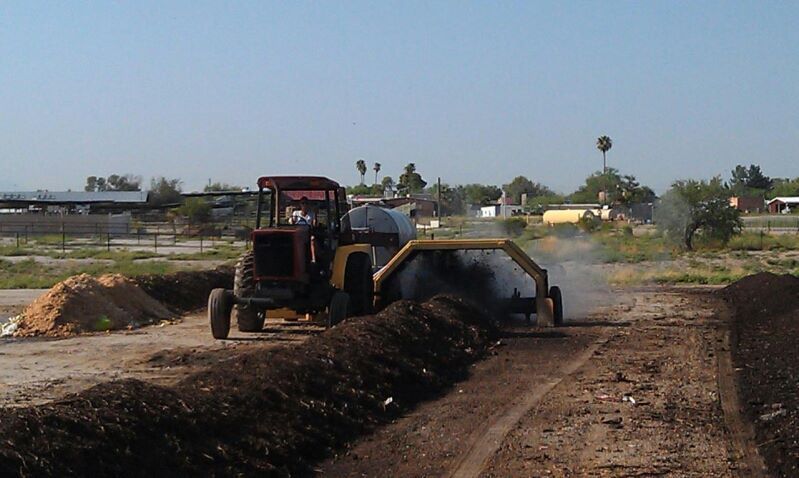
They don’t call it black gold for nothing.
When Tucson decided to offer free compost to residents in honor of International Compost Awareness Week, all it took was a few eager souls in pickup trucks to wipe out the week’s supply.
Cristina Polsgrove, the public information officer for the city’s Environmental Services Department, said she was expecting people to pick up a bucket or two — not the whole pile.
But we gardeners know you can never have enough compost, especially if it’s free.
In a pilot program, the city of Tucson has found a cost-effective way to get into the composting business.
Last year, Tucson joined a partnership with the University of Arizona’s Compost Cats and the Tohono O’odham Nation that collected and delivered compostable scraps from restaurants, supermarkets and other businesses to the composting site at the Nation’s San Xavier Co-op Farm.
People are also reading…
The Compost Cats wanted to focus on managing the composting operation rather than collecting and delivering the goods to the San Xavier site, Polsgrove says.
It seems like a no-brainer — after all, it’s one thing the city does well: curbside collection.
“We’ve been doing recycling for a long time now, and this is the next step,” she says.
Some of the finished compost comes back to Tucson and is sold to gardeners at the Heirloom Farmers Markets. Or, if you have access to a truck, you can make arrangements to pick up bulk compost at the San Xavier site, south of Tucson off Interstate-19.
For you non-gardeners, here’s why the city should be in the composting business: 80 percent of what’s dumped in landfills is compostable or recyclable, according to city stats. And about 50 percent of food that’s thrown away is compostable, Polsgrove says.
It’s cost-effective because the Nation provides the land and the students provide the labor to manage the composting piles, she says.
The city started with 16 businesses — which pay for the service — and now has almost 30 on its pickup route.
Polsgrove calls the program a success, despite the fact that it does cost the city some money to run it. Because money’s not the point, she says.
The program, one of just two in Arizona, keeps garbage out of the landfill and turns it into something useful — even valuable.
So if you’re out and about today, there might be another round of compost available at Udall Park, 7200 E. Tanque Verde Road, near the neighborhood recycling area or at the Randolph Golf Course parking lot, 600 S. Alvernon Way, (southeast corner). But don’t be disappointed if someone beats you to it.