

Q We have nine menu holders from the last Hindenburg flight from New Jersey to Germany. On its return trip here, it crashed. I've researched all things Hindenburg but have not seen anything like these. Who will buy them, and what is their value?
— Judy, Tucson
A This inquiry offers important lessons for smart collectors. Read and learn.
To the general public, Hindenburg was the airship that burst into flames May 6, 1937, while docking at the Naval Air Station in Lakehurst, N.J. In the frame of German history, Paul von Hindenburg was commander of all German land forces in World War I, a war hero who later became president of Germany.
In the general scheme of collecting, items directly linked to a famous disaster increase in value with the passage of time. Signature items linked by image or logo to that disaster accrue greater value. Marked or significant items tied to a famous or significant person involved in the disaster (e.g., the ship's logbook from the Titanic) have even more value.
People are also reading…
In contrast, mass-printed newspapers about a disaster are usually worthless. Too many were printed and are still held by collectors. Complete first editions from the site of an incident are another story. Those, collectors will buy.
The same psychology applies to Hindenburg artifacts. Immediacy is the name of the game. Dinnerware with the ship's logo is a big deal. But logo-less menu envelopes marked only with passenger names cannot be linked directly to the ship. Even accompanied by a passenger list that matches the names, the paper pockets will not bring major bucks.
Hindenburg artifacts have sold and do sell. Stamps and documents related to the man are collected. According to www.artfact.com, a porcelain bowl bearing his likeness brought $81 at auction last April. Disaster-related sales include a sequence of 12 photos from the Lakehurst disaster that sold at Swann Galleries in New York last year for $3,800.
A Christie's New York specialist told us that while the house has sold plates from the airship, "we really do not work with ephemera." Translation: The paper offered is not linkable.
Manuscript specialist Adam Stackhouse at Bonhams and Butterfields in California told us that without markings from the Hindenburg, the "lack of insignia is detrimental to collector interest." The house sold a single 1936 service plate for $840, but it had a logo.
To sell, you can offer the holders to other auction houses or post online. First, gather all documentation you can find.
Q When I bought my first home, I found an in-the-wall table made by the Clearwater Lumber Co. Can you tell me anything about it?
— Walt, Smithfield, Va.
A Around the turn of the last century, when efficiency was a new-fangled idea, built-ins were more common than they are today.
The Clearwater Lumber Co. was in Idaho and its timberland was absorbed into the Potlach Lumber giant in 1903. Inventor Anton J. Uphus filed for a patent on his folding table in January 1922 and was granted #1524415 in January 1925. As for info, I assume you mean value. Value comes from demand, and as far as I know, demand is minimal. Very minimal.
If I wanted to sell the table, I'd post it online, tell the history, set a price I could live with, and see what happens.
» AUCTION ACTION
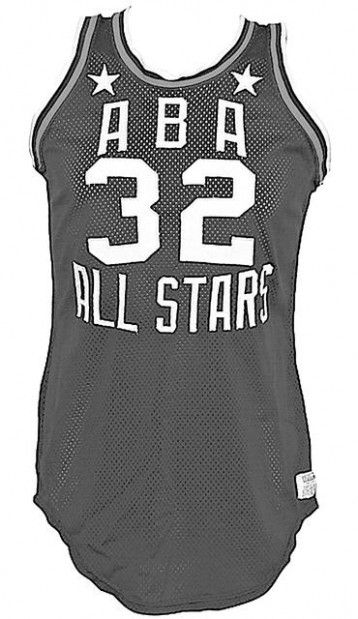
A jersey worn by Julius "Dr. J" Erving during the first-ever halftime slam dunk contest in 1976 brought $188,321 in a recent Grey Flannel auction, breaking the record for a game-worn jersey. The previous record, also hammered by Grey Flannel, was $141,927 for another Erving jersey. In the contest 32 years ago, Erving, the ABA's top scorer, was declared the winner.