

Q Do you have any information on a Hull art pottery bowl and two cornucopias my mother gave me? She says they were bought between 1950 and 1953, but I can't find a name for the pattern.
— Barbara, Tucson
A Your pattern was produced by the Hull Pottery Co. in Crooksville, Ohio, and it has an interesting story. While the pieces may have been bought in the 1950s, they probably were made in the 1940s. The pastel colors and rounder, "prettier" shapes seen in your images are typical of Hull 1940s ware. By the 1950s, Hull designs were streamlined with brighter colors.
Bows accenting most pieces in the line explain why your pattern is called "Bow-Knot." It was introduced in 1949 and made into 1950, and was decorated with matte shadings of blue, turquoise and pink. Twenty-nine shapes were made, including vases, a tea set, candleholders, wall pockets, a wall plaque and a small ewer. What you call a bowl is described in the 1949 catalog as a jardiniere. Yours is 5 3/4 inches; a larger version is 9 1/2 inches.
People are also reading…
Always popular, Bow-Knot was reproduced in the 1970s, especially as wall pockets, large vases and other expensive pieces. Fakers don't bother with low-interest designs.
While I doubt that your pieces have been reproduced, a hands-on assessment is warranted. A collector or seller knowledgeable with Hull or art pottery needs to verify that your pieces date from the 1940s.
For actual market results, check completed sales on eBay. When I looked, 43 pieces were active — who knows how many were originals? When it comes to Hull, also refer to guides by Brenda Roberts. Her most recent is "The Collector's Ultimate Encyclopedia of Hull Pottery: Volume I" (Collector Books, $29.95). There is none better.
Smart collectors know book values are only an author's benchmark. Actual results are reality. For example, your cornucopia, booked at $225 to $265, sold on eBay for $66. A double cornucopia, booked at $350 to $450, sold for $167.50. Variables, particularly authenticity and condition, affect price.
Q Any information on this metal tray, 8 1/2 inches by 3 1/2 inches, made for the 1933 Chicago World's Fair? Several collectors have told me it's worthless junk and to throw it into the garbage. I have a hard time finding no value to a 1933 item.
— Steadman, Lincolnville, Maine
A Good for you, questioning free advice. Actually, it's not age that counts; it's what the object represents. As a memento from a very collected world's fair, the tray will appeal to collectors. As a piece of base metal, it is scrap to a noncollector.
Trays were popular souvenirs from the 1933-34 Chicago Century of Progress fair. All kinds survive, from ceramic to copper and pot metal such as yours. Many were made in Japan. As fair souvenirs go, trays aren't rare. But depending on the scene, they do appeal. Yours, showing three sites, including the Hall of Science and the Federal Building, will speak to someone. I suggest posting in an online auction. If you don't want to do the work, eBay lists trading assistants in your area who will, for a percentage.
FYI: "World's Fair Collectibles" by Howard M. Rossen (Schiffer, $29.95), has a section on collectibles from the Chicago event.
Q How do I sell Hallmark ornaments from 1984 to 1994?
— Bessiegaye, Smithfield, Va.
A I don't want to seem like a broken record, but you need to reach a wide audience of motivated buyers, so an online auction is the place to sell these. Boxes are a plus, but the main thing is the ornament.
If you lack computer access, a storefront eBay seller in your area can post them for you. Or ask a computer-savvy friend.
● Send e-mail to smartcollector@comcast.net or write Danielle Arnet c/o Tribune Media Services, 435 N. Michigan Ave., Suite 1400, Chicago, IL 60611. Include an address in your query. Photos cannot be returned.
Courtesy of Sotheby's
» Auction Action
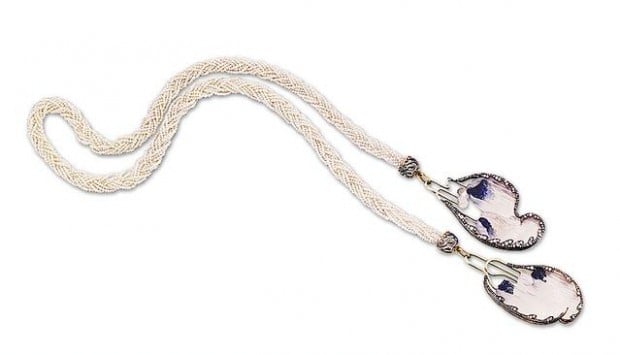
French glass master Rene Lalique was also the premier art nouveau jeweler. An enamel, diamond and seed pearl necklace signed "Lalique" sold for $352,000 at Sotheby's recently. It features molded glass plaques of poppy blossoms applied with deep blue enamel at each end. The piece also is wearable as a belt. It was once part of the Barbra Streisand collection.