

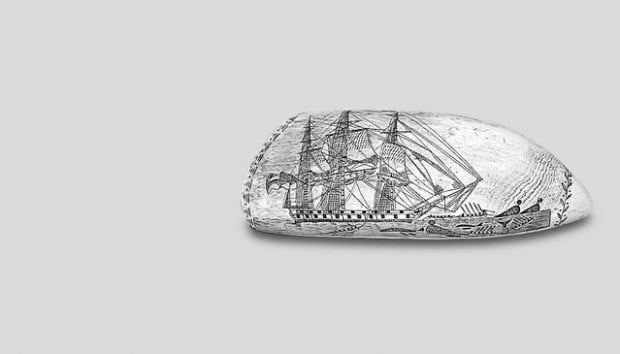
Q: What is the value of and how do we sell a piece of Confederate scrimshaw on whale's tooth? It has a scrimshaw picture of the Confederate warship "Alabama." Also, a rare ivory-walrus-tusk cribbage board signed by John Octuck.
— Nancy, Sierra Vista
Q: What is the value on my 21 1/2-inch scrimshaw walrus tusk marked Nome 1903? There is a cribbage set on the back.
— Pat, Chester, Va.
Q: The scrimshaw artist on my 4-inch whale tooth is marked JA. Value? When was the tooth engraved?
— William, Glen Allen, Va.
A: Since all questions deal with scrimshaw, a short tutorial is in order for novices.
First, check the art accompanying this column. It is a remarkable piece of scrimshaw because:
People are also reading…
1. It is a genuine tooth, not a fake.
2. It was engraved by a celebrated scrimshaw artist, perhaps the best.
3. Art is simple and to the point, showing a noted maritime disaster and rescue. Aesthetics are superior.
4. Engraving was done of the period. Scrimshaw was done when the tooth was fresh, not decades after it was removed from the animal.
The points seem basic. But remember them as you read answers to the reader queries.
Alaskan and American scrimshaw are separate categories. Eskimo arts, including walrus scrimshaw, are in the ethnographic category. Whale-tooth scrimshaw by sailors on American ships sells as Americana. Standards deviate within those categories.
The golden age of whaling in America began in the 1820s, when fleets of ships plied the Atlantic for whales that supplied oil and baleen. Whaling voyages lasted three to four years or more as whalers hunted Arctic waters in summer and the Indian and Pacific oceans in winter. Whale products were used in everything from corsets to candles, spawning whole industries.
Nothing went to waste. Whale teeth, walrus tusks and porpoise jaws were removed to be engraved in a sailor's pastime called scrimshanding. The product was called scrimshaw. During the golden age of American scrimshaw, from 1830 to 1850, all kinds of objects were produced by scrimshanders.
All scrimshaw, Alaskan and American, must be handled by someone who knows the genre to tell if it is fake or real.
Jim Haas, director of Native American Art at Bonhams and Butterfields in San Francisco, said in Alaskan scrimshaw, art has "everything to do" with value. A noted artist helps as well.
The first reader's tusk is notable because of its size. "Very nicely done," it might sell for $1,500 to $2,000, according to Haas. Cribbage boards are a common feature on Alaskan scrimshaw.
Bear in mind that today's market — for each reader's item — is very different from four or five years ago when good scrimshaw (actually, anything good) brought high prices. In today's market, pieces may not sell or bring far less. Fair warning!
3/4 AUCTION ACTION
A circa 1828 sperm-whale tooth that sold for $182,250 in a 2005 sale at Bonhams and Butterfields was remarkable in every possible way. Edward Burdett, the scrimshaw artist, is considered a master of American scrimshaw art. He was also the first. The burning ship on the 17 1/4-inch tooth was a noted whaler returning to London with a full cargo of oil when it caught fire. The second ship rescued the captain and crew. The maritime disaster and rescue figures on other Burdett scrimshaw.