

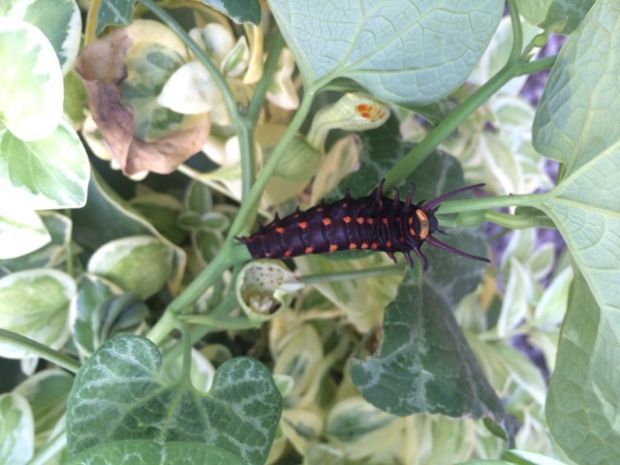
I planted some Dutchman’s pipes to attract swallowtail butterflies and it worked. I heard the caterpillars are poisonous to birds. Is that true?
Yes, it is true, although not so much when they are young. After they have eaten enough pipevine, they become poisonous. The elder caterpillars and the adult butterflies are both poisonous to birds. Other species of butterflies have developed mimicry so birds avoid them simply because they look like pipevine swallowtails. The pipevine plants are members of the Aristolochia genus, and do best in part-shade with adequate irrigation. There is a native species in Southern Arizona called Aristolochia watsonii that is the reason we have pipevine swallowtails in the Sonoran Desert in the first place. The species pictured here growing at our office is the white-veined Aristolochia fimbriata, a native of Brazil. The good news is the caterpillars like them both.
People are also reading…
What is humic acid, and is it helpful to apply it to plants?
Humic acid is a component of any material containing well-decomposed organic matter, including soil, composts, etc. According to James Walworth, a professor of soil science at the University of Arizona, used in significant quantities, these materials can help improve soil’s physical properties (structure, water infiltration, drainage). However, recommended rates are often too low to do much. I think a better alternative is to add other organic materials, such as green wastes, manures or composts to soil. These will also improve physical properties, stimulate soil microbial activity, and the end-products of their microbial decomposition include humic acids.
I am planning to plant some trees this fall. Where is the best place to plant them to maximize their energy-saving properties?
There are a few benefits to planting trees in your yard. Aside from the shade under them for relaxing, they also provide evaporative cooling. To get the savings on your home-energy bills, plant the trees on the east and west side of your house to block the morning and afternoon sun. If you want to know more about energy savings, you might consider attending the Arizona Energy Masters course this fall. To learn more and to register, go to www.regonline.com/arizonaenergymasters online.
Peter Warren is the urban horticulture agent for the Pima County Cooperative Extension at the University of Arizona. Send questions to plwarren@cals.arizona.edu