

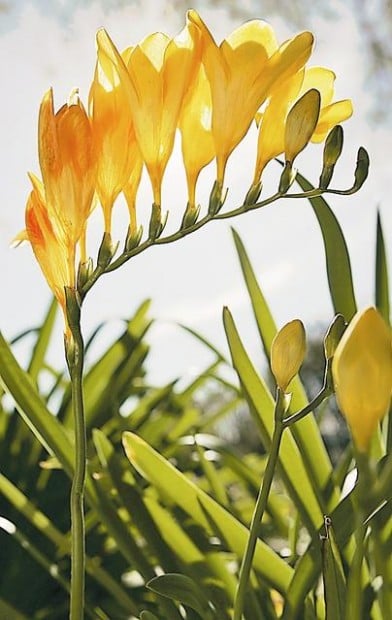
Some of the most interesting and beautiful of all flowering plants are the bulb and bulblike plants. Here in Tucson, we can grow a number of temperate, tropical and subtropical types. Most bloom in the spring and summer.
Bulbous plants are those with thickened underground storage organs that enable them to survive unfavorable environmental conditions. Not all bulbous plants are true bulbs. Other specialized underground-storage organs include corms, tubers, tuberous roots and rhizomes.
Bulbous plants are great to use around the house, along walkways and around patios. They can be planted among shrubs and ground covers or in flower beds for outdoor color. They also can be used in a cutting garden for making indoor arrangements.
Unfortunately, many of the common bulbs of the Northern states, such as tulips, hyacinths, and some irises and lilies, don't grow well in the Tucson area. Often, they flower poorly or not at all.
People are also reading…
Varieties best adapted for our climate include freesia, amaryllis, narcissus, gladiolus, iris, buttercup, spider lily and rain lily. With proper care, these bulbous plants will produce beautiful flowers year after year.
After flowering, the bulbs need proper spring and summer care to maintain their health. Do not remove the leaves after flowering.
Bulbous plants must replenish the carbohydrates stored underground in bulbs, tubers, corms and rhizomes. These carbohydrates are essential for next year's bloom.
Continue to water bulbous plants frequently enough to keep the soil evenly moist but not overly wet. Too much moisture will cause the thick underground portions of the plants to rot. A moisture meter is the best tool to measure the level of soil moisture. They can be bought at most garden centers and home-supply stores.
Apply fertilizer to keep the leaves green and healthy. You can use a water-soluble liquid plant food, such as Peters or Miracle Gro, or a granular plant food for bulbs or flowering plants. Nitrogen will keep the leaves green. Phosphorous will encourage additional root growth and aid in next year's flowering.
Every few years, it will be necessary to divide bulbous plants. This should be done in the fall. Dig up and separate the bulbs, corms, tubers or rhizomes. Save the larger ones, and discard those that are smaller or appear to be diseased.
Replant with the proper spacing and in a soil improved with organic amendments. Digging and replanting at the proper spacing encourages more uniform flowering and larger blooms.
To protect bulbous plants from burrowing critters such as ground squirrels and pocket gophers, line the bottom of the planting bed with woven wire, also referred to as hardware cloth.
The woven wire should be placed a foot below the surface of the soil to allow room for adequate root growth. The edges of the wire should be turned up to extend slightly above ground to prevent critters from burrowing in from the side.
Of course, all of the bulbous plants mentioned above may be grown in containers. Doing so eliminates the need to provide special protection.
Storage organs help them survive
Demonstrations
"Preparing the Garden for Summer" will be the topic of this week's gardening demonstrations. Presentations will be at 1 p.m. Wednesday at the Wilmot Library, 530 N. Wilmot Road; and 1 p.m. Friday at the Oro Valley Public Library, 1305 W. Naranja Drive.