

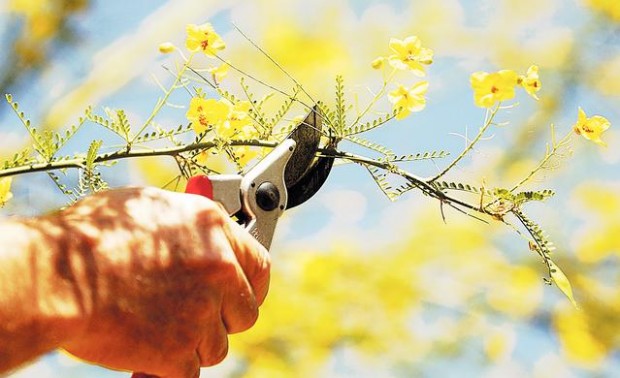
The consensus among arborists and desert-plant experts is that many desert trees should be pruned during the hot part of the year, primarily May and June.
There are indications that trees such as palo verde, mesquite and desert willow seem to form callouses over pruning wounds faster when temperatures are hot. Callous formation closes off cuts and prevents fungal infections, such as sooty canker, that enter trees through open wounds.
For home gardeners, pruning should be limited to those parts of the tree that can be reached from the ground, either with hand pruners, loppers, saws or pole pruners. Climbing and the use of power saws should be left to professional arborists.
When considering pruning your trees, first determine if pruning is really necessary. If there's plenty of room for the tree to grow, leave it alone. If size control is needed, branches can be partly trimmed back or removed entirely. If you want to shorten a branch, just be sure to cut back to the nearest side branch. Never make an arbitrary cut; have a purpose in mind before you prune.
People are also reading…
Essential pruning includes removal of any low-hanging or errant branches that have become an obstruction, such as limbs overhanging walkways or growing into the house. If a branch is in the way, it can be removed entirely or trimmed back to a side branch. Removing it entirely means removing it at the trunk. Partial removal requires pruning it back to where a substantial side branch originates from the one being removed. Never leave a stub that will later decay.
When pruning to the trunk, do not cut the branch off flush with the trunk. Cut the branch at the outer edge of the branch-bark collar. This collar is a slightly raised area at the base of the branch. Cutting at the outer edge of the collar will prevent cutting into and damaging the trunk tissue. If you cannot see the swollen area at the base of the branch, cut a little farther out from the trunk than you might have originally.
It's better to leave a slight stub than to cut into and damage the trunk.
When pruning heavy branches, it's important to use the three-cut method to prevent injury to bark on the trunk. The three-cut method is a way to cut the branch off cleanly without it breaking off before it's cut through and, in the process, stripping off bark from the trunk.
Using a pruning saw, make the first cut about a foot out from the trunk. Cut from the bottom up, about one-third of the way through the branch. Make the second cut on the top side of the branch an inch or two in from the first cut. Continue cutting until the branch snaps off cleanly at the point of the first cut. Now you're left with a short stub that should be removed by cutting near the trunk, on the outside edge of the branch collar.
After pruning off the branch, leave the cut open to heal. Do not cover the cut with pruning paint or wound dressing. This will delay or prevent the cut from healing and may promote the development of sooty canker or other wood-infecting fungi.
● John P. Begeman is the urban horticulture agent for the University of Arizona-Pima County Extension. If you have questions, call 626-5161 to reach a master gardener.