

Just look at the shelves in garden departments, and you'll find them overflowing with weedkillers.
Some of those products, however, can be dangerous for home gardeners to use — not to people, pets or wildlife, but to valuable plants. Chief among them are products containing a weedkiller called Triox.
Triox is a total vegetation killer. It's advertised for use on walks, on driveways, along fences and in other spots where no growth is desired. Read the label information, and what you'll find is that Triox will damage or kill any desirable plant whose roots come into contact with it.
Applying Triox to a fence line, driveway, walkway or patio will surely allow this vegetation killer to move into the soil, where it is likely to contact underlying roots of surrounding desirable trees and shrubs. Also, a heavy rain can wash the Triox from the area of application to nearby areas, causing additional damage.
People are also reading…
The bottom line for home gardeners: Don't use products containing Triox. Be cautious using products labeled vegetation or brush killer; they're likely to have similar harmful effects.
Another herbicide that can damage trees and shrubs is dicamba, a weedkiller for use on lawns. If tree or shrub roots are growing in your lawn area and you use dicamba, it too can be absorbed by tree and shrub roots, damaging these desirable plants. It's common for mature trees to have roots that extend as much as four times farther than the spread of the branches. Shrubs also have roots extending well beyond the ends of their branches.
Fortunately, one of the most popular weedkillers for home gardeners — Roundup — is relatively safe to use. It is not absorbed by plant roots, and it has no harmful effects in the soil.
It kills weeds by being absorbed by their leaves and other green tissue such as green stems. It moves from the leaves to the roots via the plant's internal cambium tissue. Once it reaches the roots, it kills the entire plant.
Roundup is actually the well-known brand name for the chemical glyphosate. It's available as the active ingredient in a number of herbicide products for the control of perennial broadleaf and grassy weeds. It's one of the most effective products for use on hard-to-control, woody-stemmed weeds such as our notorious desert broom.
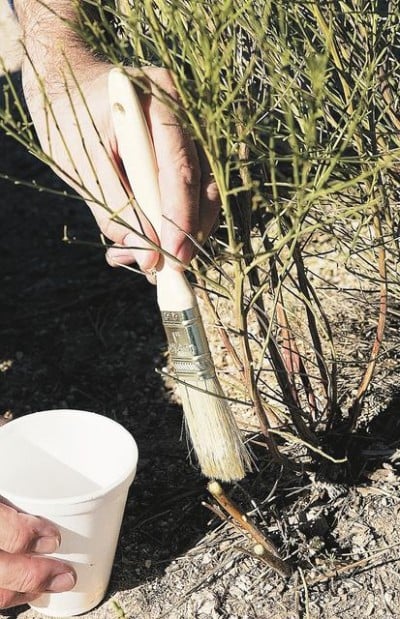
The best way to kill desert broom and other woody brush is to apply undiluted Roundup concentrate directly to cut stems at the base of the plant. Do this while the plant is actively growing.
It's best to hold off treatment until late March or early April. At that time, cut the stems of desert broom close to the ground and immediately paint them with concentrated Roundup. The material will be absorbed through the cuts and will transfer directly to the roots.
Select a product with a concentration of at least 18 percent glyphosate. The most simple way to apply the weedkiller is to pour a small amount in a foam cup and use a small paintbrush to dip and paint the weedkiller on to the cut stems.
Because of the potential for contamination, don't pour any leftover glyphosate back into the original container. Use it up by applying it to the cut stems.
● John P. Begeman is the urban-horticulture agent for the University of Arizona-Pima County Extension. If you have questions, call 626-5161 to reach a master gardener.
Demonstrations
"Spring Fertilization of Gardens and Landscapes" will be the topic of this week's garden demonstrations. They will be held at 9 a.m. Wednesday at the University of Arizona-Pima County Extension Center, 4210 N. Campbell Ave.; at 1 p.m. Wednesday at the Wilmot Library, 530 N. Wilmot Road; and at 1 p.m. Friday at the Oro Valley Library, 1305 W. Naranja Drive.