

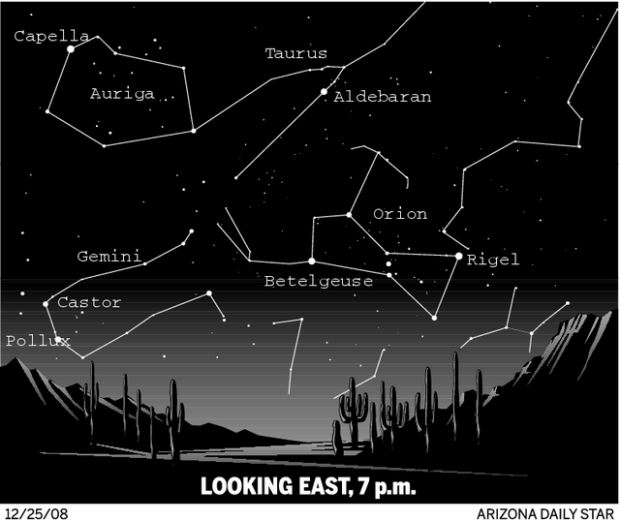
The winter sky is a wonderful gift this evening.
Some of the brightest and most spectacular constellations will be grouped above the eastern horizon after sunset.
Look toward the east around 7 p.m. to see the rising of Orion the Hunter and Gemini the Twins. A little higher above the horizon will be Auriga the Charioteer and Taurus the Bull as well as one of everyone's favorites, the Pleiades.
This collection of constellations contains many bright stars with widely differing colors.
Contrast the red of Betelgeuse with the blue of Rigel in Orion. Both are giant stars far larger and brighter than the sun. They're also living in the fast lane, using up their nuclear fuels in only a few million years compared with the approximately 5 billion years of life the sun has left.
People are also reading…
In Gemini, Castor is white and Pollux is orange-red. Aldebaran is bright orange and is said to be the glaring eye of Taurus the Bull. Even though it's cooler than the sun, Aldebaran is 350 times more luminous.
Capella in Auriga is a very interesting star. It's the closest really bright star to the celestial north pole and is the sixth brightest star in the sky. It is said to be yellow-white, though it looks more orange to me. Capella is actually a closely paired double star each with a similar brightness.
The stars rotate rapidly around each other with a period of 104 days. It takes the Hubble Space Telescope or very special optical techniques with professional ground-based telescopes to actually see both stars separated from each other.