

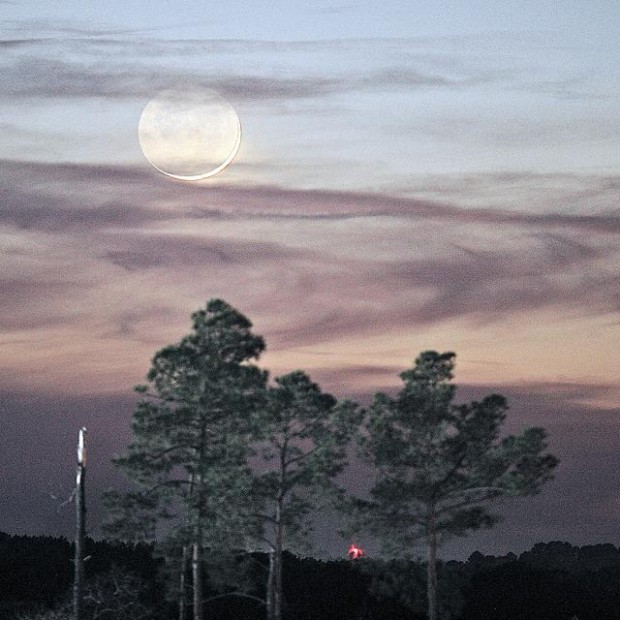
The sun is obviously the brightest object in our sky.
The moon is second, because it reflects the light of the sun.
If you pass sunlight through a prism, it will stretch into a spectrum of colors from deep red to deep purple. Different light sources have slightly different spectra — an incandescent light will have more red in it than a fluorescent light.
If you closely compare the spectrum of the moon with the spectrum of the sun, you will see the spectrum of the moon is the same — confirming that moonlight is the same as sunlight.
When the moon is directly between the Earth and the sun, the bright side of the moon faces away from the Earth, and the moon appears dark to us. This represents the new moon — which officially took place about 8:45 p.m. Wednesday night.
People are also reading…
A new moon rises at sunrise, crosses the meridian at noon, and sets at sunset. The meridian is that imaginary north-south line in the sky that divides the sky into equal halves.
A full moon occurs about two weeks after a new moon when the moon is on the opposite side of the Earth from the sun. The entire bright side of the moon faces the Earth. A full moon rises at sunset and sets at sunrise.
The next full moon will be on the evening of Feb. 20, and it will also be a pretty memorable total lunar eclipse. Next week's Sky Spy is devoted to it.
Tim Hunter has been an amateur astronomer since grade school. Contact him at skyspy@azstarnet.com.
Flandrau: The UA Science Center and the Tucson Amateur Astronomy Association have planned a special talk on the eclipse and a free viewing on the University of Arizona mall on Feb. 20 for what will be the last total lunar eclipse until Dec. 20, 2010. And it's the last such eclipse visible in the evening until Sept. 27, 2015 — all other eclipses from now until 2015 will take place after midnight. Read more on that next week as well.