

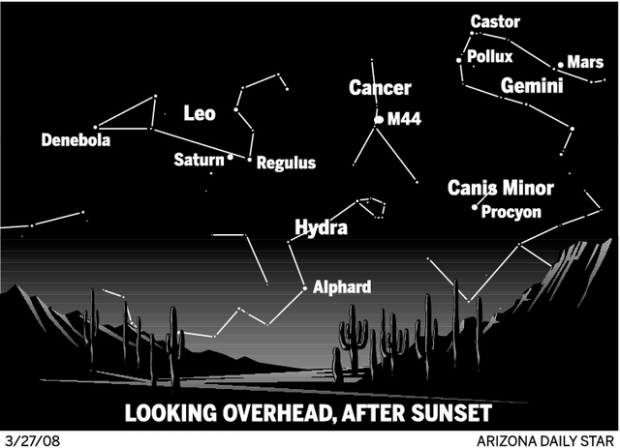
There's a lot to see in the sky after sunset these days.
Look overhead and find the bright constellations Leo the Lion and Gemini the Twins. Saturn has been in Leo for some while, and it is very close to the bright star Regulus. Mars is in Gemini along with Castor and Pollux. And don't overlook Procyon in the tiny constellation of Canis Minor.
The constellations of Cancer the Crab and Hydra the Water Snake don't get the same press or respect as the others because they are relatively faint and uninspiring at first glance, but both contain interesting sights.
Cancer is easy to recognize once you have found Leo and Gemini. Right in the middle of Cancer is the Beehive, a large star cluster.
It's also known as M44 because the famous French astronomer Charles Messier (1730-1817) included it as the 44th object in his catalog of important sky objects. It's visible to the naked eye in dark skies and is a gorgeous sight through binoculars.
People are also reading…
Just south of Cancer is the polygonal head of Hydra, which is also not that difficult to see. Hydra is a long constellation that stretches over a considerable part of the sky and sort of looks like a sea snake.
Be sure to look for Alphard, the brightest star in Hydra. Alphard is 175 light years away, and can be seen in relatively light-polluted skies. It's 40 times larger and 400 times more luminous than the sun.