

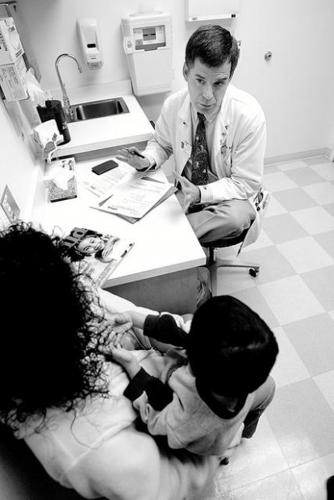
Adrienne and Jay Foust of Tucson took their 11-month-old son, Leo, to Phoenix Children's Hospital last week for surgery to repair a defect in one of the baby's kidneys.
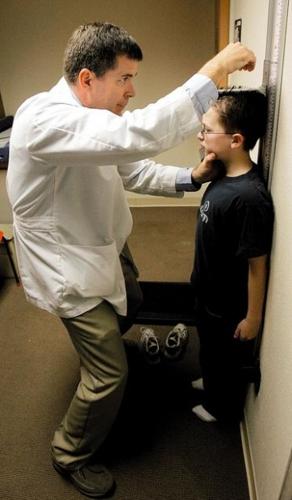
Joyce and Mike Cheung will take their daughter Brandee to Phoenix next month to learn why the 11-year-old is not growing as fast as others her age.
Both families have come face to face with a serious deficit in children's medical care in Tucson. A shortage of pediatric specialists — doctors devoted exclusively to the treatment of children's medical problems — is sending many families to Phoenix and elsewhere for the care their children need.
The shortage of pediatric specialists is a national problem because fewer medical students are choosing fields that require up to five years of additional training. But Tucson is particularly hard-hit, in part because it lacks a children's hospital, where specialists prefer to practice. And physician pay in Tucson is behind that in Phoenix and other larger communities.
People are also reading…
"It's bad and it's frustrating when you have kids you wish could be seen right away but it's just not possible," said Dr. Graciela Wilcox, a Tucson pediatrician and Leo Foust's aunt. She encouraged his parents to contact Phoenix Children's Hospital.
"We have some superb doctors here, but they're overwhelmed," said Dr. Rickey Williams, Brandee Cheung's pediatrician.
And in some specialty areas, Tucson has no doctors at all.
Tucson has no pediatric neurosurgeons to operate on children with brain tumors or traumatic head injuries. No pediatric dermatologists practice here, where the risk of skin cancer is higher than almost anywhere in the world. There are no pediatric rheumatologists — here or elsewhere in the state — to care for children with arthritis.
There are no pediatricians specializing in ear, nose and throat care. Here, specialists for adults also care for children with those problems. But for complex procedures such as cochlear implants for hearing-impaired kids, families travel to Phoenix.
Tucson has just one pediatric urologist, who moved here last July and also treats adults. And despite Southern Arizona's distinction of having the highest incidence of diabetes in the country, Tucson has only one full-time pediatric endocrinologist.
Dr. Mark Wheeler spends five days a week seeing children with diabetes, growth problems and other endocrine disorders at the University of Arizona's Steele Children's Research Center. Weekends usually find him making hospital rounds and answering endless calls.
All that, despite the UA's hiring of a half-time endocrinologist last summer.
"It's more hours than my family would like," Wheeler said. "We could easily keep three full-time pediatric endocrinologists busy here without any trouble whatsoever. We get patients from all over Southern Arizona, and some from Mexico and New Mexico."
On Williams' recommendation, Mike Cheung called Wheeler's office Thursday. The first appointment available was in October.
Brandee's height is not considered an urgent problem — if it had been, Wheeler's schedulers would have worked her in sooner. But she and her parents don't want to wait eight months.
"It may turn out that everything will be OK, but we told Brandee that we are going to do something about it," said Cheung, who was able to get an appointment for Brandee at Phoenix Children's Hospital next month.
Carin Ferris called last March to get her son Cory, 13, a follow-up appointment with Wheeler. The first opening was last Friday.
"It's frustrating," Carin Ferris said.
But she and Cory like Wheeler, and so they waited 11 months.
Leo Foust was 3 months old when tests showed his left kidney was enlarged from a blockage that kept the kidney from draining into his bladder. Tucson has many urologists who see both adults and children, but the Fousts wanted a kids-only urologist. Phoenix Children's has six.
After months of tests here and in Phoenix, the surgery was scheduled for 5:30 last Monday morning. Leo and his parents left Sunday for Phoenix, where they spent the night in a hotel while relatives in Tucson stayed with 2-year-old Isabella.
Leo's surgery went well, and he was discharged Tuesday. But the family stayed over through Wednesday morning, when the surgeon removed a drain from Leo's abdominal incision.
"He's doing so well — we can't get over it," Adrienne Foust said Thursday. "He's already crawling all over the place. Absolutely, we would have preferred to do all this in Tucson, but we feel fortunate that we found the doctor in Phoenix."
Dr. Mary Rimsza, a pediatrician with the Arizona State University School of Health Management and Policy, said physicians who work with adults are less skilled with children. "Diseases are very different in children and adults," Rimsza said.
For example, she said, a child with diabetes can be much more difficult to manage than an adult for a number of reasons, including the fact that growing children have different nutritional needs.
The UA is setting up new training programs for pediatric specialists with the hope of keeping at least some of them in Tucson, said Dr. Fayez Ghishan, who heads the UA's pediatrics program.
One example, launched last summer, is a new five-year program to train doctors in pediatrics and emergency room medicine.
"We have a saying that kids aren't just little adults," said Dr. Dale Woolridge, who co-directs the program. "ER physicians in general are trained to deal with people of all ages, but having those people who are focused on children is really a benefit."
Along with creating new training programs, Ghishan spends much of his time raising money, he said.
Private donations make it possible, he said, to promise larger salaries and research support to doctors he recruits. They include a children's cancer specialist and his wife, a neonatologist who works with premature infants, who will start here in May.
And a $750,000 donation from Tucson's Angel Charity for Children built the UA's new children's diabetes clinic.
The Arizona Arthritis Center is trying to raise at least $1.5 million for an endowment that would entice a pediatric rheumatologist to the UA, said center director Dr. Jeffrey Lisse. But competition is stiff — only about 20 such specialists finish their training each year.
Dr. Andreas Theodorou, associate head of pediatrics at the UA, said doctors in Tucson do a good job of getting kids the care they need when they need it — even if it means sending them to Phoenix.
"Our objective is to have it so no child ever has to leave the community to get the care he or she needs," Theodorou said.
On StarNet: Find out about children's health issues, such as learning disabilities, weight problems and more, at go.azstarnet.com/kidshealth
● They may not make huge sums of money in Tucson, but some pediatric specialists say the city is a good place to set up practice. Page A15


 Historic bank vault now new Tucson speakeasy


