

Amid a wave of gun violence, Buffalo police are taking a new approach to investigating shootings.
They're convening “shoot reviews.”
The Police Department has begun holding weekly meetings that bring together members of the homicide, intelligence and gun violence units and the chiefs of each district. Also attending are representatives from the Erie County District Attorney’s Office, the US Attorney’s Office, the ATF and the FBI, as well as crime analysts and parole and probation officials.
They review every single shooting from the previous week – not just homicides.
“It increases solvability of non-fatal shootings,” said Buffalo Police Commissioner Byron Lockwood.
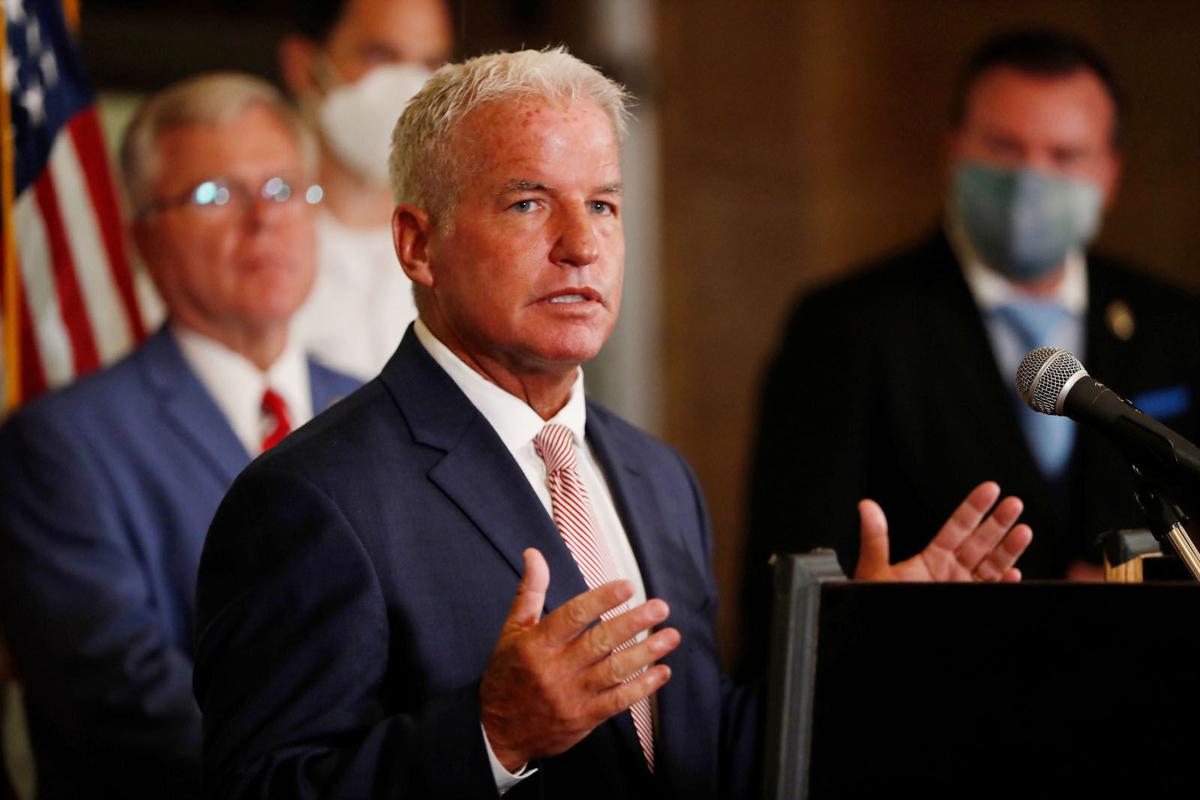
Mayor Byron Brown announces the cooperative "shoot review" initiative, aimed at investigating unsolved shootings.
With everyone in the same room, Lockwood said, police and prosecutors can quickly and easily share information about each incident – about the victim, the kind of gun involved, where the incident took place, information about the suspect, whether there’s a connection to a previous case and if there’s concern about retaliation.
People are also reading…
It’s modeled after a strategy developed by the Milwaukee Police Department that has been credited with helping decrease shootings and homicides in that city.
At a news conference Thursday afternoon, Mayor Byron W. Brown, U.S. Attorney James P. Kennedy and Erie County District Attorney John J. Flynn unveiled the new initiative, funded by a $229,000 grant from the U.S. Department of Justice.
How it works
The shoot reviews take place every Tuesday at the Buffalo Police and Fire headquarters. The first happened on July 14.
Buffalo Police Deputy Commissioner Joseph Gramaglia describes the new "shoot reviews" crime solving initiative at the Buffalo Police Department.
Detectives with the Gun Violence Unit, a squad formed in late 2018 to focus specifically on non-fatal shootings, give reports on each shooting from the previous week. They also go over developments in the investigations from previous shootings.
Then the Intelligence Unit offers what it knows about the cases and the people involved, if there’s a connection to a gang or a drug ring, and if the victim had been shot before or is a suspect in another case. Sergeants from homicide also attend and discuss any connections to their cases.
The local and federal prosecutors help determine which avenues to pursue.
Buffalo police often work closely with the FBI on gang-related cases through the FBI’s Safe Streets Task Force. The federal Bureau of Alcohol, Tobacco, Firearms and Explosives helps identify evidence related to guns.
All of that information is shared instantly and with the entire group, said Buffalo Deputy Police Commissioner Joseph Gramaglia.
Previously, those kinds of details were left to be followed up on by a detective who would have to reach out to each of the agencies.
“And those are the things that get lost in the shuffle,” Gramaglia said. “We’re not operating in silos anymore.”
The shoot review process was launched as Buffalo saw a disturbing increase in gun violence this year.
The first half of 2020 saw a 54% increase in shootings in Buffalo. And in the first half of July, more than two people were shot in the city every day, on average.
Thirty-four people were shot from July 1 through July 15, according to data released by the Buffalo Police Department. Three of the victims died.
A year ago, 25 people were shot in the entire month of July, with only 13 through the month’s first 15 days.
The number of people shot over the first half of July 2020 is already greater than the total for the entire month of July in five of the last nine years, according to a Buffalo News analysis of department statistics.
Modeled after Milwaukee
In early March, just before New York began to shut down because of the Covid-19 pandemic, Lockwood, Gramaglia, Kennedy, Flynn and Buffalo Chief of Detectives Dennis J. Richards traveled to Milwaukee to see for themselves how a shoot review works.
They liked what they saw.
The shoot reviews there were an extension of the Milwaukee Police Department’s homicide review commission, which was formed “to look for gaps in our criminal justice systems, things that we could do better to prevent the next homicide from occurring,” said Milwaukee Police Captain Paul Formolo.
Shoot reviews are different from “COMPSTAT,” Formolo explained, which is a popular policing strategy that uses mapping to identify crime hot spots.
“Instead of just looking at dots on a map, we look at what's specifically causing crimes,” Formolo said.
At Milwaukee shoot reviews, police look at “people, groups and places,” he said, not just a neighborhood.
For instance, a shoot review can help police identify clusters of shootings around closing time at a certain tavern. Then police would reach out to licensing authorities or a local city leader to deal with the situation there, Formolo said.
“We'll put stipulations on them or go for revocation of the liquor license,” Formolo said.
The review process also can help police identify people who keep turning up shot and others who are first-time victims with no previous interaction with the legal system.
“We can refer them to get help and other resources,” Formolo said.
The shoot reviews seem to be paying off, he said.
Milwaukee started the reviews in 2018.
The number of homicides in Milwaukee dropped from 119 in 2017 to 99 in 2018 and 97 in 2019, according to Milwaukee police. Non-fatal shootings went from 501 in 2017 to 452 in 2019. Clearance rates for non-fatal shootings improved too, from a 36% clearance rate to 47% last year. The homicide clearance rate remained about the same – 78% in 2017 and 77% in 2019.
Shoot reviews help police do their job better by helping them identify the root of a problem, Formolo said.
“It's focused enforcement, rather than a shotgun approach,” he said. “Before you'd go into a neighborhood with an army of cops and arrest everyone. That just makes everyone mad. Now we go and look at this one house or this one person or this one group. So instead of just looking at dots on a map, we’re seeing what's specifically causing it.”
-Staff Reporter Aaron Besecker contributed to this article.
Maki Becker


