

A Pima County Superior Court Judge denied RJ Godfrey's request for a temporary restraining order against the NCAA, likely keeping the Arizona forward out for this week's Maui Invitational.
Presiding Judge Scott McDonald issued the ruling Monday morning after meeting with attorneys for Godfrey, Arizona and the NCAA via Teams. He ruled that it would be "inappropriate" to apply a TRO when the NCAA had not yet been served of the five-for-five eligibility lawsuit, which was amended Friday to include the organization.
McDonald ordered Godfrey's attorneys to serve the NCAA on or before Nov. 30 and scheduled a show-cause hearing for a preliminary injunction for Dec. 2, after the Wildcats finish the Maui Invitational and host New Orleans on Dec. 1. Godfrey has already missed five UA games.
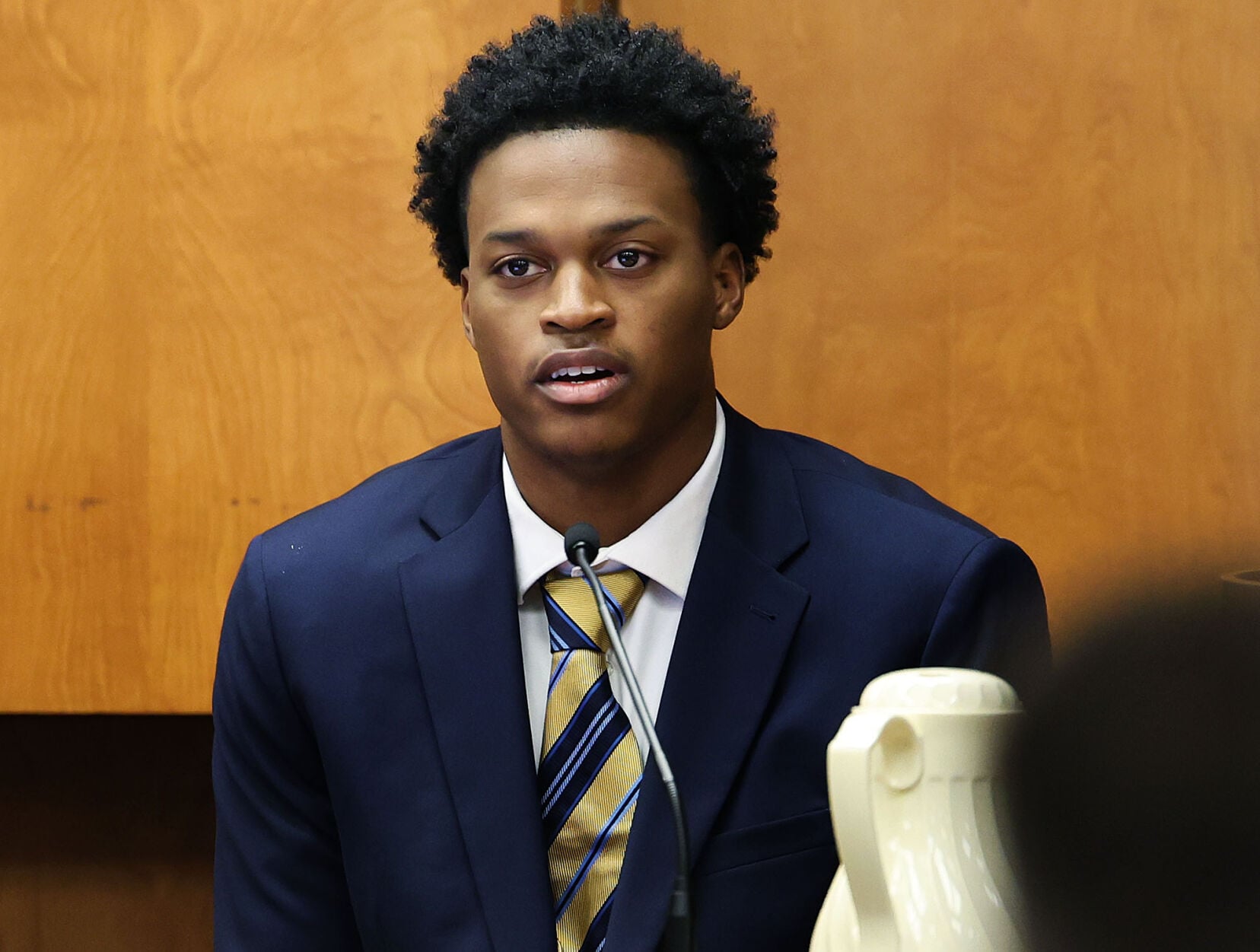
Arizona basketball player RJ Godfrey speaks during a hearing at Pima County Superior Court in Tucson on Nov. 17, 2026.
Initially, Godfrey's attorneys sued only UA and the Arizona Board of Regents, and received a temporary restraining order and preliminary injunction against them from Pima County Superior Court Judge Jeffrey Bergin on Nov. 17. But while that order compelled UA to certify Godfrey, the NCAA still ruled that he was ineligible and he has remained out.
People are also reading…
In an email from NCAA outside counsel that was filed as an exhibit by Godfrey's attorneys, the NCAA maintained that Godfrey was still ineligible and that Arizona would be playing him “at its own risk.”
Godfrey's Godfrey's attorneys filed an emergency motion on Nov. 18 for enforcement of Bergin's order, but the judge denied that request.
Bergin wrote that the emergency motion “exceeds the scope and intent” of the temporary restraining order and preliminary injunction he issued during an evidentiary hearing Tuesday. Bergin had expressed concern during the hearing that the initial lawsuit could affect a non-party, since Godfrey was suing UA and not the NCAA.
Bergin said his ruling was limited only to ordering UA to certify Godfrey under NCAA Bylaw 12.6, the NCAA's new eligibility rule allowing athletes to play five seasons, and that he did not rule on Godfrey’s other potential eligibility issues for playing in a college all-star game and receiving benefits from an agent.
Those secondary issues do not appear to be a problem anymore, at least with UA. Godfrey’s attorneys said he has since repaid benefits received, while UA said it has applied for Godfrey’s reinstatement over the issues.
Instead, the hangup is that the NCAA is still declaring Godfrey ineligible despite UA’s move to certify him under the court order, and threatened the school if it played Godfrey.
In their emergency motion filed Wednesday evening, Godfrey’s attorneys wrote that “the NCAA has refused to engage with Arizona” on the agent and all-star game issues because of its position that he is already ineligible because he played four years already. While 12.6 now allows players five seasons of eligibility, it did not go into effect until June, after Godfrey finished his fourth college season.
The NCAA has “instead disregarded this Court’s order,” Godfrey's attorneys wrote.
In response, Bergin said the relief Godfrey’s attorneys requested would require the court to adjudicate matters that were intentionally left out of its ruling.
“The Court recognizes that much of the Plaintiff’s frustration appears to stem not from actions taken by the Defendant but from the continued inaction of the non-party NCAA,” Bergin wrote. “Nevertheless, the existence of that frustration does not change that a motion to enforce is not a vehicle to enlarge the substance of an injunction or to obtain additional relief that was neither requested nor granted in the underlying order.”
Contact sports reporter Bruce Pascoe at bpascoe@tucson.com. On X(Twitter): @brucepascoe

Bruce Pascoe
Reporter


