The University of Arizona’s chief financial officer said administrators were “overly optimistic” about how much net tuition revenue would come in to the UA this year, adding that their new enrollment process meant they didn't have historical data to base forecasts on.
According to its first quarter budget update, the university expects to bring in $66.8 million less, or 7% less, in net tuition revenue than it had budgeted for fiscal year 2027. The university is now expecting $880.6 million in tuition revenue.

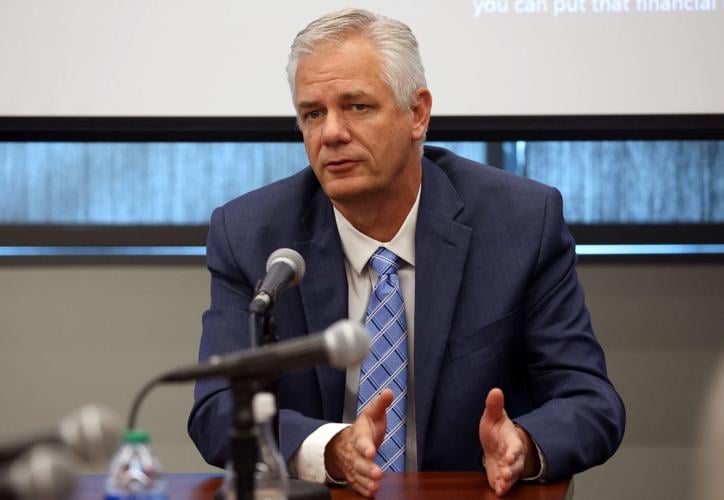
University of Arizona CFO John Arnold
“One, it’s a new enrollment process. So, we were forecasting based on a new enrollment process,” UA’s Chief Financial Officer John Arnold told the Arizona Daily Star Thursday.
“We didn’t really have a baseline to forecast against because it was new. So, you look at historical behavior and then try to forecast forward. We didn’t have that historical behavior to forecast,” Arnold said, after the Arizona Board of Regents meeting where the first quarter update was presented.
People are also reading…
“We were overly optimistic about who would come and our yield rates and the melt rates over the summer, and part of that was this change in national (student) behavior. So, we were dealing with a change in enrollment model and change in national behavior,” Arnold said.
Yield rate refers to the number of admitted students who accept a university’s offer of admission, and melt rate signifies the percentage of students who pay a fee to enroll in the fall but don’t show up to classes.
The UA saw an overall enrollment drop of 7.6% in fall 2026 from fall 2025.
Nicholas Prevenas, UA’s director of communications and news, said the university reformed its enrollment approach and made “important strategic changes” for the fall 2026 class, which has been a year “marked by significant market disruptions.”
“We expected enrollment declines due to the shift to a new enrollment strategy and the graduation of previously larger classes,” Prevenas told the Star Thursday in a written statement.
“However, nationally, student behavior changed, with the average four-year public university seeing melt rates grow from 15% to 20%. We are already adjusting how we recruit and how we will build our forecast for fall 2027," he wrote.
UA officials have said the enrollment decline is mostly due to a drop in out-of-state undergraduates.
The number of on-campus out-of-state undergraduates fell 23.7%, and enrollment of online out-of-state undergraduates fell 9%. In-state undergraduates overall dropped by only 1.5%, while graduate enrollment stayed flat overall.
The UA, Arizona State University and Northern Arizona University presented their net tuition revenue figures to the Board of Regents Thursday. There were no questions from regents or comments from university officials about the issue during the meeting, which UA President Suresh Garimella and Arnold attended.
According to Prevenas’ statement, the enrollment decline was also driven by the UA graduating a “larger class” last year.
This is due to “a combination (of things),” Arnold told the Star after the meeting. “Graduation rates are up a little bit, but we also had very large incoming classes four or five years ago that are now reaching the end of their natural cycle as a student.”
UA officials, including Garimella and Provost Patricia Prelock, have repeatedly said that enrollment shrinkage this fall and in fall 2025 was “intentional.”
They’ve said their strategy has been to make sure more of the students they admit are academically prepared to stay in school and graduate. Garimella has said the UA had the most academically prepared first-year class this fall, with an average grade point average of 3.55. More than 40% of the students had a high school GPA higher than 3.75, and nearly 36% were in the top 10% of their graduating class.
“I just want to remind you that we’re focused on recruiting graduates and not just numbers," Garimella told the Faculty Senate in April.
As part of this strategy, the UA changed its admissions model to emphasize a new Nov. 1, 2025, deadline for early acceptance into the university’s fall 2026 class.
Faculty members criticized this change at the time, warning that tuition revenue could decline. They also said there was a lack of clear communication about the change and that the earlier deadline put nontraditional students at a disadvantage.
Applications from in-state students dropped by 24% and from out-of-state students by 33% for this year’s fall freshman class, according to internal UA data obtained by the Star in August.
Gary Rhoades, a UA professor in the Center of Study for Higher Education, told the Star last week that UA’s enrollment decline wasn’t about a “a general ‘melt rate’ among public universities.”
“It is about a meltdown of enrollment mismanagement,” he said. “This is a self-inflicted wound.”
“The UofA, unlike its public research university peers, has experienced drops in entering undergraduate classes of 19% and 18.5% the last two years, and is continuing down the same path this year,” he wrote to the Star.
“That is not because of national trends — our peers have not experienced this," Rhoades said. "It is because the UofA has caused these declines with its new and flawed enrollment practices which fly in the face of our historic role and mission as well as in the face of ongoing feedback from academic and professional staff in the university that the new path is not working.”
UA leaders including Kristina Wong Davis, vice president for enrollment management and dean of admissions, have also pointed to a “demographic cliff,” the decline nationally in students of traditional college age due to falling birth rates during and after the Great Recession, as a contributing factor.
Rhoades said the enrollment cliff has not “actually materialized, especially for public research universities.”
The Chronicle of Higher Education reported Thursday that despite national conversations about the “demographic cliff,” a majority of institutions the publication surveyed said they had met their undergraduate enrollment goals for fall 2026.
“About 55 percent of some 260 colleges that took the October survey reported that, for both their total undergraduate and first-time, full-time student enrollment, they were either within 1 percent of the head count they’d budgeted for (in either direction), or 1 percent or more above their goal. Respondents included public four-year institutions, community colleges, and private four-year nonprofits,” the article reported.
UA Faculty Chair Leila Hudson said that adapting to the “dramatic decline in enrollment our administration has brought about will require a creative redoubling of our commitment to our students and the faculty and staff who carry out the academic mission.”
“We can only trust that the board of regents understands the need for accountability, despite their public silence on the matter. The faculty certainly does," Hudson said.
Reporter Prerana Sannappanavar covers higher education for the Arizona Daily Star and Tucson.com. Contact her at psannappa1@tucson.com or DM her on Twitter.

Prerana Sannappanavar
Higher Education Reporter