BAD AROLSEN, Germany — A mother and child separate: That's among the discoveries made by 40 Jewish genealogists who spent the past week plumbing a trove of Nazi documents made public after 60 years.
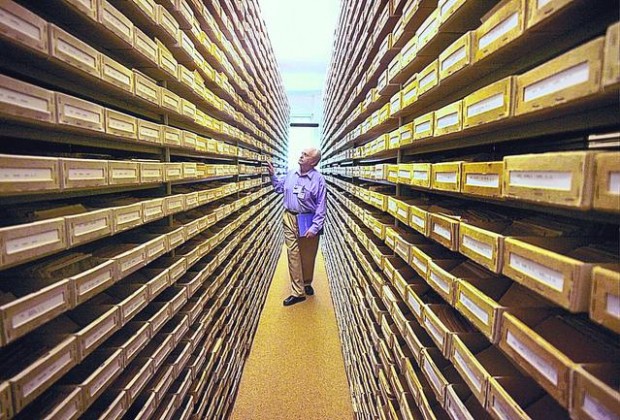
For genealogists of Jewish families, the Holocaust is both a tragedy and a black hole, because so many of the 6 million Jewish victims disappeared without a trace. For years, researchers hoping to fill the gaps have longed to dive into the more than 50 million documents held in this central German spa town and entrusted to the International Tracing Service, or ITS.
"The Nazis took away our names and gave us numbers. Our role is to take away the numbers and give back the names," Gary Mokotoff, a genealogist from Bergenfield, N.J., who helped organize the group from the United States, Israel, Britain and Australia, said Thursday. "There is a wealth of information here."
People are also reading…
For decades after World War II, the files were used only to help find missing persons or document atrocities to support compensation claims. But in November, the last of the 11 countries that govern the archive under the auspices of the International Committee of the Red Cross cleared the way for public access.
Since then, interest has skyrocketed. Erich Oetiker, deputy director of the archive, said that while the staff of 400 continues to process some 1,000 tracing requests per day, there are now also near daily visits from historians or individuals eager to trace a lost person's fate or view an original document.
Sallyann Amdur Sack, a genealogist from Bethesda, Md., suspected for years that the collection held answers to questions about her family.
In the 1980s, she put in a request trying to trace the birth parents of her adopted cousin, who had survived Buchenwald as a 9-year-old, then been brought by her aunt and uncle to the United States. A form letter came back saying the search had turned up nothing.
But digging deeper during her time here, Sack was able to cross-reference the woman's second given name and access records of search requests made to the ITS since it opened in 1955.
"I found here that his mother, who was separated from him when he was less than 5 years old, also had survived," she said. "She came to the U.S. in the same year that he did, in 1949." The mother, if alive, would be 93, and Sack presumes she is dead. The cousin is in his 70s and still alive, but Sack asked not to identify him.
"They never found each other," Sack said of her cousin and his mother, her voice breaking.
Oetiker says the archive is in constant contact with the U.S. Holocaust Memorial Museum in Washington, D.C., as well as Israel's Yad Vashem — both of which hold digitized copies of part of the collection — along with the Polish Institute for National Remembrance.
Next month, a conference of historians is to meet here to map out the archive's unexplored contents and help determine how best to use the information.
On the Net
• International Tracing Service: www.its-arolsen.org
• U.S. Holocaust Memorial Museum: www.ushmm.org


 Vacant Tucson stores could transform into new housing