
BRUSSELS, Belgium — The split of Czechoslovakia into two countries 15 years ago has been referred to as a "velvet divorce" — hassle-free, peaceful and as amicable as a breakup can be.
Now Belgium's Dutch- and French-speaking halves are studying that split to see if they, too, could divide their country in two and part in a no-nonsense way.
Three months after elections, Belgium still has no government.
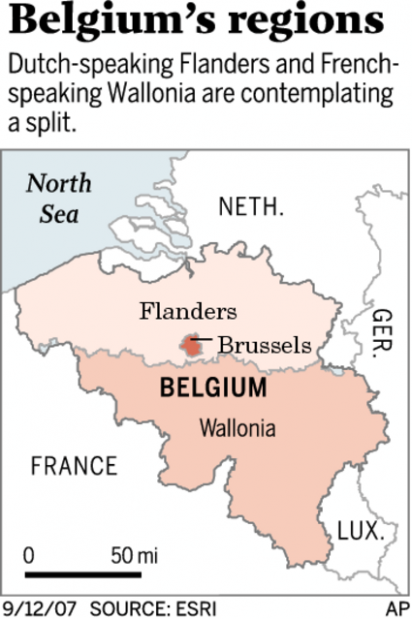
And talk of breaking up the 177-year-old federation of 10.5 million people is growing on both sides of the linguistic border that partitions the country into a richer north and poorer south, with Brussels — the nation's and the European Union's capital — the only officially bilingual region.
Le Soir, a leading French-language newspaper, devoted three pages of its Monday edition to the Jan. 1, 1993, breakup of Czechoslovakia.
People are also reading…
The newspaper called it a "civilized and noble settlement" that had a blissful effect on relations between Czechs and Slovaks — and pondering possible similarities for Belgium.
Filip Dewinter, head of the nationalist Flemish Interest group shunned by all other parties in Belgium, told the parliament in the country's northern Flanders region that it is time for a "velvet divorce."
And while his party is the only one openly advocating a split — the other Flemish political groupings have rejected his appeal for a referendum on a possible breakup — the issue no longer is taboo among mainstream politicians, and comparisons with Czechoslovakia keep popping up.
For the moment, the key political players in the north, such as Flanders' Christian Democratic Premier Kris Peeters and his predecessor Yves Leterme, are intensifying their calls for more self-rule for the affluent region of 6.5 million Dutch speakers.
That rings a loud bell in Slovakia, which spent the better part of the three years Czechoslovakia held together after the 1989 fall of communism campaigning for a far-ranging shift of authorities from Prague, the capital of the federation of 15 million people, to its two republics.
In Czechoslovakia, the split was initiated by the poorer of the two parts, Slovakia, which for centuries was denied any form of national identity. In Belgium, the driving force is Flanders, the wealthier part that long ago shed past oppression by the Francophones.
The Flemish want constitutional reforms to shift more power in health care, justice and transport — some of the remaining areas where Brussels has central control — to Flanders and Wallonia, the southern French-speaking part.
That scenario is similar to Slovakia, where Vladimir Meciar — elected the republic's prime minister on a nationalist ticket in 1992 — advocated a loose confederation keeping only the basics, such as the army and the currency, together.
Many Flemish complain their wealthier, service-based economy subsidizes Wallonia. Dutch speakers view the Francophones' dilapidated cities and 14 percent unemployment — double their rate — as the legacy of Socialist rule.
The Czechs also grumbled, and finally agreed to swiftly part with the Slovaks when it became obvious the will to live together was no longer there.
But Czechoslovakia had no Brussels, the main sticking point in the Belgian debate. It is hard to see Flanders giving up Brussels, the city of 1 million where the majority of people speak French.
It is equally hard to imagine that Wallonia could survive without it.

 Vacant Tucson stores could transform into new housing