

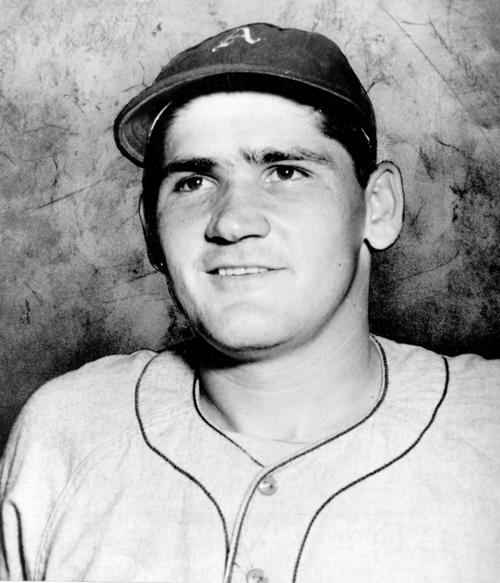
Alex Kellner was a major-league pitcher who grew up in Tucson and made it his home after retiring from baseball.
Kellner was born in Tucson Aug. 26, 1924.
Here are just a few of the articles that ran in the Arizona Daily Star about a home town hero.
From the Star, May 16, 1941, Kellner's professional debut at age 16:
KELLNER HURLS 10-INNING WIN
_____
Tucson Cops Game With El Paso, 7 to 6 In Overtime
_____
By VIC THORNTON
The "kid" came through!
Alex Kellner, 16-year-old lefty from Amphitheatre high school, making his first start in professional baseball, pitched the Cowboys to a spine-tingling, 10-inning, 7 to 6, victory over the El Paso Texans before an overflow crowd of 2,500 last night.
The game was packed with pulsating drama, and held the crowd to a man until—with two away in the tense tenth—Shortstop George Todhunter and Left Fielder Joe Bezdek touched off the all-important fireworks.
Payoff Run
Todhunter lashed a double to deep right. Bezdek followed with a roaring single to left which sent Todhunter dashing home with the payoff run, and it was all over but the cheering. Two Amphitheatre girls rushed up and embraced Kellner, much to the latter's embarrassment.
It was a great game and a great pitching exhibition by the "kid." Kellner was touched for 10 hits, but didn't give up a single walk. For eight innings he matched pitch for pitch with Dick Jerome, El Paso procrastinating playboy chucker. Three times the game was tied up.
Tucson drew first blood in the first, producing a run on Doug Smith's walk, Todhunter's single, and Bezdek's fielder's choice. In the second, however, a scratch hit by Catcher Galios combined with Bill Benevich's error at first, en· abled the Texans to knot up the count. It was a tough break for the "kid," but he only grinned and bore down that much harder.
Cowboys Ahead
The Cowboys galloped ahead in the third on a misplay and Benevich's single, and the score stood 2 to 1 until the Texans got to Alex for two hits and another tally in the first of the seventh.
But the Cowboys didn't allow it to stand at two-all long. In their half of the lucky seventh they lashed out with a two-run burst to regain command. Kublcek's singles, Kellner's sacrifice, another walk for Smith and Todhunter's smashing triple to right center were good for two more. Jerome didn't enjoy the shellacking at all, nor the ribbing he took from the fans.
Troublesome Eighth
In the eighth Kellner ran into trouble. (He's been pitching seven inning games in high school all year, and this was his second longer-than-seven of the season.) He whiffed Jerome to the delight of everyone but Jerome to start it off, but then the visitors found his portside delivery for four singles and three runs. That gave them the lead, 5 to 4. That lead, however, was short lived, for Benevich drew a free pass and Clements and Kellner lashed out singles to tie it up again at 5 all.
El Paso surged ahead again in the ninth on hits by Williamson and Jerome, but again the Cowboys came from behind to deadlock it at six-all in their half of the inning which saw Jerome relieved with the tying and possibly winning runs on base. Benevich, first man to face Lefty Cash, the relieving pitcher, pounded a single off the latter's glove to load the bases after Jerome had walked two. Clements's outfield fly drove in Bezdek with the tying run.
One-Two-Three
Alex put the Texans away in 1-2-3 order in the first of the tenth, and then when it appeared that the game would go into the eleventh (there were two out and none on in the Cowboys' half of the tenth), Todhunter slapped out his double and Bezdek followed it with his payoff single.
Kellner struck out seven, while Jerome whiffed eight, out the Texan walked 10 men to none for Alex.
It was Tucson's' third straight over El Paso.
Tonight the Cowboys open a three-game series with the Albuquerque Cardinals. It's "ladies night" and women will be admitted for a 10-cent defense and service tax.
Manny Salvatierra, home-run king of Mexico, may break into the Cowboy's lineup in the outfield tonight.
People are also reading…
From the Star Oct. 3, 1958:
For Tucson's Alex Kellner
Steady Work Pays Dividends
By DON CARSON
Good, hard work on a steady basis.
That's what shot Tucson's Alex Kellner from close to the bottom of the American League's pitching pile to close to the top of the National League's moundsmen.
And there's a good chance that he'll stay in that status for the next couple of years.
"My arm feels real good," the 34-year-old southpaw said yesterday after returning to his Tucson home after the end of the regular season.
A 10-year veteran with the Athletics—both at Philadelphia and Kansas City—Kellner was waived out of the American League this year and sold to Cincinnati.
After a 6-5 record in 1957 and a 0-2 AL slate this year, the burly hurler rebounded to a 7-3 mark with the Redlegs.
"It's getting a chance to work regularly," he explains. "I got real sharp at Cincinnati and then I was able to stay that way. With the Athletics I might not start for two weeks.
"The big difference was that I got to stay in the games I started. I had an 0-2 record at K.C. before I left, but it could have been just the reverse. I was leading 5-3 in the ninth inning of one game when I loaded the bases and then was relieved. The reliefer couldn't stop the rally so I got the loss. And in another game I was behind 2-1 in the seventh when they took me out for a pinch-hitter.
"At Cincinnati they let me stay there and finish (the former Amphitheater pitcher went the route four times while gaining his 7-3 mark).
"No, I don't think the hitters the National League are easier to handle than those in the American. The main thing that brought me back was steady work.
"As to my future, I can't say. It all depends on how and how much they work me.
"But the Cincinnati future looks good. I think we can give the Milwaukee Braves a run for their money next season. We've got good pitching and our hitters—guys like Gus Bell, Frank Robinson and Ed Bailey—should come back strong. That lack of power was what hurt us this year."
Kellner was semi-silent on the subject of the new Cincinnati manager, Mayo Smith.
"I don't know him," he said, "but from what I've heard he's a pretty good man and everyone on the team seems to like him.
"Yes, I think Jimmy Dykes (the man who took over the Redleg helm after Birdie Tebbetts quit near the end of the season) thought he might get the job. He did a good job after he took over, but according to the newspaper stories he wasn't even considered because of his age (61)."
Kellner plans to spend the winter in the same manner that he has spent other off-seasons — hunting and fishing. He plans to get the season underway on the 10th with a fishing trip to Baja California and Mexico.
From the Arizona Daily Star Friday, Feb. 15, 1991:
Kellner's best often fooled the best
By Ron Somers
The Arizona Dally Star
Alex Kellner spends a lot of his time these days in front of what he calls the "squawk box," watching baseball.
Although he played major-league baseball for 12 years, Kellner prefers watching the college game on television, instead of the pros.
"Them boys really put out," he said of the college players.
Kellner, 66, was born in Tucson and retired here after pitching for the Philadelphia Athletics from 1948-54, the Kansas City Athletics from '55-'58, the Cincinnati Reds in '58 and the St. Louis Cardinals in '59.
He had a lifetime record of 101-112, with a 4.41 ERA. His best season came in 1949 when he went 20-12 with a 3.75 ERA.
In those days Kellner's salary was in five figures. Nowadays, even mediocre players make seven figures. He doesn't think much of baseball's current salary structure.
"It's completely out of line as far as I'm concerned," he said. "The bottom wlll drop out before long. The owners can't keep it up."
He said he doesn't begrudge the players the money but believes it hurts the game and diminishes the players' dedication.
"They're more worried about the money than playing the game and having fun," he said. "I think I had more fun than they're having."
He blames the big money for baseball's drug problem. "My God, it's unbelievable," he said. "In my time I didn't know anyone (using) drugs. I never heard of anything like that."
Unlike the modern player, who is often set for life financially, Kellner had to struggle to make a living after his playing days.
He said the end of his baseball career wasn't that much of a shock because he saw it coming.
"I told myself a long time before, when my time comes I would know it," he said. "When it became a chore to try to stay in shape and too much like work, I hung it up."
He returned to Tucson to look for a job. It was a lengthy search.
"I was off for eight months," he said. "I looked around to try to find something to do. That was the hardest part. I had to get what I could."
What Kellner got was construction work. Although he never married, Kellner supported his mother and father until they died in the early '70s. Kellner, whose brother Walt played in a handful of major-league games, retired from construction work in the mid-'70s.
"Arthritis hit hard," he said. "I had a bad knee (from baseball) and it would swell up."
Kellner's health deteriorated as the arthritis moved to his back and he had to give up his favorite activity — hunting.
"I can barely walk. I use a cane now," he said.
He has also gained weight. He weighs 284, up from 215 during his playing days.
"I look at food and gain weight," he said.
Kellner, a left-hander, eagerly reminisced about his career.
"The fastball was my best pitch," he said. "I had a good curve, a changeup, a slider, a slight knuckleball and a screwball."
He says he fooled around with a spitter on the sidelines, but he never used it in a game.
"I could never get it to do anything for me," he said.
Even though he went 8-20 the year after his 20-12 season, he said his pitches were still working.
"We had a different team. The defense was not there," Kellner said. "But I can't complain."
Boston Red Sox outfielder Ted Williams found Kellner's pitches most effective.
"Ted Williams didn't hit me too well," he said. "He came out in the papers one day and said I was one of the ones he hated to face because he didn't see the same pitch twice."
Detroit Tiger third baseman George Kell was another matter.
"He was the toughest hitter," Kellner said. "You'd think he owned me. He was a spray hitter and hit .360, .380 or .390 off me."
Kellner couldn't pick the best player he ever played against or with.
"That's a toughie, awfully hard," he said. "I couldn't name one particular one."
However, New York Yankee shortstop Phil Rizzuto impressed him.
"He was hard to get out. He bunted so well,'' Kellner said. "(On defense) he amazed me the way he could go get the ball. It would look like the runner was going to beat it out, but he would catch him by one step. He didn't throw that hard but he got rid of the ball quickly."
Kellner said one of the worst things about modern baseball is the designated hitter.
"I used to love to hit," he said. "(The pitcher) is part of the game."
Kellner said his biggest thrill in baseball was hitting a triple in Kansas City's Municipal Stadium in '56 or '57. He was slow and said he never thought he'd get a triple.
"It was a fluke hit,'' he said. "It caromed around the outfield. I hit it in left field and it ended up in center field. It was a stand-up triple."
He's also proud of his four home runs.
Another highlight was pitching the first major-league game in Kansas City, in 1955. He beat Detroit 3-2, undaunted by the snow flurries that hit the area.
The A's moved to Oakland in 1968, which didn't please Kellner.
"I don't have a team anymore. I've never been to Oakland," he said.
Alex Kellner died May 2, 1996, in his sleep. He is one of our Tucson notables.


