


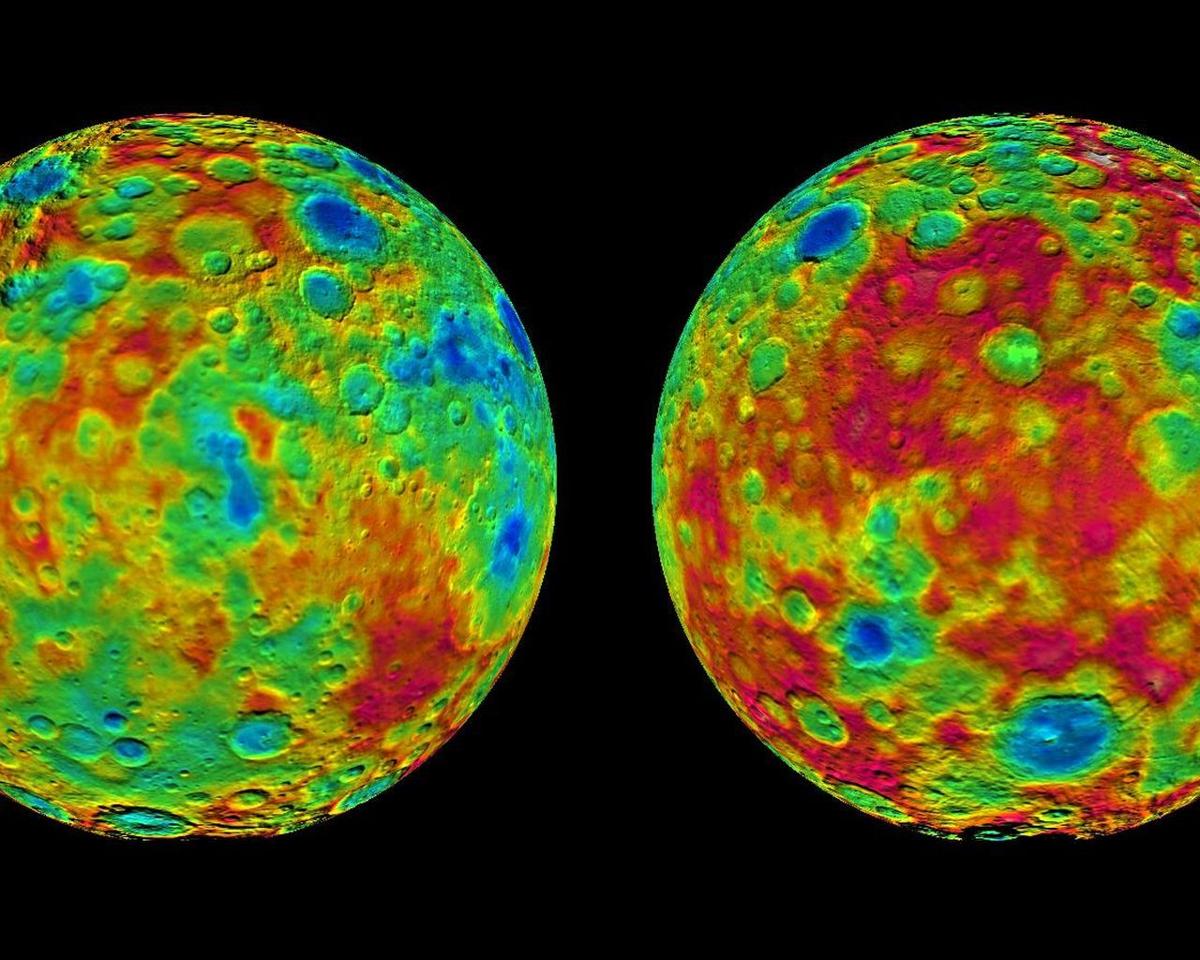
NASA's Dawn mission to Ceres released these colorized maps of Ceres that demonstrate the vast differences in height on the surface of the tiny planet — up to nine miles between the deepest crater and tallest mountain.
As the team analyzes data, the spacecraft is slowly spiraling down to an orbit just 900 miles above the surface of Ceres. Images from that orbit will be available beginning in mid-August.
Ceres, queen of the asteroid belt between Jupiter and Mars, is 584 miles in diameter — or 40 percent the size of Pluto, the other dwarf planet visited by a NASA spacecraft this summer.
You can see more images here:
From the NASA press release:
Colorful new maps of Ceres, based on data from NASA’s Dawn spacecraft, showcase a diverse topography, with height differences between crater bottoms and mountain peaks as great as 9 miles (15 kilometers).
People are also reading…
Scientists continue to analyze the latest data from Dawn as the spacecraft makes its way to its third mapping orbit.
“The craters we find on Ceres, in terms of their depth and diameter, are very similar to what we see on Dione and Tethys, two icy satellites of Saturn that are about the same size and density as Ceres. The features are pretty consistent with an ice-rich crust,” said Dawn science team member Paul Schenk, a geologist at the Lunar and Planetary Institute, Houston.


